23 May 2012 A majority of Russians support public protests that followed the December 2011 parliamentary vote, yet 47% believe the election was fair. Notably, 72% of Russians say they have a favorable view of Vladimir Putin and 62% hold a positive opinion of Dmitri Medvedev.

22 May 2012 On Twitter especially, more people expressed views that the Internet company's stock was overhyped than highly valued. On Facebook, many people discussed CEO Mark Zuckerberg, as the founder also got married over the weekend.
• How the online discussion differed by platform
• Facebook: A profile of its 'Friends'

18 May 2012 A new poll of 21 countries finds widespread opposition to Iran obtaining nuclear weapons and a strong majority support international economic sanctions to try and stop Iran's weapons program. The poll found notable exceptions among the public in Russia and China, where less than half support economic sanctions.
• Report: Differences Among E3+3 on Iran

17 May 2012 The nation’s racial and ethnic minority groups—especially Hispanics—are growing more rapidly than the non-Hispanic white population, fueled by both immigration and births. This trend has been taking place for decades, and one result is the Census Bureau’s announcement today that non-Hispanic whites now account for a minority of births in the U.S. for the first time.
• Analysis: Pew Research Center explains the trend
14 May 2012 Roughly half of Americans (52%) say President Obama's public support for gay marriage did not affect their opinion of him. The president said he came to his decision after a long consideration. The public's view of gay marriage has evolved, with growing support.View an interactive graphic that illustrates the trend in public opinion.
• Listen: NPR's interview with Pew Research Center's Andrew Kohut, May 11
• Strong Support for Gay Marriage Now Equals Strong Opposition
• Pew Research Center's Michael Dimock on "The Diane Rehm Show"
• Andrew Kohut: The Electorate and Gay Marriage

8 May 2012 A year after the ouster of Hosni Mubarak and a few weeks ahead of historic presidential elections, Egyptians remain upbeat about the course of the nation and prospects for progress. Most Egyptians continue to want democracy, with two-in-three saying it is the best form of government. Egyptians also want Islam to play a major role in society, and most believe the Quran should shape the country’s laws.

23 April 2012 The largest wave of immigration in history from a single country to the United States has come to a standstill. After four decades that brought 12 million current immigrants -- more than half of whom came illegally -- the net migration flow from Mexico to the United States has stopped and may have reversed.

23 April 2012 While it took him almost four months to secure his grip on the GOP presidential nomination, Mitt Romney established himself as the clear winner in the media narrative by the end of February. The shift in coverage followed his narrow Feb. 28 win in his native state of Michigan, after which the news media began to view his nomination as inevitable.

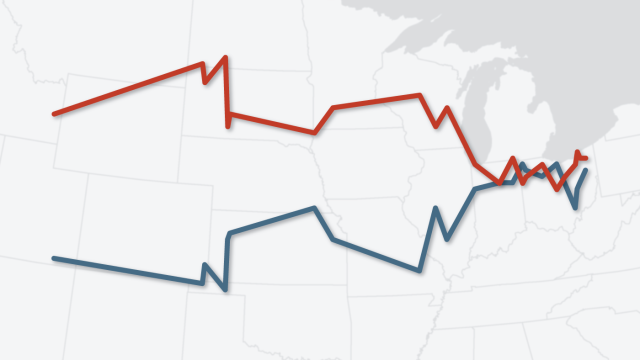
17 April 2012 As voters continue to focus on the economy and jobs as top issues, Barack Obama's lead over Mitt Romney has narrowed from a 12 points last month to a slim 49% to 45% advantage. Neither candidate has a clear advantage on the economy or jobs issues, which more than eight-in-ten voters cited as "very important" to their choice. Some of the hot-button social issues, like gay marriage and birth control, are at the bottom of the electorate's agenda.

11 April 2012 Most Americans can correctly identify the relative positions of the Republican and Democratic parties on the major issues of the day. But a review of what Americans know about the political parties shows that the public is better informed about the partisan affiliations of two popular recent presidents -- Ronald Reagan and Bill Clinton -- than it is about the positions of the parties on key issues. Take the NewsIQ quiz and see how your score compares to others.
Un-Mirrored Self-ImagesNine-in-ten U.S. adults say most of their fellow Americans are overweight. But only 39% say they themselves are overweight.
President Obama made his first Latin America stop in a country where self-confidence and hope runs high.
Does Google Make Us Stupid?Most experts say the internet will enhance--not degrade--our intelligence. It will also change the way we read and write and be rebuilt by new gadgetry and applications.
Tiger Moms Most Americans agree with Amy Chua that U.S. parents aren't tough enough, but most Asians think parents put too much pressure on children.
23 May 2012 On the eve of the first presidential election of the post-Mubarak era, Egyptians remain hopeful about the future of their country, and they strongly desire both an improved economy and the democratic freedoms they were denied under the previous regime.
18 May 2012 Interactive games that reward participants with points, badges and discounts are on the rise. Experts believe they will spread widely to key areas, such as education and health by 2020. Others worry about a darker side.
17 May 2012 As the G-8 leaders prepared to meet at Camp David on Friday, the dominant topic of conversation will be the European debt crisis. Yet, the topic has attracted little interest or concern among the U.S. public. Fewer than half in the U.S. see Europe's problems as a "major threat."
17 May 2012 The issue of costs and rising student debt have have touched off a national debate about the cost and value of a college education. See the results of our surveys on what the public thinks of investing in a college education.
16 May 2012 For years, the Pew Internet & American Life Project has been polling people who use social media to explore how they use it and what they get out of it. The results paint a portrait of what kind of people use sites such as Facebook, who they connect to and how they manage their privacy.
Public Opinion Surveys: 15 May 2012 Polls conducted by telephone have struggled with lower response rates in recent years, but they continue to provide accurate data on most political, social and economic measures.
11 May 2012 Nearly three-fourths (74%) of smartphone users use their phones to obtain real-time, location-based information and almost one-in-five use geosocial services such as Foursquare. The overall portion of adults who get location-based information has almost doubled in less than a one-year period.
7 May 2012 Nearly 9-in-10 (86%) smartphone owners used their phone in the past month to make real-time queries in their daily lives. Men are more likely than women to use their phones to find information to settle an argument. Parents with kids are more likely to use their phone to decide whether to visit a local business, such as a restaurant.
3 May 2012 Online teens use video most to chat with others using applications such as Skype, Google Talk or iChat. Recording and uploading videos to the internet is the second most popular activity. Fewer teens stream live video for others to watch. Social media users are much more likely to engage in all three video behaviors.
2 May 2012 There’s been a recent surge of interest in the topic of whether and how the poor economy has an impact on divorce rates. As with marriage rates and the economic downturn, the evidence is not clear-cut. One complication is that the quality of data about divorce is uneven.
1 May 2012 Public assessments of the Supreme Court have reached a quarter-century low. Unlike past years in which opinion was divided along partisan lines, The court now receives relatively low favorable ratings from Republicans, Democrats and independents alike.
30 April 2012 A year after the death of its leader, al Qaeda is widely unpopular among Muslim publics. Majorities in Egypt, Jordan, Pakistan, Turkey and Lebanon expressed negative views of the terrorist group.
26 April 2012 The favorable rating for the federal government has fallen to just 33%, its lowest positive mark in 15 years. By contrast, ratings of state governments remain in positive territory, with 52% offering a favorable rating, and local governments are viewed positively by 61%.
26 April 2012 The Census Bureau plans to take a big step into the world of digital data collection starting in January, offering more than 3 million households that receive the American Community Survey each year the option to respond online for the first time.
19 April 2012 In a reversal of traditional gender roles, young women now surpass young men in the importance they place on having a high-paying career or profession. The past 15 years have also seen an increase in the share of middle-aged and older women who say being successful in a high-paying career or profession is important in their lives.
17 April 2012 Public support for maintaining U.S. forces in Afghanistan has reached a new low. And as the general election campaign begins, swing voters, by nearly two-to-one, favor removing U.S. troops from Afghanistan as soon as possible.
17 April 2012 Tech experts believe that by 2020 many consumers will have embraced smart-device swiping for purchases, but some suspect financial companies will slow down the trend. The experts also think credit cards and cash will survive among older adults and among those who have security concerns and a desire for anonymity.
13 April 2012 Democratic strategist Hilary Rosen's comment this week about Ann Romney's lack of work experience has put the "mommy wars" back in the news. The Pew Research Center has done many surveys in recent years that provide background on public attitudes about issues related to women, work and motherhood.
13 April 2012 While the number of Americans who go online has increased substantially over the years, about one-in-five adults still do not use the internet. Differences in internet access exist among different demographic groups, especially when it comes to access to high-speed broadband at home. Age (being 65 or older), a lack of a high school education, and having a low household income are the strongest negative predictors for internet use.
12 April 2012 Nearly three quarters of Americans say they follow local news closely most of the time, whether or not something important is happening. These news enthusiasts are more wedded to their local newspapers than others. Younger local news followers differ in some important ways, including less reliance on local papers -- a potential sign of changes to come in the local news environment.
4 April 2012 Federal agencies have been using the terms "Hispanic" or "Latino" since the 1970s to describe Americans whose roots are in Spanish-speaking countries, but Hispanics have not fully embraced these terms. About half say they identify themselves most often by their family’s country or place of origin; just 24% say they prefer a pan-ethnic label.
4 April 2012 One-fifth of American adults report that they have read an e-book in the past year. This number increased following a gift-giving season which saw a spike in ownership rates of both tablet computers and e-book reading devices, such as Kindles and Nooks. The increasing availability of e-content is prompting some to read more than they have in the past and to show a preference for buying books rather than borrowing them.
2 April 2012 After a 72-year wait required by law, the National Archives has released individual records from the 1940 Census, opening a gold mine for people researching their family histories. In addition to traditional methods, this census was the first to use a sample of randomly selected respondents in order to add more questions without burdening the entire population.
See also: The 1940 Census: A Few FAQS
22 May 2012 Americans focused most closely last week on news about the presidential election, as the race increasingly shifted from the Republican primary contest to the head-to-head fight between Barack Obama and Mitt Romney.
17 May 2012 During a week when North Carolina voters rejected same-sex marriage and President Obama endorsed it, the controversial issue inspired a passionate debate on blogs and Twitter. In both social media platforms, those in favor of allowing gay couples to wed dominated those who were opposed.
17 May 2012 In contrast to the extensive coverage in 2008 of the nomination battles won by Barack Obama and John McCain, the press this year is paying considerably less attention to the race for the White House.
Updated 16 April 2012 Pew Research staff discuss major findings of surveys and studies. Newest question: Pew surveys often show results based on "non-Hispanic whites" and "non-Hispanic blacks". Why aren't Hispanics counted in these categories?
Test Your News IQ
Take our latest quiz about prominent people and major events in the news. Then see how you did in comparison with 1,000 randomly sampled adults.
![]()
Take our quiz and we'll tell you how "Millennial" you are, on a scale from 0 to 100, by comparing your answers with those of respondents to a scientific nationwide survey.
Family Trends Test
Compare your views on the changing structure of U.S. families with those of Americans generally. Are you an Accepter? Skeptic? Rejecter? on pewsocialtrends.org

How much do you know about the world's major religions? And how do you score compared with the average American? Take our quiz and find out. on pewforum.org
The Media Tech Quiz
Test your knowledge of how the media cover technology. Which companies get the most press? What tech topics are trending on Twitter? on journalism.org
Check Your Science IQ
Take a 12-item quiz, a mix of contemporary knowledge and text-book style questions, to find out.
Rate your community as a place to live, then compare your responses to those from our national survey. on pewsocialtrends.org
Users of communication technology range from "Digital Collaborators" and "Media Movers" to "Tech Indifferents" and "Off the Network." Take the quiz to find out which group you're in. on pewinternet.org
Couples Quiz
Who calls the shots in your home? Nowadays, it's often the woman who wears the pantsuit. Take our quiz to find out where you fit. on pewsocialtrends.org
Beyond Red vs. Blue
Analyze the 8 politically engaged 2011 Typology groups--from Staunch Conservatives to Solid Liberals--to compare their characteristics and positions on major issues.
Explore five decades of economic and demographic change in the structure of American families with an interactive database.
on pewsocialtrends.org
An interactive map shows the locations -- with click-through details -- of 35 proposed mosques and Islamic centers that have encountered community resistance in the last two years. on pewforum.org

Which of the 50 states has the most religious population? See how your state ranks on importance of religion in people's lives, attendance at worship services, frequency of prayer and certainty of belief in God. on pewforum.org

Explore state-by-state marriage, divorce and remarriage patterns across the country to see how your state measures up. on pewsocialtrends.org
![]()
An interactive database of firms that own news properties in the U.S. lets you explore each media sector. Also, Year in the News answers questions about media coverage in 2010.
on journalism.org

Interactive maps covering 232 countries and territories show the size and distribution of the 1.6 billion worldwide Muslim population. on pewforum.org
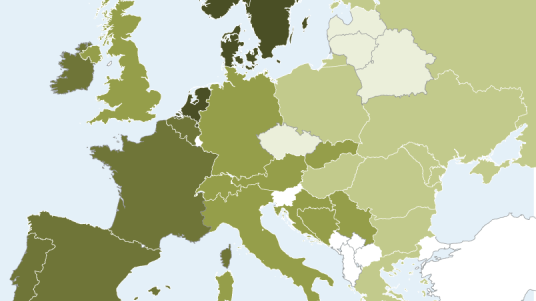
Explore public opinion trends in 55 countries on topics ranging from attitudes toward the U.S. to views about globalization, democratization, an extremism. Results can be displayed in map, table or chart format. on pewglobal.org
Latinos by Geography
Interactive maps and data bases provide details about the changing Latino population in each of the nation's 50 states and 3,141 counties. on pewhispanic.org
An extensive survey details the religious makeup, beliefs and practices of the American public. This online feature includes maps, graphs and charts. on pewforum.org