48% of technology users need help from others with new devices and many tech users encounter problems with their internet connections, home computers or cell phones; As gadgets become more important to people, their patience wears thin when things break
Modern information and communication technologies open doors to a wealth of information. But many users find it difficult to set up these devices and frustrating when they break. According to a recent survey by the Pew Research Center’s Internet & American Life Project, nearly half (48%) of adults who use the internet or have a cell phone say they usually need someone else to set up a new device up for them or show them how to use it. And many users of various devices and services encounter breakdowns from time to time. Specifically:
- 44% of those with home internet access say their connection failed to work properly for them at some time in the previous 12 months.
- 39% of those with desktop or laptop computers have had their machines not work properly at some time in the previous 12 months.
- 29% of cell phone users say their device failed to work properly at some time in the previous year.
- 26% of those with Blackberries, Palm Pilots or other personal digital assistants say they have encountered a problem with their device at some time in the previous 12 months.
- 15% of those with an iPod or MP3 player say their devices have not worked properly at some time in the prior year.
Respondents from all demographic groups who own a certain device are about equally likely to have that device fail, but younger cell phone owners are significantly more likely than seniors to have their cell phones break:
- 30% of 18-29 year old cell phone owners say their cell phone failed to work at some time in the previous year.
- 33% of 30-49 year old cell phone owners had a cell phone break at some time in the previous year.
- 26% of 50-64 year old cell phone owners report cell phone failure at some point in the previous year.
- 18% of cell phone owners 65 years old and older report a broken cell phone in the previous year.
How did people deal with tech breakdowns? Some 15% of those experiencing problems with any of the five devices or services listed above said they were unable to fix the problem. However, the majority of users found solutions in a variety of ways:
- 38% of users with failed technology contacted user support for help.
- 28% of technology users fixed the problem themselves.
- 15% fixed the problem with help from friends or family.
- 2% found help online.
Users whose technology had failed also reported a mix of emotions during the course of trying to solve the problem:
- 72% felt confident that they were on the right track to solving the problem.
- 59% felt impatient to solve the problem because they had important uses for the broken technology.
- 48% felt discouraged with the amount of effort needed to fix the problem.
- 40% felt confused by the information that they were getting.
This data memo is based on a survey of 2,054 adults between October 24, 2007, and December 2, 2007. Some 734 respondents in the survey were technology users who had at least one device fail in the past year.
Electricity was new once, too.
It is often the case that new technologies become popular well before the technology itself is understood by the general public: as these technologies gain traction, it is not always intuitive for new users to know how to use them, much less fix them when they break. And there are always some users who catch on faster than others to new technology.
A new technology becomes mainstream at the time that it becomes easily accessible, affordable, and usable to the general population. Electricity caught on in America around 1880-1920, though it was more or less “discovered” in 1771 and harnessed in 1821. The telephone was invented in 1876, but it did not become widely used in America until the early 1900s. And, while the first American patent for photography was issued for an early version of the camera in 1840, it was not until 1900 that the camera was first mass-marketed.
Nowadays, we are born under bright lights, and flipping the switch when it is dark seems to us common sense. But just over 100 years ago, no one had ever seen light that was not also fire or electricity that was not lightning or static. When the Edison light bulb was introduced in 1880, it was not only a novelty, but it was regarded as a phenomena bordering on the supernatural. People stared in awe, and some fell to their knees in wonder, as the court house in small-town Wabash, Indiana, put on one of the first displays of harnessed electric light.1
When the telephone was taking off in homes in the early 1900s, subscribers were given specific instructions for how to make a call – something we now do automatically several times a day. Instructions given by telephone companies ranged from technical directions, such as speaking directly into the mouthpiece, to proper etiquette, such as avoiding banging the receiver when hanging up.2
The first mass-marketed camera, “the Brownie” was developed in 1900 by George Eastman, the founder of Kodak. The Brownie was the first camera that was truly marketable to the public for two main reasons: it was easy to use and extremely affordable. Unlike its predecessors that had bulky equipment and technical processing requirements, the Brownie could be held in the hand, took a snapshot with the press of a button, and was loaded with film that could hold up to 100 images. The camera initially cost just $1. Because the technology was simple and affordable, anyone, not just professionals, could take photographs – without knowing the slightest about lenses or film.
Most Americans probably still do not know the science behind the flip of a light switch. But they probably know that when the lights are out to check the breaker, and, when the breaker fails to fix the problem, to call the electric company. Nearly all Americans know how to pick up a receiver and dial a seven-digit combination of numbers, but most do not know how those numbers add up to connect their phone with another phone across the country. Similarly, the amateur photographer wielding a point-and-shoot digital camera probably does not fully grasp the physics behind the lenses inside, but he probably knows how to aim and press a button. But when the line is dead or a camera fails to click, many users are likely to contact the telephone company or take the camera to a repair shop.
So where would computers, cell phones, Blackberries, MP3 players and the internet fit in to this picture? Do owners know enough about their Blackberries to fix the devices themselves when they break? Do users know enough about what goes on inside their computers to even know when they need a checkup? Could Americans still get the information they need, or be able to communicate as easily with their friends and family, if their cell phones broke or their internet connection failed?
Mix of solutions, reactions to failed devices.
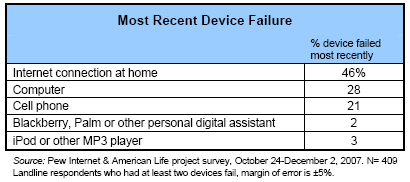
A home internet connection is the technology most likely to fail, with 44% of home internet users reporting that their internet failed in the past 12 months. Computers are the second most common device to fail, followed by cell phones, Blackberries and iPods. PDAs and MP3 players are the devices least likely to have failed in the past year, and of owners who had multiple devices fail, very few reported that their Blackberries or iPods had been the device to fail most recently.3
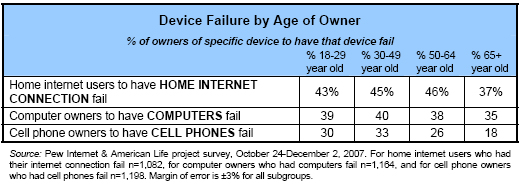
All demographic groups are about equally likely to have certain devices fail them, though seniors who own cell phones are significantly less likely than younger cell phone owners to have problems with their cell phones. Just 18% of cell phone owners 65 years old and older reported that their cell phones had failed in the past year, while 26% of 50-64 year olds, 33% of 30-49 year olds and 30% of 18-29 year olds reported cell phone problems. Seniors are not as exclusively reliant on their cell phones as younger owners, and so they may have less wear and tear on their phones than do younger users who are more likely to experience cell phone failure. Significantly more seniors than 18-49 year olds who own cell phones also have landline phones at home. Fully 79% of senior cell phone owners also have regular phones, while just 30% of 18-29 year olds and 52% of 30-49 year olds have both types of phones.
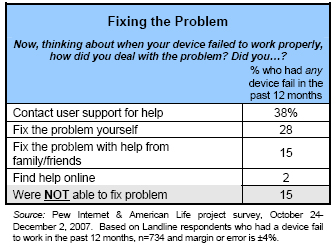
While over one-third (38%) of those who had devices fail contacted user support for help, many owners fixed problems without customer support, whether on their own, with the help from friends, or by finding help online. Some 15% of those who had devices fail were unable to fix the problem.
Men (33%) were significantly more likely than women (22%) to fix gadget problems by themselves, while women (18%) were more likely than men (12%) to consult their friends or family for help.
Adults 50 years old and older were much more likely to contact user support for help, but otherwise age did not significantly affect how a respondent fixed his device.
Different devices, different solutions
The device that failed did, however, seem to play a role in the respondents’ chosen solutions, and the majority of respondents chose either to fix the device on their own or to contact user support for help.
While fixing a device on one’s own significantly trailed contacting user support as the most popular solution to device failure, those with computer, internet and cell phone problems were equally likely to fix their devices in this way.
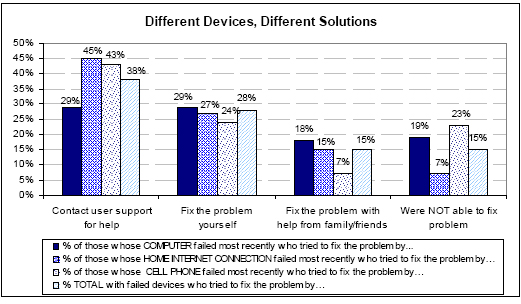
Those who had their computers fail most recently were equally likely to fix it themselves as they were to contact user support for help (29%), but they were significantly less likely than those with internet connection or cell phone failures to contact user support. Some 45% of those with internet failure and 43% of those with cell phone problems contacted user support, compared with 29% of those with computer problems to do so.
Some 15% of all technology users with failed devices fixed the problem with help from family or friends, and those with computer (18%) and internet (15%) failures were significantly more likely than those with cell phone problems (7%) to get help from family or friends.
Cell phones were the device least likely to be fixed, as nearly one-fourth (23%) of those with broken cell phones were unable to fix problems they had with their cell phones. Some 19% of those with broken computers reported not being able to fix their computers, while significantly fewer were left without internet (7%). Put another way, while 77% of cell phone owners were successful fixing their phones when they broke, 93% of those whose home internet connection failed were able to fix it.
When a home internet connection fails, broadband may be trickier to fix than dial-up without help from customer support. Based on those who reported a failed home internet connection, broadband users were much more likely to seek user support for help (49% v. 27%). The problems, however, were equally likely to be fixed, with just 6% of dial-up users and 7% of broadband users unable to fix the problem.
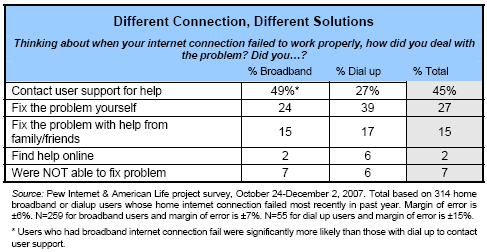
The number of devices that failed a respondent in the past 12 months had no bearing on the way he dealt with the problem. Those who had one device fail were equally likely as those who had two or three problems to try to fix it themselves, for example, or to seek help from customer support.4
Reactions to tech failure related to users’ solutions as well as their ease with technology
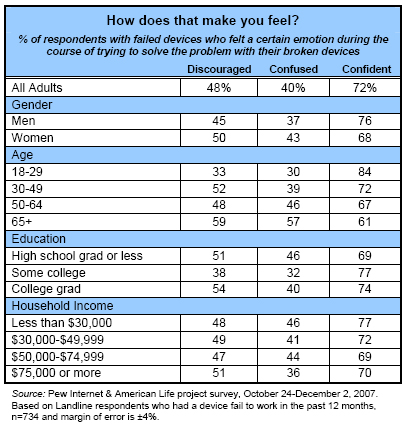
During the course of trying to fix their broken technology, respondents reported a variety of attitudes, not all of them stemming from frustration. The majority (72%) of respondents said they were “confident” that they were on the right path during the course of trying to solve the problem. Fewer respondents harbored more negative feelings about fixing their devices: about half (48%) were “discouraged” and 40% were “confused” about the problems.
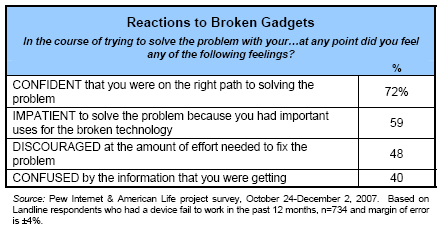
Regardless of whether respondents had their computers, cell phones or internet connections fail, they were equally likely to feel discouraged, confused, confident or impatient during the course of trying to fix the problem. Respondents’ emotional reactions were, however, related to the solutions they chose.
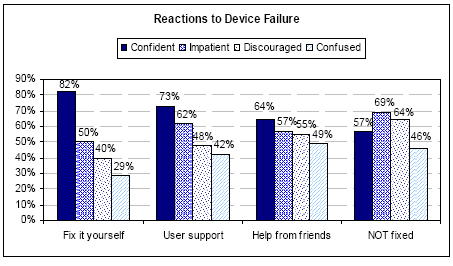
Respondents who fixed gadgets themselves were significantly more likely to report being confident that they were on the right track to solving the problem than to report any other emotional reaction. Fully 82% of fix-it-yourselfers said they were confident, which is also significantly more than respondents who got help from friends or family (64%) or were unable to fix their devices (57%).
Respondents who fixed their broken technology themselves were also significantly less likely to report being confused than those who found other solutions or were unable to fix their devices. Some 29% of fix-it-yourselfers reported being confused, compared with 49% of those who consulted friends and family, 42% of those who contacted user support and 46% of those who could not fix the problem.
Adults who contacted user support for help were significantly more likely to report being confident or impatient, rather than discouraged or confused, during the course of trying to solve the problem. At the same time, those who were unable to fix their devices and those who got help from friends or family were the groups most likely to report being discouraged during the course of trying to solve the problem.
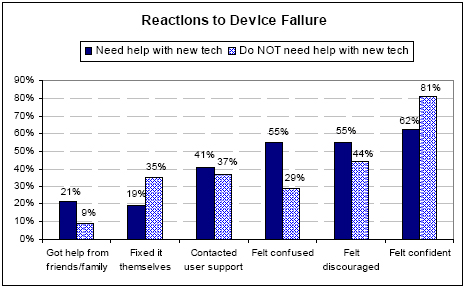
A technology user’s experience and ease with new technologies may play a role in his chosen solution as well as in his attitude during the course trying to solve the problem. Adults who admitted that they need help setting up or learning how to use a new device (48% of internet and cell phone users) are significantly more likely than those who are at ease setting up new device to seek help from family or friends in order to fix a broken device (21% vs. 9%). Those tech users who need help with new devices are also significantly more likely to feel confused (55% vs. 29%) and discouraged (55% vs. 44%) during the course of trying to solve the problem.
The 52% of tech users who are comfortable learning to use new devices on their own are more likely to be independent and confident device fixers. Some 35% of this group, compared with 19% of those who need help with new devices, fixed broken technology on their own; and, 81% of the more tech-savvy group said they felt confident during the course of fixing their devices, while 62% of those who need with devices help felt confident. Both groups, however, are equally likely to contact user support for help and are equally likely to fix their broken devices in the end.
Attitudes are also sometimes associated with age and gender
Younger users are generally much more optimistic than older adults when their gadgets fail. Although young adults age 18-29 years old are no more likely to be able fix devices on their own, they were significantly more likely to be confident that they were on the right path to fixing it, and they were significantly less likely than older adults to feel discouraged or confused about fixing devices. Fully 85% of 18-29 year olds reported being confident about solving their device problem, while only about a third of them said they were discouraged or confused. Meanwhile, over half (52%) of adults age 30 and older reported being discouraged, 44% said they were confused, and about two out of three (67%) said they were confident. Adults age 30-49 were somewhat less likely than older adults to be confused, as just 39% said they were.
Men were significantly more likely than women to be confident about the problem solving (76% vs. 68%), but they were no less likely than women to report being confused, discouraged or impatient during the course of trying to solve the problem.
There were no significant differences in emotional reactions to device failure across income and education groups.
Just get it fixed already!
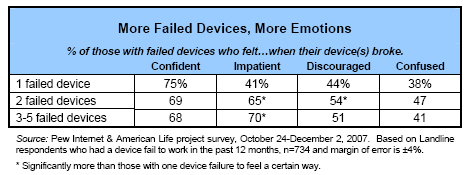
The majority (59%) of respondents reported being impatient to fix their devices, and the percentage was equal across demographic groups. Adults who are most likely to be impatient waiting for their devices to be fixed are those who had had the most devices fail, those who use their devices most, and those who rely more heavily on their devices for work or information.
While emotions did not vary significantly according to the types of devices that failed, those who had more gadgets fail in the past 12 months were more likely to become impatient with fixing the problem. Respondents who had two or more devices fail in the past year were significantly more likely than those who had only one gadget fail to report being impatient to solve the problem. Similarly, those who had two devices fail were significantly more likely than those who had only one fail to be discouraged at the amount of effort needed to fix the problem.
Adults who more frequently use their gadgets are more likely to be impatient to fix their broken device than those who do not use their devices as often. For instance, cell phone owners who use their phones for four or more different functions – including emailing, text messaging, taking pictures and playing games – are significantly more likely than those who had fewer uses for their cell phones to say they were impatient to fix their broken phones. More than three in four cell phone owners (76%) who had four or more uses for their phones reported being impatient to get their phones fixed, compared with around 55% of those who had 1-3 uses for their phones and about half of those who used their cell phone only to make calls.
Similarly, internet failure was a bigger frustration for those who were using the internet several times a day. Fully 68% of internet users who are online several times a day said they were impatient to get their internet fixed, while about half (49%) of those who logged on less often were impatient to get their internet fixed. Avid internet users are also less likely than those who use the internet less often to be confused by the information they got during the process of fixing their internet. Some 29% of those who use the internet several times a day said they were confused, compared with about half of those who use the internet between once daily and once weekly.
Adults who rely more heavily on devices to get information and to be productive are more likely become impatient when their devices fail to work. Based on respondents with any device failure, those who are more reliant on the internet and technology to get information are significantly more likely than those who are less dependent on technology for information to be impatient to fix their devices (69% vs. 51%). Fully 74% of those who felt “very” strongly that they would be lost for information without the internet or electronic devices also reported that they were impatient to get their device fixed, significantly more than those who agreed “somewhat” (63%). Similarly, those who said devices made them more productive were also significantly more likely than those who did not think so to be impatient to fix their broken devices (66% vs. 50%).


