Library of Congress Washington, D.C.
With the passage of the International Religious Freedom Act in 1998, the United States became one of the few countries in the world to make promotion of religious freedom an explicit foreign policy goal. The act, signed into law by President Clinton, established an Office of International Religious Freedom at the State Department, headed by an ambassador-at-large responsible for issuing a yearly country-by-country report on religious freedom. This year the office designated Uzbekistan, Burma, China, the Democratic People’s Republic of Korea, Eritrea, Iran, Saudi Arabia, Sudan and Uzbekistan as “countries of particular concern” for their “systematic, ongoing, and egregious” violations of religious liberty.
The 1998 act also created the U.S. Commission on International Religious Freedom, an independent government agency that issues its own annual report and makes policy recommendations to the State Department, Congress and the president.
The Pew Forum on Religion & Public Life, the American Academy of Religion and the Library of Congress’ Kluge Center invited four distinguished experts to explore why the U.S. has made international religious freedom a priority and in what ways the policy has succeeded or failed.
Speakers: Thomas Farr, first director of the U.S. State Department Office of International Religious Freedom
Allen D. Hertzke, University of Oklahoma, author of Freeing God’s Children: The Unlikely Alliance for Human Rights
Elizabeth H. Prodromou, Boston University, author of forthcoming books on pluralism in Greece and in Russia; vice chair of the United States Commission on International Religious Freedom
Winnifred Fallers Sullivan, University of Buffalo Law School, State University of New York, author of The Impossibility of Religious Freedom
Moderator: Timothy S. Shah, Senior Fellow in Religion and World Affairs, Pew Forum on Religion & Public Life
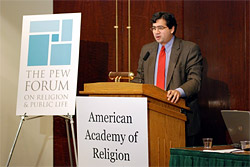
TIMOTHY S. SHAH: Almost precisely 25 years ago, on November 25th, 1981, the United Nations General Assembly proclaimed a declaration on religious freedom, or in classic diplomatic language, the Declaration on the Elimination of All Forms of Intolerance and Discrimination Based on Religion or Belief. That mouthful hints at the lengthy and torturous deliberations required for the UN to draft this declaration, a process that took something like 20 years. But in the end the world body achieved a fairly robust consensus and was able to declare forthrightly that “All states shall take effective measures to prevent and eliminate discrimination on the grounds of religion or belief.”
Twenty-five years after that landmark declaration, only two countries in the world have made the advancement of international religious freedom an explicit and significant goal of their foreign policies. One is the Vatican city-state and the other is the United States of America.
The fact that the U.S. is virtually alone in the world in adopting a policy of not only promoting religious freedom at home but advancing it abroad is the starting point of this panel. We will tackle two main issues. One, how did the United States come to adopt a policy of promoting religious freedom abroad? Two, what kind of policy has it been?
With respect to the second, evaluative question, there are two sub-questions: Has a policy of promoting religious freedom been good or bad for U.S. foreign policy and for American national interests? Secondly: Has this policy been good or bad for the cause of international religious freedom in the world?
These questions are all the more important because religious freedom has become a salient and significant thrust of U.S. foreign policy today. Just how salient and significant was made apparent by President George W. Bush during his visit to Asia this month. While in Vietnam, the president attended an ecumenical service on Sunday morning at a Catholic cathedral, and afterwards he said publicly, “A whole society is a society that welcomes basic freedoms. My hope is that people all across the world will be able to express religious freedom.”
We’re honored that representatives of the State Department’s Office of International Religious Freedom are in the audience today, in addition to representatives of the U.S. Commission on International Religious Freedom.
Our first speaker is Allen D. Hertzke, professor of Political Science and Director of Religious Studies at the University of Oklahoma. He is the author of Religion and Politics in America, several other books, and, most recently and most relevantly for discussion, a book called Freeing God’s Children: The Unlikely Alliance for Global Human Rights, which describes how the U.S. came to adopt, via legislation, a policy of international religious freedom.

ALLEN D. HERTZKE: I want to start by providing the context for the legislation. What were the conditions underlying the legislative initiative? The first condition is the globalization of Christianity. The tectonic shift of the Christian population to the developing world of Asia, Africa and Latin America provide the crucial underpinning for this movement. It created a constituency around the world that communicates with an American constituency here at home. Some two thirds of all Christians live in Asia, Africa and Latin America today, and the percentage is growing. Many of these Christians live amidst conditions of poverty, exploitation, war and religious persecution; these communities communicate with their counterparts here in the United States and sensitize many lay Americans to the problem of religious persecution.
The second condition is related to the importance of religion in the modern world. The pervasiveness of religious persecution has a lot to do religion’s importance. As Samuel Huntington noted in one work, “If religion is unimportant, it can be tolerated. If it is important, governments will insist on controlling it, regulating it, suppressing or prohibiting it, or manipulating it to their own advantage.” That context helps explain why persecution endures in so many parts of the world today.
The pervasiveness of persecution and the globalization of Christianity also create another context: the potential for allies in the campaign against persecution. What began initially in 1996 as a campaign primarily for persecuted Christians blossomed into a concern for persecuted religious minorities. Evangelical, Catholic and mainline Protestant Christians found allies among Tibetan Buddhists, Iranian Bahai, Buddhists in Southeast Asia and China, and Muslim Uighars in western China. Many U.S. Christian groups, which began with what we might call a parochial concern about their own, became sensitized to the issue, more broadly, of religious freedom and the persecution of minorities. This created what I call the “unlikely alliance” that made the legislation seem compelling to members of Congress.
The final piece of the puzzle had to do with church-based networks here in the United States, and, in particular, the activation of evangelical networks on behalf of the legislation. Harvard political scientist Robert Putnam has written about how the evangelical community has built, in the last quarter century, the most vibrant social movement network we have seen in recent years. Those social-movement networks were mobilized initially on behalf of domestic, conservative issues but were activated later on behalf of international religious freedom.
I want to turn to the legislative battle, which is a fascinating story. I won’t bore you with all the twists and turns, but as a student of Congress, it was a delight to behold.
There were two opposing views about how best to address and remedy the issue of religious persecution abroad. One vision was public exposure, automatic sanctions and even unilateral U.S. action. This approach envisioned a tough and often blunt instrument to deal with religious persecution, and it was embodied in the so-called Wolf-Specter legislation that passed the House. The other vision emphasized quiet diplomacy and a wider menu of actions, including multilateral approaches. That vision was embodied in the original Senate alternative bill, the so-called Nichols-Lieberman bill.
You also had two different views on what the focus of the legislation should be. One view, embodied in the House bill, was the focus should be on the most egregious persecution, the kind no one can justify or excuse, the kind that would be impossible for Congress to ignore. The other view was there should be a wide focus on promoting religious freedom generally, including all aspects of discrimination as well as more severe persecution.
These multiple, competing visions produced a very contentious process. Who can be against persecution? There was a lot of cachet in the campaign against religious persecution – it’s very much a part of the American ethos – but the views of the proper remedies were deeply divided. The partisans who were ultimately successful in crafting legislation described it as one of the most frustrating, debilitating, and tiring processes they’d ever been involved in.
Interestingly, the division was not along conventional ideological lines; it was not along Christian right, Christian left lines. The competing visions were often backed by competing teams of evangelicals, who had very different views about the proper way to approach this issue.
Ultimately, the legislation passed because it was consonant with the American tradition of religious freedom and because it appealed to such a wide array of religious constituencies in America. It passed because people were willing to suffer through the deliberative process; I often wonder if there’s a theological point here. Had the legislation swept through Congress more easily, its impact would not have been as dramatic. Because there were such deep divisions, partisans continually groped for the proper solution. If the process had been less dramatic, there might have been a more mixed vote. As it was, the contentiousness led to the last-minute passage of the legislation in the waning days of the congressional session in 1998.
Here’s what’s interesting about the legislation. Whether it’s as a result of the Madisonian genius of our system or the hand of Providence, the legislation in a profound way blends both of these visions.
The ambassadors for international religious freedom have generally backed the vision of quiet diplomacy and multilateral approaches. The previous ambassador, Richard Seiple, even criticized some of the initiatives of the U.S. Commission as cursing the darkness instead of lighting candles. In terms of focus, the State Department report casts a wide lens across the globe; it is a comprehensive almost encyclopedic document.
On the other hand, the U.S. Commission for International Religious Freedom embodies that tough-public-exposure posture some partisans envisioned as the proper way to deal with religious freedom concerns. The commission has called for the naming of more so-called “countries of concern,” countries that practice egregious forms of persecution and demand a more vigorous response from the State Department. There are documents by the U.S. Commission calling for more robust sanctions.
To a degree, the law is working as the diverse partisans envisioned. The State Department report is a global resource. It’s used not only by our own government, but by other governments, who view it as the most thorough compendium of the status of religious freedom around the world. It’s widely distributed and widely read in the diplomatic community. Because State Department officials must meet with religious dissidents and develop relationships with religious communities, we now have a much better sense of what’s happening on the ground in these various countries; this was one goal of the partisans of the International Religious Freedom Act, to make sure our State Department officials were knowledgeable about the religious forces at play around the world.
[Sasser received]
At that time, it didn’t seem necessary to brief the new ambassador on the persecution of religious minorities in China, particularly house-church Protestants and Catholics, who attempt to operate independent of the government’s heavy-handed regulation.
That could not happen today. Our diplomats are much more in touch now with what’s going on around the world, and I think that’s a good thing.
[Members of the commission]
The commission has also emphasized a more thematic approach to reporting. Whereas the State Department report, as a necessity, must be an encyclopedic report – and the reports are getting better, more thorough, more aggressive – the U.S. Commission has been free to focus thematically. It has raised the issue, for example, of Saudi funding of literature intolerant toward Jews, Christians, or Sufis, Shiites and other minority Muslims. It’s raised the issue of continuing persecution in China and Tibet, of the Muslim Uighars, of house-church Protestants and Catholics. It’s raised the issue of the abysmal state of human rights in North Korea, and particularly the fate of asylum seekers who are victimized in China.
In many respects, we can point to some successes. Comparing the early 1990s to today, there’s a tremendous amount of activity on religious freedom.
But what was the vision? What was the hope? To answer that question, I will read you a passage from my book:
“Many who gathered in front of the Capitol steps on October 10, 1998, to celebrate the passage of the International Religious Freedom Act saw the legislation as providential, because it placed the government’s unalloyed imprimatur on the cause of religious freedom around the world. Under a bright October sky, there was a palpable sense of historic moment, and speaker after speaker directed eloquent remarks to those abroad, to ‘tyrants who persecute’ and ‘believers who suffer.’
“Senator Nichols described the bill as ‘one of the best accomplishments we’ve made this Congress,’ while Frank Wolf, congressman from Virginia, said, ‘It gives voice to the voiceless.’
“Wolf, in fact, proclaimed that, ‘The Catholic priests who are in jail in China today will know that this bill has passed. The evangelical pastors that are in jail will know it has passed. So,’ he observed, ‘will Coptics in Egypt, Buddhists in Tibet and other oppressed religious minorities.’
“Congressman Chris Smith displayed giant photographs of tortured believers, from a Tibetan monk to a Sudanese boy.
“Chairman Gilman said the legislation ‘sends a long overdue signal to repressive governments that their repressive behavior is no longer going to be tolerated. Persecuted believers will learn that world opinion is awakening to their plight.’
“Jeff Taylor of the Christian Coalition said that Congress had ‘taken the moral high ground and served notice to tyrants around the world that the spotlight will be focused on them.’
“Ari Storch of the National Jewish Coalition said that, ‘By shining the spotlight wherever the darkness of persecution exists, the law would respond to the Holocaust admonition ‘never again.’
“Tom Hart of the Episcopal Church called the legislation ‘a fitting way to celebrate the fiftieth-year anniversary of the Universal Declaration for Human Rights.’
“Will Dodson of the Southern Baptist Convention reassured those living in fear around the world that ‘We will work ceaselessly on your behalf.’
“Rich Cizik of the National Association of Evangelicals spoke rhetorically to the Chinese officials he met who doubted congressional resolve. ‘To those whom I promised that this bill would pass, we have done it,’ said Mr. Cizik.
“Finally, Congressman Bob Clement reflected ‘that God truly reigned in this legislation.’ And he ended by quoting Isaiah 58: Whatever is acceptable to God is to ‘undo the bands of the yoke and let the oppressed go free.’”
Rhetorical flourishes aside, that’s a tall order. In spite of all the accomplishments and publicity, the legislation has not lived up fully to that promise, perhaps not surprisingly. The real world is an intractable place.
The commission has achieved an enormous amount of stature but has not achieved the prominence at least some partisans had hoped for, comparable to the high profile of the civil rights movements in the 1950s and early ’60s.
The State Department follow-through has been criticized for not tying the routines of our diplomacy to the promotion of international religious freedom. Congressman Chris Smith complained to me that human rights continues to be an island in our foreign policy, cut off from other aspects of diplomacy. Whenever the State Department approaches the issue of sanctioning country of concern, it has continued to use existing sanctions – this is something that the commission has commented on and criticized. In cases where they have new sanctions, they often use ones that have the least bite. For example, the sanction responding to China’s designation as a country of concern is a ban on the export of law enforcement equipment to China – as if that would be a huge burden on the Chinese. There hasn’t been aggressive follow-through by our government.
Why is this? One of the reasons is foreign policy is a difficult business. There are competing interests such as economic interests and national security. Our State Department diplomats don’t want to upset delicate relationships with other governments. But there’s another reason: Religious freedom legislation and its implementation requires continued public support. Unless there’s strong pressure from the public and pressure by Congress, the normal routines of diplomacy swallow up aggressive implementation of religious freedom legislation.
One possibility I alluded to in my book is that a recrudescence in the culture war could siphon energies away from the communities providing the most muscular, grass-roots support for the legislation. The energies of the evangelical Christian community, which provided a lot of the grass-roots muscle for the legislation, have indeed been siphoned away by the gay marriage issue, concern for the judiciary and other issues that continue to roil the body politic. That’s a significant concern.
To end on a positive note: A funny thing happened on the way to passage of the International Religious Freedom Act. A coalition was formed. A human rights architecture was created that continues to grow and manifest itself. The campaign itself helped to galvanize the movement for a broader focus on human rights in American foreign policy. In the wake of that legislation, Congress passed trafficking legislation that has some real teeth; in 2002 it passed the Sudan Peace Act; in 2004, the North Korean Human Rights; this year, domestic trafficking legislation and legislation to advance democracy around the world. A whole sequence of legislative acts has grown out of the campaign to focus on international religious freedom.
It’s important not to think solely in terms of the impact of the legislation on the status of religious freedom around the world because the focus on religious freedom has galvanized the partisans to focus on other human rights as well.
SHAH: With that excellent account as a background to the International Religious Freedom Act, we now turn to Thomas F. Farr, who served as the Department of State’s first director of the Office of International Religious Freedom. As director, Thomas Farr negotiated issues of religious freedom with governments in the Far East, the Middle East and Europe. He has written on religious freedom in First Things, in the Review of Faith and International Affairs, and is at this moment writing a book on religious freedom and American national security.
THOMAS F. FARR: I’d like to talk about the implementation of the International Religious Freedom Act, or IRFA, as it is known. I’m an enthusiast for IRFA, but I don’t like that acronym. Seven years ago when I showed up at the Office of International Religious Freedom, I looked in the State Department phone book and read “the Office of IRF.” (Laughter.) I thought, “This office has got enough problems trying to integrate religious issues into American foreign policy without a label like that.”
Acronyms are very important in Foggy Bottom at the Department of State. If you can take an acronym and make a verb out of it – particularly a transitive verb, as in “IRF-ing the Saudis” (laughter) – then you know you’ve arrived. Fortunately, there’s much more to this legislation than its acronym suggests.
On its face IRFA mandates the advancement of religious freedom as a central element of American foreign policy. As such, it can play a critical role in a host of American foreign policy and national security issues, including the war on Islamist terrorism and our attempts to encourage stable, peaceful self-government in the Middle East and elsewhere. But in my view, IRFA is being implemented in a way that’s largely unconnected to those issues.
What I hope to do today is describe the current operation of the law and why it’s being so narrowly applied. Then I’ll briefly outline what would be a more productive application of IRFA not only for the advancement of religious freedom around the world but also for our American national interests.
Last week, the State Department held a press conference and announced the governments that are, under IRFA, the worst religious persecutors. The department spokesman declared the goals of U.S. policy as follows: “To oppose religious persecution, to free religious prisoners and to promote religious freedom.” Note the order of those three goals.
I would suggest that the first two, opposing persecution and freeing prisoners, are so dominant in the way the department has implemented IRFA that the third, promoting religious freedom, has been overshadowed. Over the long term, this almost exclusive focus on persecution and prisoners puts all three goals at risk. Further, American foreign policy does not seek to advance religious freedom in any systematic way. To do so would require wading into thorny issues such as human freedom and the relationship between religion and faith. Opposing persecution, however, is something that foreign policy makers can, within limits, agree upon.
But opposing persecution does not mean ending it, and even if we’re able, by some combination of sticks and carrots, to convince a government to stop persecuting, that does not mean that country has religious freedom. A political order of religious freedom is one in which individuals and religious communities are free – not simply free from abuse, but free to do things: to worship, to raise the children in the faith, to train clergy, to manifest truth claims, and perhaps most importantly and controversially of all, to participate in and influence the public life of their nation within the limits of liberal democracy. This is the critical step to create stable self-government in nations that have significant religious communities.
Consider Afghanistan. When the United States deposed the Taliban in 2002, the horrible persecution of women and minority Shiites stopped. Prisons were emptied. The liberated Afghanis elected a democratic government and ratified a democratic constitution. But these developments did not add up to a political regime of religious freedom. In March of this year, Abdul Rahman, an Afghan citizen, was tried for apostasy for converting from Islam to Christianity, a crime meriting beheading under the court’s interpretation of Afghanistan’s democratic constitution.
State Department pressure induced the Afghans to permit Mr. Rahman to flee the country, an effort that was called a victory for U.S. international religious freedom policy. But while it may have been a victory for opposing persecution and freeing prisoners, it was actually a defeat for religious freedom. It was a defeat because American diplomacy failed to engage the real problem: Unless Afghanistan addresses the issue of human freedom in its religious, political and social institutions, it will not achieve the kind of democracy that will endure or be able to resist the toxic ideas of the resurgent Taliban.
America’s international religious freedom policy should be taking this problem on, but it has neither the resources, the bureaucratic clout, nor the internal policy mandate to do so.
Why not? Why does our policy focus on persecution of prisoners? One plausible answer is the law’s supporters and the Congress intended it that way. IRFA created an office in the State Department headed by an ambassador-at-large to monitor persecution around the world, issue an annual report and produce an annual list of the very worst violators. The secretary of state then must consider taking some punitive action, which could include economic sanctions; IRFA also encourages negotiations with the governments on the list of countries of particular concern.
This approach has had some successes. Both the past and current ambassadors-at-large, Bob Seiple and John Hanford, have achieved significant prisoner releases, and this is manifestly a good thing. Ambassador Hanford has negotiated creatively with governments on the list, most notably and most recently, Vietnam and Saudi Arabia, on what they have to do to be taken off the list. Just last week, Ambassador Hanford announced that his negotiations with Hanoi had produced enough progress to take Vietnam off the list. That decision has been criticized by the U.S. Commission on International Religious Freedom, a separate, watchdog agency created by IRFA, as Professor Hertzke was talking about. But even the commission notes some improvement has been made in Vietnam.
We hope this signals a commitment by the government of Vietnam to rid the country of religious persecution. If so, it will clearly mark a step toward religious freedom and a sign that Vietnam sees religious freedom as in its own interests. Ambassador Hanford deserves a great deal of credit for his work on this. The danger, of course, is that Vietnam’s decision to reduce persecution could be a short-term concession to secure favorable trade relations with the United States. If so, it would still constitute a positive step but would probably be temporary and easily reversed.
The effort against persecution is isolated in our foreign policy and seen by both sides as mainly a humanitarian issue. For the Vietnamese, responding to our push on persecution is too easily seen as a question of “America management.” Every foreign ministry in the world has an America management division; I’ve met them all. We can have a longer-term impact if we integrate religion into our full relationship with Vietnam and other countries. Persecution and the absence of religious freedom impact Vietnam’s own long-term interests, including its political stability and economic performance. When we talk to them about economic growth, we should also talk about why religious communities participating in that growth is good for the nation – not good for the United States but good for Vietnam. The conversation should not be carried out solely by the ambassador for religious freedom.
Let’s peek briefly into Foggy Bottom to see what I mean by the isolation of the IRFA office. A reasonable reading of the law is it envisions an office headed by a very senior official, an ambassador-at-large, with considerable authority and a mandate to promote religious freedom. Unfortunately, both the Clinton and the Bush administrations isolated the IRFA ambassador-at-large and his office. Since 1998, when this business began, both have been nested within the Human Rights Bureau, itself out of the mainstream of American foreign policy, although, let me hasten to add, staffed by some of the best, brightest and most dedicated people you’ll ever meet. This placement means the ambassador-at-large is subordinate to a lower-ranking official. Unlike other ambassadors-at-large at the State Department, he does not attend regular senior staff meetings. When senior meetings are held on U.S. policy on China, Saudi Arabia or even engaging Islam, this ambassador-at-large is not present. If a priest is about to be executed, the call goes out to the Religious Freedom Office, but if the issue is our policy on Islamist political parties in Egypt, the International Religious Freedom Office is not thought to be relevant.
What is the case for interpreting IRFA as an integral part of American foreign policy and national security strategy for the 21st century? Let’s begin with a dose of realism. Two powerful, international forces cry out for a refurbished international religious freedom policy on the part of the United States. The first is the growing demand for self-government and the continuing popularity of democracy around the world. The war in Iraq, the ascendancy of a nuclear Iran and other factors may slow the pace of political reform in the greater Middle East, but it’s not going to stop it.
The second force is what sociologists of religion call the desecularization of the world and, for better or worse, the inevitable public consequences of that phenomenon. Those consequences include transnational Islamist terrorism, a nuclear-armed Iranian clerical autocracy, and the potential for either revolution or stability in nations vital to our national interest, such as India, Saudi Arabia, Pakistan and Egypt. The demand for democratic elections in the greater Middle East is being led by Islamists, not secular liberals. The phenomenon, of course, is not limited to Islam. Religion plays a critical role in a host of non-Muslim nations, including India, Russia and China, that are vital to American interests. These two forces, the spread of democracy and public religion, often work in tandem.
As religion becomes more influential in people’s lives, democracies inevitably must grapple with religiously informed, moral judgments intruding into public policy. The natural tensions between the claims of religious communities and those of the liberal, democratic state must be reconciled if democracy is to be stable and peaceful.
How would a refurbished international religious freedom policy address this problem? What would it look like? Let me stipulate a couple of broad principles and then look at how it might work in a key Arab country such as Egypt.
As a first step, American diplomats have got to abandon their disposition to treat religion as a private matter or something unfit for policy analysis. American diplomacy must accept that most religious communities by their nature seek to influence the rules and the norms under which they live. Our challenge in planning democracy, certainly in Muslim countries, is not one of privatizing religion – that’s a fool’s errand – but of enticing Muslim communities to embrace liberal norms as consistent with their own religious beliefs.
That’s a tall order. I’m not suggesting that all American diplomats become theologians. I am suggesting they become realists when it comes to the issue of religion, addressing religion much as they do economics and politics – as a powerful, natural, human enterprise that influences how men, women and nations behave. We have to integrate this thinking into our strategies, whether we’re trying to undermine Islamist extremism, counter China’s anti-religion policy, or influence the Islamist political party that governs democratic Turkey.
Consider Egypt. For half a century, a secular autocracy has dominated that country, but it’s widely acknowledged if elections were held today, they would be won by the Muslim Brotherhood. Yet the United States is not seeking to influence Islamist groups like the Muslim Brotherhood, or the more democratic Hizb al-Wasat, even though they – and not our favored Egyptian secularists – are likely to win elections. Even if we did engage those Islamist parties, we currently lack the discernment and the vocabulary to influence them.
This must change. Our international religious freedom policy should be the vehicle for serious interaction with selected Islamist groups in Egypt and elsewhere through private and public diplomacy; democracy promotion programs, which we have spent billions on for the last 25 years and which have been religion-free zones; U.S.-supported interreligious dialogues and a host of other initiatives. Our goal in each of these areas should be, first, to assess the potential attraction of Islamist groups to liberal norms, and, second, when feasible, to demonstrate how a liberal political order can benefit their religious communities and their culture, with their truth claims. In the State Department, the ambassador-at-large should be given the authority IRFA already prescribes. He and his office should heavily be involved in public and private diplomacy in the Muslim world and elsewhere where religion is a factor, which is almost everywhere in the world.
The Foreign Service should adopt a religion subspecialty under political and economic training analogous to subspecialties in arms control or trade. All of our diplomats – every one of them around the world – should be capable of discussing religion as part of politics, part of economics, part of the way human beings live their lives. In our embassies abroad, IRF matters should no longer be left to the most junior human rights officers, who often feel saddled with an unwanted and unrewarded task that’s not going to help their careers.
There is much more to be said, although some probably think I’ve said enough. What I am suggesting would require significant policy decisions by a president and a secretary of state, new training, new incentives for diplomats and much more. But everything I’ve proposed is consistent with IRFA as it exists now. Amendments to the law may be wise over the long term, but I see no obstacle in the current legislation to the policy I’m suggesting here.
In closing, let me emphasize, above all, this subject needs public debate, especially among scholars, policymakers and congressional representatives. That debate should be free as far as possible from the cant that often attends discussions about religion in America. This is not a red state, blue state issue; it is a question of the security and well-being of the American people, who expect and deserve a foreign policy that encounters the world as it is, not as we might wish it to be. That world, for better or worse, promises to be one suffused with religion for the foreseeable future. American diplomacy must work to ensure it is also a world of ordered liberty.
SHAH: We now turn to Elizabeth Prodromou, an outstanding academic with wide-ranging expertise in political science, international relations and religion. She’s an assistant professor of international relations and a research associate of the Institute on Culture, Religion and World Affairs at Boston University. She’s written articles on proselytism and human rights; religion and U.S. foreign policy; Eastern Orthodox Christianity; and democratization. She’s writing a book on church-state relations in Greece at the moment, and since October 2004, she has served as a commissioner on the U.S. Commission on International Religious Freedom. Today she speaks strictly as an academic and in her own capacity, not on behalf of the commission.
ELIZABETH H. PRODROMOU: Let me reiterate what Tim said, that I speak as an academic rather than on behalf of the commission.
I want to set out four points to begin unpacking this relationship between religious freedom and U.S. foreign policy. First, I want to characterize the current moment of international religious freedom. Second, I’d like to take a stab at explaining what accounts for the decision, particularly at this moment in time after the Cold War, to do something unprecedented in American history, which is to legislate religious freedom as a formal part of our foreign policy. Third, I want to consider whether the goals of the legislation have actually been met. If we look at the bottom line, is the balance sheet positive or negative when it comes to promoting religious freedom abroad? Finally, I’ll offer a brief point of conclusion.
[the government]
Despite this long and complicated history, the actual legislating of international religious freedom – the use of the legislative process to specify and formalize the relationship between our foreign policy and the promotion of religious freedom – is quite recent and certainly new. There’s only a decade of history for us to discuss.
The decision to legislate international religious freedom as part of American foreign policy comes at a time of unprecedented religious pluralism in this country. Diana Eck, at Harvard Divinity School, has written about the United States as the most religiously plural country in the world. It also comes at a time of unprecedented religious pluralism in the world at large. Some would talk about the Roman Empire as equal to this moment in time, but I think there are some qualitative differences.
Finally, the legislation of religious freedom into our foreign policy comes at a time when the salience of religion around the world is producing real challenges to the foundations of the Westphalian international order that’s existed since the 17th century.
Given the complexity of the current historical moment, the decision to legislate religious freedom into our foreign policy was a bold and daring move.
At the same time, this decision has met with what some would call “capacity deficits” in our foreign policy apparatus. Until recently, an open and, some would argue, aggressive secularist predisposition has informed almost every aspect of our foreign policy. Religious sentiments have long been associated with irrationality and disorder and have been viewed as a threat to American national security and strategic interests. Our policy apparatus itself is going through what one might call a paradigm shift when it comes to religion.
Given that background, why now and toward what purpose this legislative move to promote and protect religious freedom?
The decision to make the protection of religious freedom a formal aspect of our post-Cold War foreign policy is based on a series of rational calculations about how to optimize our national security and strategic goals. In this post bipolar era, IRFA reflects a conviction of the majority of lawmakers that a foreign policy commitment to religious freedom will bring real gains to the United States in terms of our strategic interests, whether we understand those in terms of hard power or soft power, military needs or moral authority.
Legislating religious freedom as part of our foreign policy reveals a new national security calculus, one that openly combines idealist and realist thinking. The bottom line says a marriage of values and interests can best improve our national security both at home and abroad: that’s a qualitative shift in the way we think about security strategy.
Now to my third point: Has the goal been achieved? It’s tough to make an assessment because we’re talking about an eight-year history, but we can make some preliminary claims about the efficacy of the International Religious Freedom Act.
The results are mixed. Without a doubt, the symbolic and real value of America’s commitment to religious freedom has sent a powerful message to both our allies and our adversaries that violations of religious freedom can produce concrete consequences. We see this in a host of examples, whether it’s the U.S.-led NATO bombardment of Serbia during the 1990s or decisions to place countries on the watch list and the CPC list. These decisions sometimes produce reevaluations of foreign economic assistance or export legislation.
Balanced against these gains are negatives, and these give us cause for concern. One negative consequence of legislating religious freedom has been a palpable international perception that the U.S. policy of promoting religious freedom abroad is merely a façade for a new American imperialism built on cultural dominance and military conquest. There’s a cynicism around the world when it comes to the United States’ intentions in promoting religious freedom. Having traveled around the world as an academic, as a private citizen and also as a member of the United States Commission on International Religious Freedom, I can say at least anecdotally that this perception problem is one we need to take seriously because it constrains our capacity to achieve our goal, which is to improve religious human rights for everyone around the world.
What accounts for this perception – or misperception – problem and the negative blowback it’s produced? A specific point of misunderstanding concerns the origins of the IRFA legislation: One view is the legislation is more a product of domestic political and electoral interests than an overriding concern with the promotion of religious freedom abroad.
A second factor is the application of IRFA. Some countries have come under the microscope of IRFA while others have not. There have been inconsistencies in the use of the watch list and the CPC list and, in particular, the willingness of the State Department and the White House to bring IRFA’s teeth to bear. In terms of action – where we have intervened, how we have intervened – but also in terms of inaction – where we have not intervened when it’s clear there are very serious violations of religious freedom -inconsistencies have given traction arguments that the promotion of religious freedom is nothing more than realism under the garb of idealism.
Another factor that helps explain the perception problem is the issue of defining religious freedom. Two issues in the last eight years have become central to controversies about the intentions and the capacity of the United States to protect and promote religious freedom abroad. The first issue is proselytism and whether or not proselytism always is equivalent to religious freedom. The second lightning-rod issue is the question of religious dress, the right to wear religious dress in the public sphere and, more specifically, in institutions and environments of government and state.
This is by no means a full list of issues contributing to the perception problem, but these points, at least anecdotally, have affected how countries around the world understand America’s decision – a unique and brave decision – to legislate religious freedom as part of foreign policy.
I see the promotion of religious freedom as synonymous with improvements in America’s national security at home and abroad. We can correlate the effective promotion of religious freedom with soft and hard power gains that are good for America.
How do we develop a measure of consistent improvements in religious freedom? A research agenda that evaluates the effectiveness of legislating religious freedom would have to address the perception constraints I just mentioned.
One question would be, where has IRFA been focused, and where has it averted its gaze? The criticism often leveled against the United States is that we’ve concentrated our religious freedom concerns on the Muslim world, but issues of aversion of gaze are equally important. We need to think about places where religious freedom violations occur and, yet, we have focused less of our attention. Some would argue these are cases where conventional security interests trump values and norms, and an interesting case might be Pakistan, a U.S. ally in the war on terror.
Another topic needing research is how the internal components of the IRFA legislation work together. We analyze the reasons for cooperation, consensus, disagreement, and, ultimately, the outcomes at the U.S. Commission on International Religious Freedom and the State Department Office of Religious Freedom in particular cases like Saudi Arabia, Vietnam and China.
Finally, we may want to do a more serious and systematic analysis of particular issues, as they tell a story about how the rest of the world understands our commitment to religious freedom and how we ourselves understand what constitutes religious freedom; I mentioned these lightning-rod issues of proselytism and religious dress.
Someone could argue this list of research topics isn’t the most urgent; there may be other priorities. But whatever one chooses to put on the list, it is absolutely imperative for us to recognize our legislation of religious freedom as part of foreign policy has placed the United States under a microscope. We’ve taken a bold and daring step, but we are also arguing, implicitly, that there’s a measuring stick, a threshold. We, too, need to meet the standards of that threshold. Therefore, we need to be as consistent as possible in the ways that we promote and protect religious freedom around the world.
SHAH: We’ve had a series of powerful, substantive presentations, and I know our fourth and final speaker will not disappoint. Winnifred Fallers Sullivan is a remarkably multidisciplinary thinker, and her writings on religious freedom are provocative and interesting. She’s a visiting associate professor of law at the University of Buffalo law school, State University of New York. She is a former dean of students and senior lecturer in anthropology and sociology of religion at the University of Chicago Divinity School. She is the author of The Impossibility of Religious Freedom and Paying the Words Extra: Religious Discourse in the Supreme Court of the United States.
WINNIFRED FALLERS SULLIVAN: I would second the previous two speakers’ insistence that this is a moment in human history in which the religious landscape is extremely complex and rapidly changing. In order to be effective both in protecting ourselves and in furthering human freedom, it is crucial for Americans, both in government and out, to have a more nuanced understanding of religion.
I’m here today because of my book, The Impossibility of Religious Freedom. How can anybody be against religious freedom? I’m not against religious freedom. I’m an American, and I believe in freedom – freedom for everyone, religious and not religious – from all forms of persecution. But I believe religious freedom to be impossible in a practical sense. It’s not that it’s bad; it’s that we don’t know how to do it in a fair and just way because we don’t really know what religion is. I’ll illustrate that in a minute.
Because my own expertise concerns religious freedom laws in the domestic context, I will talk primarily about the U.S. I’m not an expert in the international context. It’s important to talk about the domestic setting because the U.S. is the implicit and explicit model for the International Religious Freedom Act. In one sense, through IRFA, Americans are trying to export their ideas about what religion is and what role it should play in society. This is made particularly evident by the annual report on religious freedom, which has a section for every single country in the world with one exception. This omission has bothered me since the act was passed, and at this time in American and global history, it would be appropriate for Americans to be self-critical about this. We have not done it perfectly either in the past or today, and by omitting ourselves from this report, we do set ourselves up as the model of religious freedom.
Let me talk about why I think it’s impossible for these laws to work. It’s very simple-minded, in a sense. Laws that protect religious freedom naturally require those who enforce them to distinguish between what is religion and what is not religion. In many countries that distinction is made by an office of religious affairs that licenses religious organizations. One must meet certain criteria and abide by certain rules in order to be a religion, officially. In most countries, then, individual conscience is protected by laws guaranteeing free speech and freedom of association, but freedom of religion, generally, is regulated through these special offices; unpopular, or unfamiliar, or foreign religions often have trouble making the grade.
In the U.S., we do not have any such central office. We have no centralized definition of religion. This fact often surprises Americans. In the various armed services, the Internal Revenue Service, every state prison, there are thousands and thousands of laws that refer in some way to religion in this country, but there is no centralized place for deciding what religion is.
Let me give you a small-scale example of the problems of deciding who is entitled to protection under laws of religious freedom. The Florida Religious Freedom Protection Act says the government may not substantially burden your exercise of religion without showing the government has a compelling state interest that overrides your religious freedom.
The City of Boca Raton in Florida has a municipal cemetery, and the cemetery regulations limit memorialization to a small plaque about the size of a standard piece of paper, which has to be flat on the ground so it can be mowed over. But during the 1980s, the managers of the cemetery allowed people to build little constructions, or shrines, over the graves of the people whom they had buried there. These were ordinary Protestants and Catholics and Jews; this was not exotic from an American point of view. You had, for example, Jewish relatives who placed stone Stars of David. The Jewish plaintiffs testified they had been taught by their grandmothers to protect a grave from being walked on, so they put little fences or plantings around the grave.
There were Catholic graves that had statues of the Sacred Heart of Jesus, of Mary, of the saints. There was a Lebanese immigrant man, a self-described born-again Christian, who had constructed a four-foot cross covered with silk lilies on the grave of his wife. This cross was a centerpiece of this cemetery and was spoken of as inspiring many of the other plaintiffs.
Over the course of ten or 15 years, 400 of these graves were nonconforming. They were in violation of the law, and finally Boca Raton decided to remove them all and restore the capacity to simply mow over the graves.
The ACLU brought a lawsuit on behalf of the plaintiffs, arguing that this violated Florida law because it substantially burdened the exercise of religion. The issue at trial was: Was what they did religious? After much testimony, including testimony by experts in religion, including myself, the court concluded that what they had done was something the judge called “purely personal preference.” He saw it like a decorating decision, not “real” religion because it was not mandated by scripture or an official church body.
This is something I would call the rich religious diversity of the United States. It was tremendously moving to be in the courtroom when the plaintiffs talked about why they had done what they had done on these individual graves. Religious authority in the United States resides in each individual, I would argue, and law cannot protect the disaggregated, deregulated religion we have here.
I’m not sure isolating religion as something that needs to be protected makes sense in the 21st century, when religion has become as disestablished and as complex and mobile and pluralistic as it has.
My other concern is that exporting our notion of religious freedom, which tends to focus on the individual, around the world may cause both misunderstandings on the part of other people and distort our own capacity to listen to how other countries have arranged their religious lives and understood religious freedom. Such an effort may undermine our capacity to work together with other countries to advance liberty.
If you look at the documents produced over the years by IRFA, there’s a continual claim to the uniqueness of the American legacy and a real suggestion of perfection in the American achievement of religious liberty. Many people admire our vision of religious freedom, and at its best it makes spaces for many religious cultures. But at the worst, exporting our American version of God’s plan – and that’s how it’s described in many IRFA documents – may lead us to uncritically support the State of Israel, insist on abstinence as a cure for AIDS, and restrict access to family planning and reproductive rights. Not everyone will agree the issues on that list, but you can add your own.
[Legislating religious freedom]
Question & Answer
QUESTIONER: I’m Al Millikan, affiliated with Washington Independent Writers. Do any of you think the role the United States played in influencing the constitutional processes recently in Iraq, Afghanistan, or Palestine – each of which name Islam in their document – has promoted religious freedom, particularly for non-Muslims or Muslims outside the ruling power structure?
FARR: Does placing Islam in the constitutions of Afghanistan and Iraq – I’m not familiar with the constitution of Palestine – promote religious freedom?
Let me turn the question around a bit: Is it possible to have an Islamic constitution making favorable reference to Islam and still have religious freedom? The answer is there better be, because it is utterly unrealistic for us to expect constitutions that act as if Islam were not the dominant force in these countries. The trick is not to keep Islam in or out of the constitutions but to work toward the day when expressions of Islam are consistent with democratic norms. In some constitutions, that reference is there in word, not necessarily in deed, and we have important experiments going on in Turkey and Indonesia.
There was an awful lot of fighting and gnashing of teeth over those two constitutions, and a lot of people in this room have stubby teeth as a result. But to paraphrase James Madison, a constitution can be nothing but a parchment barrier. It’s not going to solve the problem; the problem is deeper.
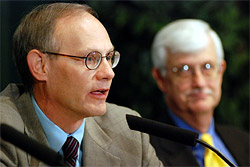
HERTZKE: In response to Winnifred’s comments about the impossibility of religious freedom and the perception around the world Elizabeth mentioned that we’re attempting to impose an American standard: The standard to which IRFA points is, in fact, Article 18 of the Universal Declaration on Human Rights. The UN declaration, passed in 1948, has been ratified by all countries except Saudi Arabia, which abstained because the declaration contains a statement about the freedom of people to practice their religion either individually or corporately and the right to change one’s religion. A crucial dimension to any stable, liberal, democratic society is the right to change one’s religion.
It will be necessary for Islamic intellectuals to develop a way of understanding the sharia such that anti-blasphemy laws, or laws against changing your religion, are not acceptable in an Islamic society. There are some American Muslim intellectuals attempting to work out a way of understanding sharia that is compatible with liberal, democratic norms.
QUESTIONER: I’m David Rabinowitz from Corvallis, Oregon. Anytime you talk about religious freedom, you have to define what a valid religion is. Throughout history, there have been religions that required human sacrifice. I assume IRFA is not going to defend something like that, but how about mutilation – female circumcision or, for that matter, male circumcision? Closer to home, there are several states prohibiting members of religious groups that practice faith healing from withholding modern medical care from their children, and there are several people in prison now for having done that. Is that something IRFA would support, or would IRFA consider that to be religious persecution? Who makes the determination?
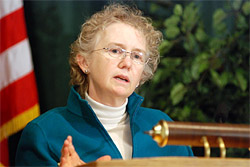
SULLIVAN: The ideas of religious freedom we have inherited came out of the Enlightenment, and they’re the result of the disestablishment of church bodies in Europe and the redistribution of responsibility for various public functions. One result of that legacy, which is particularly strong in the U.S., is the assumption that religion will produce morality and good citizenship. The rest of religion drops out of people’s consciousness: When they think of religious freedom, they think we might have our choice, but we’re all basically going to Sunday school to learn to be good citizens.
The role of religion throughout human history has been a very ambiguous, complicated thing, because religion has been a way of understanding ourselves in all our violence and complexity.
The more important example is those religious traditions in the world today that don’t believe in religious freedom. For us to say everyone has to agree conversion should be completely free is to impose our ideas. To say there should be separation of church and state and no religion in the constitution – those are also our ideas, not universal ideas of religious freedom.
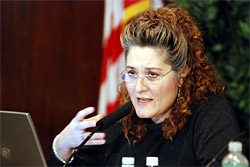
PRODROMOU: You get at the question of how we define religion when we find it in international covenants and how we distinguish among national differences. Even at the level of international treaties and covenants, there’s not categorical consensus about how to define what religion is, much less what religious freedom is. That’s a very serious practical problem.
You also raise the importance of recognizing that national, historical experiences condition the way religious freedom is legislated around the world. That makes it a far more complicated and challenging task, but it’s absolutely central, at least in terms of the IRFA legislation, to recognize the importance of national and historical particularity.
RABINOWITZ: Under IRFA, who makes the determination?
PRODROMOU: IRFA refers specifically to international treaties and covenants, so it refers to the international legislation.
QUESTIONER: I’m Roger Trigg of the Ian Ramsey Centre for Science and Religion in the University of Oxford. Sometimes American views are too influenced by the idea that religious freedom is linked to the separation of church and state. Coming from a country with an established church that values religious freedom very much, I don’t think the two are necessarily connected. The United States should be careful not to impose its own particular historical tradition on other countries whilst strongly and rightfully pursuing the goal of religious freedom.
HERTZKE: I agree. These issues were dealt with during the legislative battle; there was a concern that IRFA not be an Equal Employment Commission for the world and not get into fine tuning religious freedom issues. The language of “separation of church and state” is not in IRFA. Its language is drawn from Article 18 of the Universal Declaration on Human Rights and the UN covenants on human rights.
We can get bogged down in discussions of defining religion. What we’re really talking about are basic freedoms: the right to form a church; the right not to be arrested if you proclaim your faith openly; the right not to be tortured on behalf of your faith; the right to practice your faith with other people, to teach it to your children and so forth. These are essential human rights. They’re inherent, some of us would argue, to human dignity. Those are the standards that ultimately became the standards for IRFA.
PRODROMOU: There is justifiable concern about not, either implicitly or explicitly, using the First Amendment as a model for religious freedom. That’s an important caution, but it also risks keeping us focused on constitutions as the only way of evaluating religious freedom. We need a far more nuanced approach to understanding how religious freedom is either protected or violated, and there are some identifiable practices we can evaluate. First, how are policies implemented regarding majority and minority populations? Two, access to education and educational policy; three, judicial process, such as judicial interpretation that either protects or violates religious freedom; and, finally, the right to work, whether labor policy and or other formal or informal mechanisms discriminate against individuals for their religious beliefs and practices.
Constitutions and constitutional arrangements are central to the protection and evaluation of religious freedom, but these other spheres of activity give us a far richer understanding of the way religious freedom is promoted, protected, or violated.
FARR: I agree we should not export separationism. Professor Hertzke says separationism is not in the documents, but it’s also not in the American constitution. One problem is that many of our diplomats are strict separationists, and, as a result, are not terribly effective in discussing the issue of religion and state.
It’s a cultural matter of addressing religious communities where they are and trying to entice them to liberal norms based on the way they understand the world. That’s very different from strict separationism.

[Americans]
I’ll never forget the shock in the eyes of the Iraqi constitutional committee, which had voted to make no mention of religion or ideology in the constitution. After the Americans overruled them, they looked at us and said, “We thought that was the whole point.”
[In the final draft of the constitution, see Article 2.]
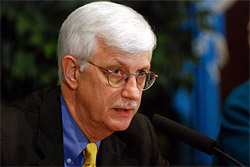
FARR: I think I’m safe in saying IRFA cannot solve the problem in Iraq. I’ve often asked myself what, if anything, American religious freedom policy could have contributed that it didn’t in Iraq.
You’re going in the same direction as the earlier questioner, suggesting that the problem in Iraq boils down to the constitution. The problem is not what the words of the constitution say. The problem is what Islam is. We’re not going to solve that problem with brilliant experts drafting constitutions for Iraq. Most of those we sent over – excellent people like Larry Diamond, Noah Feldman – are strict separationists: read their books. They don’t want to mix religion and state, and they may well be right, but that’s not a realistic way to attack the issue in a country with strong religious communities.
Just to add briefly, there’s a wonderful book I would recommend to you, which includes a chapter called “The Twin Tolerations” by Alfred Stepan. He says when you have a transition to democracy in a country with powerful religious communities, it’s not going to be a stable transition until the religious communities have an internal debate and doctrinal development – that’s a Catholic phrase – in which they accommodate themselves to what’s happening. They have to buy into it. This is where we need to apply more effort.
That answer doesn’t address the military problems in Iraq, which are very different.

[member]
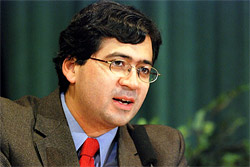
SHAH: I have my own question. Several of the members of the panel have suggested that religious freedom policy, if formulated correctly, should offer a way to advance American interests. How can or should religious freedom policy advance American national security?
PRODROMOU: The application of religious freedom is about far more than a constitution or something that looks good on paper. It’s about how religious freedom gets practiced in all the spheres where people live their lives. In countries undergoing regime transitions from authoritarian or non-democratic regimes to democratic regimes, it’s imperative to attend to issues like policing and the judiciary. These are the crucial spaces in which violation or protection of religious freedom occurs.
We need to focus on the long term. That’s easy to say, but we either have to have a long vision, or we accept that we have a finger-in-the-hole strategy and hope that when we move on, things don’t implode. There’s ample empirical evidence from around the world that short-term strategies promote neither religious freedom nor sustainable democracy.
[from religious freedom]
HERTZKE: Where the promotion of religious freedom was absolutely central to our strategic interest, and where we ignored it for too long, to our own peril, was Saudi Arabia. The Saudis funded radical Islamist schools around the world. They funded literature that promotes hatred of Jews and Christians. They provided the soil in which 15 of the 19 hijackers grew. For decades we have had an economic and strategic partnership that has looked the other way at the Saudis’ promotion of the radical Wahhabi or Salafi sect of Islam.
It wasn’t until the architecture created by the International Religious Freedom Act began to raise the issue of religious freedom in Saudi Arabia that we noticed how Saudi treats its own people is directly related to how it promotes a version of Islam around the world antithetical to the freedom for Shiites, Sufis and certain Sunnis. There’s an example of where the United States should’ve been much tougher and insisted that our relationship with the Saudi government will be dependent on what they teach as their version of Islam both internally and externally.
FARR: That’s an excellent example. Ambassador Hanford of the Office of Religious Freedom has negotiated an agreement with the Saudis on this very issue of using Saudi embassies around the world for exporting Wahhabist ideas.
But even if the Saudis do what they say they are going to do – and we’ll see – and stop spending one dime on the export of this stuff, the ideas will still be out there. Even if the Saudis’ support is dried up, the coercive effect of these Wahhabist theological ideas will still be operative. People will either be attracted to them, or they will reject them, based not so much on whether the Saudis are supporting them, but on whether they find them appealing as a religious obligation. We’ve got to attack that issue as well.
The most important thing the United States can do to undermine Islamist extremism is continue to try to seed stable self-government, and I believe that cannot exist without religious freedom broadly interpreted. Religious freedom is not simply the rights of individuals to do or not do certain things. It is the relationships between religious communities and their governments. If you don’t work those out, you cannot possibly have stable self-government. You can have elections without religious freedom. You can have constitutions with fine words without religious freedom. You can have courts and separations of powers, but if you do not, in countries with strong religious communities, have an accommodation worked out between those communities and the government, you can’t have stable democracy.
I mentioned Egypt. Saudi Arabia, one of these days, is going to be in the same boat. Pakistan is not always going to be ruled by a general that has gone back and forth between dictatorship and forms of democracy. Arguably, Pakistan is the most important Muslim country of all, because it has nuclear weapons now. If radicals take over that country, we have a very serious national security issue. What could possibly be more important than finding ways to influence the Muslim groups that are going to be running these countries? The Islamists, the people who believe that their country has got to reflect their religious obligations – we don’t even talk to them. We don’t know what they believe.
We’ve got to get feet first into the business of religion. Winnie says we don’t know what it is. This gentleman suggests we don’t know what religious freedom is. I’ll tell you what it is. It’s the search for ultimate meaning and transcendence – period. Move on. That’s what it is. We all engage in it. Some of us come out on one end. Some of us come out on another, but you don’t need a doctoral dissertation to say what religion is or what religious freedom is.
PRODROMOU: At the risk of prolonging things, I would add a cautionary note. There is a demonstrated tendency in our foreign policy to believe support for secularists is the equivalent of religious freedom, and there is ample evidence from around the world – Egypt, Turkey, et cetera – showing aggressive secularism has produced the worst kinds of violations of religious freedom. It contributes to a backlash in the form of religious extremism and cuts out the middle ground. It’s very important for our foreign policy to recognize secularism is not the equivalent of religious freedom. We know in the 20th century some of the worst excesses in human history were committed in the name of secularism.
QUESTIONER: Rosalind Hackett, University of Tennessee. I wanted to add the media to Elizabeth Prodromou’s list of critical areas where religious freedom is promoted or violated. At the American Academy of Religion conference, we’ve just had three or four panels on the Danish cartoon controversy. I wanted to report there was no clear agreement on how to treat this delicate, precarious relationship between freedom of religion and freedom of expression.
Another area that challenges our thinking about what is or isn’t a religion is the whole area of indigenous religions and indigenous cultures. Increasingly in our globally interconnected world, the fate of a people depends on how it can represent itself to the state. As a result, many indigenous cultures are adopting the language of international religious freedom. I’m happy to see there’s an increased sensitivity to that in the State Department reports.
[graduate student.]
HERTZKE: Your example of the Pope is an interesting one because, as a cardinal, Karol Wojtyla helped draft the famous document Dignitatus Humanae on the promotion of religious freedom. The Catholic embrace of religious freedom was articulated by an American religious leader, John Courtney Murray, and then Karol Wojtyla. That’s an example of where a religious community has transformed its own understanding of religious freedom. There are American Muslim leaders who are pointing to the Catholic Church as an example of a community that can change its mind about something as fundamental as religious freedom. They’re attempting to articulate a vision of how the Muslim community can do that as well.
FARR: That’s doctrinal development not a change of mind to us Catholics. (Laughter.) When Bob Seiple was the first ambassador-at-large for religious freedom, he went to the Vatican more than any other country in the world; he wanted to talk about China and Saudi Arabia. Ambassador Hanford went there on Dignitatus Humanae‘s 40th anniversary and gave a speech at the Vatican. So there are close ties.
But when Pope John Paul II gave his famous speech in Poland in 1979, the American embassy was caught off guard. They typically had very good relationships with the labor movement, and they understood what was going on, but they didn’t understand this religious aspect of the Solidarity movement. They couldn’t ignore it any longer when this old, Polish guy came by and two million people showed up for a mass; they had to say, “Wow, there’s something going on here.” We diplomats are not stupid. We just take a little time to figure out what’s going on.
SHAH: Please join me in warmly thanking our panel. (Applause)
This transcript has been edited for clarity, style and grammar by Andrea Useem.