
Overview
When Barack Obama is sworn in as America’s new president in January, he will inherit two wars in distant lands, one highly unpopular and the other going badly, along with a worldwide financial crisis that is being measured against the Great Depression. He will confront the prospect of destructive global climate change and the spread of nuclear weapons to rogue states.
The president-elect has indicated that he will focus on international cooperation in addressing global problems, but he will have to navigate a world that has grown highly critical of the United States.

The U.S. image abroad is suffering almost everywhere. Particularly in the most economically developed countries, people blame America for the financial crisis. Opposition to key elements of American foreign policy is widespread in Western Europe, and positive views of the U.S. have declined steeply among many of America’s longtime European allies. In Muslim nations, the wars in Afghanistan and particularly Iraq have driven negative ratings nearly off the charts. The United States earns positive ratings in several Asian and Latin American nations, but usually by declining margins. And while the most recent Pew Global Attitudes survey finds that favorable views of America edged up in 2008, only in sub-Saharan Africa does America score uniformly favorable marks.
America’s image gap is the central, unmistakable finding from surveys conducted over the course of this decade by the Pew Research Center’s Pew Global Attitudes Project. Since 2002, interviewers have polled over 175,000 people in 54 nations and the Palestinian territories to compare and contrast public opinion around the world on a large variety of subjects. These years coincide almost exactly with the presidency of George W. Bush, thus making it possible to assess his impact on matters of concern not just to the United States but to the world. Some of the other major findings include:
 Numerous tensions exist between Muslim and Western publics on values, policies, world events, and perceptions of one another. For instance, a 2006 Pew Global Attitudes survey highlighted the extent to which Muslims saw the controversy surrounding cartoons published by a Danish newspaper portraying the prophet Muhammad as an example of Western disrespect for Islam, while Westerners blamed intolerance among Muslims.
- Despite some rough edges, globalization has enjoyed widespread popularity during the Bush years. Surveys have found worldwide support for increased commerce across national borders. Still, enthusiasm is waning in Western Europe and the United States as rich countries become aware of accompanying dislocations. And many foreigners, even as they devour American movies and music, fear the crowding out of their own cultures.
- The rise of China has generated serious concerns in many countries. China’s favorability ratings have fallen since 2002, particularly in Europe and its biggest neighbors – India, Japan, and Russia. China is already widely regarded as one of the world’s top economic powers and is seen by many as likely to replace the United States as the world’s dominant power.
- The world’s agenda is evolving but not transforming. A 2007 survey found that global publics were increasingly concerned about the growing gap between the world’s rich and poor. Concern about pollution had also increased. At the family level, people consistently named financial concerns as the most important problem in their own lives, but they did not want to see economic growth come at the expense of the environment.
America’s Image Gap
 Mounting discontent with U.S. foreign policy over the last eight years has translated into a concern about American power. In the view of much of the world, the United States has played the role of bully in the school yard, throwing its weight around with little regard for others’ interests.
America won a measure of global sympathy after the terrorist attacks of Sept. 11, 2001, but the inaugural Pew Global Attitudes survey showed that by spring 2002 favorability ratings for the U.S. had already dropped in many countries since the start of the decade. Surveys conducted after the U.S.-led invasion of Iraq in 2003 found further declines. Positive views of the United States declined in 26 of the 33 countries where the question was posed in both 2002 and 2007.
Respondents to the 2006 survey in 13 of 15 countries found the American presence in Iraq to be an equal or greater danger to stability in the Middle East than the regime of Iranian President Mahmoud Ahmadinejad, while 11 judged it a threat to Middle East stability greater than or equal to the Israeli-Palestinian conflict.
And while the U.S.-led war on terrorism initially drew strong support among U.S. allies in Europe, in recent years world attitudes toward America’s military operations in Afghanistan have turned increasingly negative. Now in recent surveys, majorities in nearly all countries think it’s time for America to withdraw from both Iraq and Afghanistan.
Westerners and Muslims: A Complex Relationship
 The project has documented considerable tensions between Westerners and Muslims, finding that fundamentally different views of world events are feeding these tensions.
Not surprisingly, American and Muslim opinions diverge on the wars in Iraq and Afghanistan. In a 2006 survey, 51% of Americans said the ouster of Iraqi President Saddam Hussein made the world a safer place. In the five Muslim nations surveyed, support for this view ranged from 8% to 16%.
Less expectedly, the 2006 survey found that a majority of Indonesians, Jordanians, Turks and Egyptians remained unconvinced that Arabs were responsible for the Sept. 11 terrorist attacks in New York and Washington.
The furor in Islamic countries over the publication in Denmark of cartoons that depicted the prophet Muhammad revealed a similar divergence in perspective. Respondents to the 2006 survey in four Muslim countries blamed Western disrespect for Islam. But in five Western nations, majorities attributed the controversy to Muslim intolerance of points of view other than their own.
Muslims Look at the West
Many Muslims have an aggrieved view of the West. Majorities in many Muslim nations – and in some Western European ones, for that matter – believe America’s war on terrorism is really an effort to control Mideast oil or to dominate the world. In the 2004 Pew Global Attitudes survey, more than half of Jordanians and Pakistanis, as well as 40% or more of French and Germans – said that the war on terrorism was a smokescreen for a campaign against unfriendly Muslim governments.
Many of those surveyed in predominantly Muslim nations in 2006 expressed ill will toward the United States and other Western countries, frequently ascribing to them such traits as “violent” and “selfish.” In the 2007 survey, in nine of the 47 countries polled, fewer than 30% of respondents rated America favorably. With the exception of Argentina, all were predominantly Muslim.
Middle Eastern countries widely see a U.S. policy tilt toward Israel in its dispute with the Palestinians. Of Egyptians surveyed in 2007, 86% held this view, against none who thought America favored the Palestinians. Even among Israelis, a 42% plurality believed U.S. policy favors their country too much.
Westerners Evaluate Muslims
By and large, non-Muslims express somewhat less negative views of Muslims than vice versa. Majorities in four of the six Western countries in the 2006 survey voiced a favorable attitude toward Muslims. Yet many in the non-Muslim world have doubts about Muslim values. Large majorities in such countries as Spain, Russia, India and Nigeria consider them fanatical and violent as do smaller majorities or pluralities in other non-Muslim countries.
Given a list of five positive characteristics and six negative ones, non-Muslims in the 2006 survey were just slightly more likely to apply the positive traits than the negative ones to Muslims. Muslims, in contrast, associated Westerners with negative characteristics more frequently than with positive ones. Respondents in six Muslim nations most often called Westerners violent (followed by selfish). In six Western nations, Muslims were most commonly seen as devout (followed by fanatical).
Non-Muslim Europeans are particularly likely to regard Muslims as not respectful of women; prevalence of the belief that women are treated badly in Muslim nations ranged from 59% in Britain to 83% in Spain. But strong majorities of Muslims living in three of four European nations surveyed in 2006 said Westerners are respectful of women.
Non-Muslims in Western countries believe Muslims face a conflict between being devout and living in a modern, prosperous society. Muslims – notably those living in Western Europe – disagree.
Who’s to Blame?
Muslims and Westerners agree that they often disagree. But they part company on which side is responsible. Each tends to blame the other. In all five predominantly Muslim countries in the 2006 survey, majorities of those who felt relations were bad fingered the West. In Egypt, a mere 1% said Muslims were responsible.
The six Western nations were more divided in their opinions. Pluralities – but not majorities – in four of the six said Muslims were mostly to blame. In Britain, respondents by a small margin cited Westerners. In Spain, a plurality volunteered that both were to blame.
Both Muslims and Westerners agree that Muslim nations should be doing better economically. But that’s where agreement on this question ends, even within the two groups. In Egypt and Jordan, majorities blamed U.S. and Western policies. Majorities of Pakistanis and Turks pointed to a lack of education, and Indonesians to government corruption.
In the West, U.S. and Western policies ranked at or near the bottom of a list of five choices to explain poverty in Muslim countries. Government corruption was cited most often, followed by lack of education.
Some Light at the End of the Tunnel?
 Amid all the mistrust and recriminations, the Pew surveys turned up a number of positive trends in Muslim public opinion, most notably a sharp decline in support for suicide bombing. The share of Muslims who found suicide bombing as a justified means of defending Islam fell throughout the period from 2002 to 2008. In Lebanon, 74% of Muslims considered suicide bombing as justified in 2002, but that percentage tumbled to 32% in 2008. Pakistani support for suicide bombing plunged from 33% to 5%.
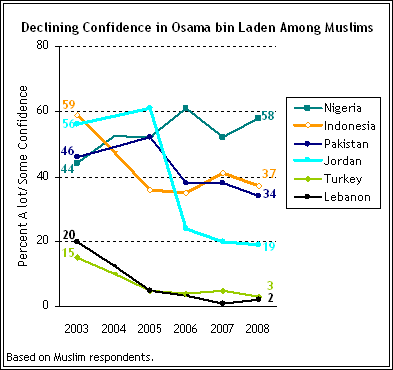
While al Qaeda leader Osama bin Laden inspired substantial confidence in a few predominately Muslim countries in 2003, his popularity has plummeted in recent years. Confidence among Jordanian Muslims has dropped from 56% in 2003 to 19% in 2008; a mere 2% of Muslims in Lebanon and 3% in Turkey said in 2008 that they were confident bin Laden would do the right thing in world affairs.
 Finally, citizens of predominantly Muslim nations express positive views of democracy, as do those of other developing countries. In the 2006 survey, majorities or pluralities in five Muslim countries said democracy was not appropriate just for the West but could work for them as well. Included were some of America’s toughest critics, such as Egypt, Jordan, and Pakistan.
For their part, Westerners are divided over whether Muslim countries are ready for democracy. In the 2006 survey, about half of Americans (49%) agreed with majorities in Britain and France that democracy would work well in most Muslim countries. Majorities in Germany and Spain said it would not.
Financial Crisis in a Global Economy
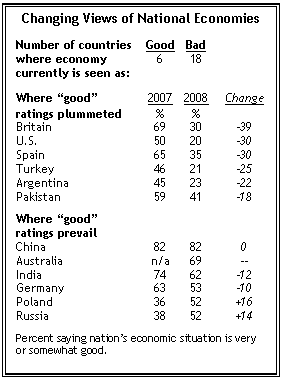 As the world’s No. 1 economic as well as military power, the United States is taking a hefty share of the blame for the financial crisis that engulfed most of the world in 2008.
Even before the crisis had fully blossomed, only in six of the 24 countries included in the spring 2008 Pew Global Attitudes survey did participants describe their national economies as “very good” or “somewhat good.” These included three nations in Asia and the South Pacific (Australia, China, and India) and three in Europe (Germany, Poland, and Russia). Majorities in only five countries – China (with a whopping 85%), India, Pakistan, Brazil and Nigeria – saw better times as likely in the next 12 months.
And at a time of global economic gloom, the survey found overwhelming agreement that the United States exerted “a great deal” or a “fair amount” of influence on other national economies. In most countries, vast majorities (95% in Japan, 94% in South Korea, 91% in Australia, 90% in Britain and Germany) subscribed to this view. The outliers were China and Pakistan, but even there, 46% and 41%, respectively, saw a substantial American influence.
Those who saw a substantial economic impact were asked whether it was positive or negative. Majorities or pluralities in 18 of the 23 countries said the influence was negative, sometimes by large majorities (72% in both Britain and Germany). In no country did a majority say that U.S. economic influence was positive.
Enthusiasm for Globalization…
 The United States, long a champion of closer commercial links among countries, is seeing much of the world not only sharing its enthusiasm but exceeding it. In fact, of the 24 nations surveyed in 2008, Americans were dead last in calling the growing multi-national trade and business ties either “very good” or “somewhat good.” A 53% majority of Americans gave thumbs up to international commerce, but that support paled in comparison with the 91% of Nigerians and 90% of Indians at the top of the list.
In general, the Asian nations that have been running huge trade surpluses thought international commerce was just fine. Majorities of 88% in South Korea and 87% in China approved of growing trade and business ties across borders.
Many industrial countries, which have been receiving new international competition from developing economies such as China’s and India’s, have found the global economy to be losing its luster. American support for trade has fallen from 78% in 2002 to just 53% in 2008; Britain, France, and Germany have also recorded declining levels of support over this period.
…But Concerns Too
The ability of people to cross national borders in search of jobs is a central component of globalization, but a controversial one. The United States is not the only country struggling to limit immigration; majorities in 44 of the 46 other countries surveyed in 2007 wanted more restrictions. The two exceptions were South Korea (25%) and Japan (47%), where barriers to foreigners were already high.
Three Americans in four favored making immigration more difficult. Majorities in Western European countries, magnets for immigrants from Eastern Europe, North Africa, and elsewhere, strongly agreed. In Italy, whose economy has been particularly lethargic in recent years, fully 87% of respondents called for stricter immigration controls.
 Other aspects of globalization are also controversial. In many countries, the public worries about the widening gap between the world’s rich and poor. In 11 of the 35 countries where trend data are available, a significantly larger share of the public rated the rich-poor divide as a top danger to the world in the 2007 survey.
Many also worry about the environmental consequences of the economic growth associated with globalization. In every one of the 47 countries surveyed in 2007, with the sole exception of Indonesia, majorities of respondents agreed that “protecting the environment should be given priority, even if it causes slower economic growth and some loss of jobs.”
 Finally, many countries, while fans of American popular culture, express concern about a tidal wave of U.S. music, television shows and movies. Of the 46 foreign nations surveyed in 2007, majorities or pluralities in only six – Japan, Israel and four African countries – said it was good that American ideas and customs were spreading there. Opinion on the other side was vehement: French and Germans found the spread of American culture unwelcome by a margin of more than 4 to 1, and only 4% of Turks and Pakistanis applauded the trend.
World Leaders
President George W. Bush’s popularity in the United States has sunk to the level of Richard Nixon’s just before he resigned from office. The president’s standing abroad is still worse.
In 2008, the Pew Global Attitudes Project asked citizens of 24 countries whether they could count on Bush to do the right thing regarding foreign affairs. Majorities in only three (India, Nigeria, and Tanzania) said they had a lot or some confidence.
On the other side of the ledger, majorities in 19 of the 24 countries had little or no confidence in the American president. In the four Western European countries surveyed, majorities without much confidence ranged from 81% in Britain to 88% in Spain. In the Middle East, majorities rose as high as 89% in Turkey and Jordan. Since 2003, confidence in Bush has fallen in eight of the 14 foreign countries where trend data are available. In the remaining six countries confidence has remained relatively low.
The 2008 survey also asked opinions of four other world leaders: Russian Prime Minister Vladimir Putin, German Chancellor Angela Merkel, French President Nicolas Sarkozy and, in only seven predominately Muslim countries, Iranian President Mahmoud Ahmadinejad. In four of the countries – India and the survey’s three sub-Saharan African countries, Nigeria, South Africa, and Tanzania – Bush received the highest confidence rating. Ahmadinejad won the highest approval ratings in three countries, Turkey, Pakistan, and Indonesia; Putin prevailed in two: his own and China. Respondents expressed confidence most frequently in Merkel, while Sarkozy was a close second.
Here Comes China
China has come a long way since Mao Zedong’s Cultural Revolution left hundreds of thousands dead and many more displaced in the 1960s and 1970s. In the intervening years, China has used a unique blend of free markets and authoritarianism to attract both admiration for and fear of its military and economic prowess. In the view of much of the world, America will not be the world’s only superpower for long; if it’s not doing so already, China will soon be knocking on the door. The 24-nation survey in 2008 asked publics whether China would replace – or had already replaced – the United States as the world’s leading superpower. Majorities in seven countries and pluralities in six more answered yes.
As for Americans, 54% said China would never supplant the United States. But it was Japan, China’s longtime rival and sometime enemy, that supplied the largest margin against China’s ultimately prevailing. Two-thirds of Japanese said it would never happen.
The 24 nations split virtually evenly between America and China in favorability ratings. Both China and the U.S. scored favorable ratings among a majority in seven nations, but the composition of the groups favoring each differed. However, while America’s overall image improved slightly among the 21 countries surveyed in both 2007 and 2008, China’s grew more negative.
Contentment at Home
China’s own people seem to have accepted and even embraced the transformation from socialism to capitalism, although nearly six-in-ten (59%) worry that their traditional way of life is disappearing.
An extraordinary 86% of Chinese said in 2008 that they were satisfied with the way things were going in their country, the highest of the 24 countries in the survey. Australia was a distant second, 25 percentage points behind.
 The Chinese are in the middle of the global pack, however, when it comes to rating their own lives. Of the 47 countries in the 2007 survey, China ranked 29th in satisfaction with family life, 32nd in household income and 34th in happiness on the job.
Economic issues lead the list of problems the Chinese identify. Specifically, they are most worried about inflation, followed by the gap between the rich and the poor.
Addressing China’s pollution problems, which attracted much international attention during the 2008 summer Olympics in Beijing, ranks high in importance to the Chinese people. Four Chinese in five believe protecting the environment should be a priority even if it means less economic growth.
China in the World
 The Chinese people tend to believe their country is admired around the world, but in reality many people in other countries voice serious concerns about China. More than three-quarters of the Chinese surveyed in 2008 said their country was generally liked abroad. In fact, in only seven of the 23 other countries in the survey did majorities express a favorable view of China, and the trend since 2005, especially in Europe, has been toward the unfavorable. Less than a third of respondents in Germany, France or Spain, and less than half in Britain, now express a favorable view of China.
Both China’s economic and military power have alarmed countries around the world. In 25 of the 46 countries other than China surveyed in 2007, majorities said China’s economic prowess was a good thing. On balance, however, publics in the United States and most of Europe found China’s growing economic might worrisome. Japan viewed it as “good” in 2007 but flipped to “bad” the following year.
No such ambivalence emerged on the military side. Of the 23 countries other than China surveyed in 2008, only in Pakistan, Nigeria, and Tanzania did majorities find China’s growing military power to be good. In neighboring Japan and South Korea, support for the rosy view of China’s military prowess was measured in the single digits.
China also gets bad marks for its environmental policies – although not as bad as America’s. In the eyes of the world, America and China rank Nos. 1 and 2 in contributing to the world’s environmental problems, with 16 of the 24 countries surveyed in 2008 naming the United States and seven naming China. (In India, an equal share of respondents picked each.)
Satisfaction With Life, But Not Without Worries
More people around the world say they are getting increased satisfaction from life than say they are growing less satisfied. Respondents in the 47 countries of the 2007 survey were asked if they thought their lives had gotten better or worse in the last five years. In 32 countries, the more common answer was “better.”
Latin America was generally upbeat. In Europe, only Italy and Bulgaria were not. China had the most favorable result: 62% of respondents said their lives had improved, and only 18% said they had grown worse. (The sample in China was disproportionately urban.) The most negative country was strife-torn Lebanon, where 58% said their lives had worsened and only 19% said they had become better.
The Pew Global Attitudes survey also asked people in 2007 to rate satisfaction with their current lives on a scale from 0 to 10. In 20 of the 35 countries for which comparable results were available from 2002, the share of people who gave themselves a satisfaction rating of seven or higher rose significantly; only in five countries did this category shrink. Americans and French held even.
Personal contentment tended to rise the most in countries whose economies were expanding most rapidly. Satisfaction rose significantly in five of the six Eastern European countries and all six in Latin America. Among the 35 nations, Brazil recorded the largest gains, advancing from 43% highly satisfied in 2002 to 63% in 2007.
Problems at Home…
 Increasing satisfaction does not mean that people no longer identify problems. As in nine of the other 46 countries surveyed in 2007, Americans put illegal drugs at the top of their list of problems. Just over three Americans in five said illegal drugs were a “very big problem.”
In 11 countries, crime earned the same dubious honor. Also prominent were the problems of corrupt leaders (at the top of eight countries’ lists), pollution and HIV/AIDS and other diseases (seven each) and terrorism (six). However, AIDS and other diseases, a major concern in Latin America and Asia in 2002, lost relative prominence, and in 2007 were the most frequently mentioned problem in only seven African nations.
…and World-Scale
Assessments of the greatest dangers to the world have shifted in recent years. The gap between rich and poor countries appeared more menacing in 2007 than in 2002, as did pollution and other environmental problems. In 2002, AIDS was selected by 17 countries, while the gap between rich and poor was the choice of five countries and pollution of only four.
 In 2007, in contrast, the five had become closely bunched. The growing gap between rich and poor was rated the greatest danger (or tied for greatest) in 12 countries. AIDS led the list (or tied) in 16 countries, religious and ethnic hatred in 12, and the spread of nuclear weapons in nine. Pollution was chosen as the greatest menace or tied for that position in 19 countries while substantial majorities in 25 of 37 countries deemed global warming a “very serious” problem.
Don’t Count America Out Yet
 The news from the Pew Global Attitudes Project is not relentlessly negative for America. For many people from all over the world, America is still the land of opportunity. Majorities or pluralities in 34 of the 46 foreign countries that took part in the 2007 survey said people who have emigrated to America have found better lives.
America beckons even in countries where majorities hold the United States in disfavor. Only 15% of Moroccans viewed America positively in the 2007 survey. But 52% thought that their fellow Moroccans who had moved across the Atlantic had improved their lives.
Most countries surveyed in 2008 give America high marks for its respect for the personal freedoms of its people. Admiration for U.S. science and technology remains nearly universal, and despite resistance to the spread of U.S. ideas and customs in many parts of the world, the appetite for American movies, music and television shows remained strong in the 2007 poll. Also, the American people continue to evoke far more positive reviews in many countries than does their country.
Most important for America’s newly elected president, the 2008 survey found signs in many countries that people are optimistic about the future course of America’s approach to the larger world. Obama himself drew the most favorable response of the major contenders for the U.S. presidency at the time of the survey (Obama and Sens. Hillary Clinton and John McCain), with confidence in his leadership especially strong among U.S. allies in Western Europe and the Asia/Pacific region. And majorities or pluralities in most countries thought that a new president would change the country’s foreign policy for the better.
About the Pew Global Attitudes Project
The Pew Research Center’s Pew Global Attitudes Project is a series of worldwide public opinion surveys encompassing a broad array of subjects ranging from people’s assessments of their own lives to their views about the current state of the world and important issues of the day. The project is directed by Andrew Kohut, president of the Pew Research Center, a nonpartisan “fact tank” in Washington, DC, that provides information on the issues, attitudes, and trends shaping America and the world. The Pew Global Attitudes Project is principally funded by The Pew Charitable Trusts.
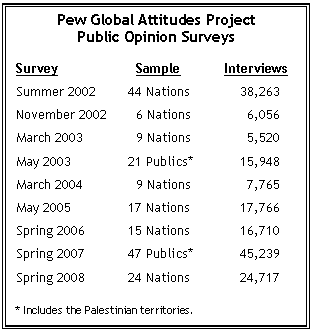 Since its inception in 2001, the Pew Global Attitudes Project has released 22 major reports, as well as numerous commentaries and other releases, on topics including attitudes toward the U.S. and American foreign policy, globalization, terrorism, and democratization.
Findings from the project are also analyzed in America Against the World: How We Are Different and Why We Are Disliked by Andrew Kohut and Bruce Stokes, international economics columnist at the National Journal. A paperback edition of the book was released in May 2007.
Pew Global Attitudes Project team members include Bruce Stokes; Mary McIntosh, president of Princeton Survey Research Associates International; and Wendy Sherman, principal at The Albright Group LLC. Contributors to the Pew Global Attitudes Project include Richard Wike, Erin Carriere-Kretschmer, Kathleen Holzwart, Jodie T. Allen, Juliana Menasce Horowitz, Elizabeth Mueller Gross, Carroll Doherty, Michael Dimock, and others of the Pew Research Center. This report benefited greatly from the work of Joel Havemann, former editor and reporter at the Los Angeles Times, who served as primary author of the essay.
The International Herald Tribune is the project’s international newspaper partner. The Pew Global Attitudes Project team regularly consults with survey and policy experts, regional and academic experts, journalists, and policymakers whose expertise provides tremendous guidance in shaping the surveys.
The Pew Global Attitudes Project’s co-chairs are on leave through 2008. The project is co-chaired by former U.S. Secretary of State Madeleine K. Albright, currently principal, the Albright Group LLC, and by former Senator John C. Danforth, currently partner, Bryan Cave LLP.
All of the project’s reports and commentaries are available at www.pewresearch.org/pewresearch-org/global. The data are also made available on our website within two years of publication.


