Summary of Findings

Muslims in Europe worry about their future, but their concern is more economic than religious or cultural. And while there are some signs of tension between Europe’s majority populations and its Muslim minorities, Muslims there do not generally believe that most Europeans are hostile toward people of their faith. Still, over a third of Muslims in France and one-in-four in Spain say they have had a bad experience as a result of their religion or ethnicity.
However, there is little evidence of a widespread backlash against Muslim immigrants among the general publics in Great Britain, France, Germany, and Spain. Majorities continue to express concerns about rising Islamic identity and extremism, but those worries have not intensified in most of the countries surveyed over the past 12 months; a turbulent period that included the London subway bombings, the French riots, and the Danish cartoon controversy.

Opinions held by Muslims in Europe – as well as opinions about Muslims among Europe’s majority populations – vary significantly by country. No clear European point of view emerges with regard to the Muslim experience, either among Muslims or in the majority populations on many issues.
Most notably, France shows no signs of a backlash in response to last year’s riots. In fact, a counter trend seems to have emerged with slightly more French people saying that immigration from the Middle East and North Africa is a good thing than did so a year ago. The French public is also more inclined this year to say that Muslims living in France want to adopt French customs – a view held by an overwhelming majority of Muslims in France. Nor do German and British publics express any increase in negative views of immigrants – although, unlike the French, they are not more positive toward immigrants this year. Meanwhile, the Spanish public’s view toward immigrants has grown slightly more negative over the last year.

But in Britain worries about Islamic extremism are intense among both the general public and the Muslim minority population as well. Concerns about the problem rose markedly this year among the general public. And worries about extremism within the British Muslim community are greater than in France, Germany, and Spain.
The survey by the Pew Global Attitudes Project was conducted in 13 countries, including the United States, from March 31-May 14, 2006.1 It includes special oversamples of Muslim minorities living in Great Britain, France, Germany, and Spain.
The poll finds that Muslims themselves are generally positive about conditions in their host nation. In fact, they are more positive than the general publics in all four European countries about the way things are going in their countries. However, many Muslims, especially in Britain, worry about the future of Muslims in their country.
The greatest concern among Muslim minorities in all four countries is unemployment. Islamic extremism emerges as the number-two worry generally, a concern shared by Western publics as well as Muslims in Egypt, Jordan, and Pakistan.

The decline in the importance of religion, adoption of modern roles by women, and influences of popular culture upon youth are generally lower-ranked concerns. Overall, British Muslims express the greatest level of concern about the issues tested.
The majority of European Muslims do not see many or most Europeans as hostile towards Muslims. But substantial numbers of Muslims do perceive such hostility. This belief is most widespread in Germany, where more than half of both Muslims and the general public see many or most Germans as hostile toward Muslims. At the same time, however, German Muslims are the least likely to report personal experiences with discrimination.
German Muslims are also far more inclined than those elsewhere in Europe to see new immigrants as wanting to be distinct – 52% take this view – and German nationals overwhelmingly (76%) share this view. In contrast, in France, 78% of Muslims say that Muslims there want to adopt French customs, though 53% of the general public feels that French Muslims want to remain distinct.

European Muslims show signs of favoring a moderate version of Islam. With the exception of Spanish Muslims, they tend to see a struggle being waged between moderates and Islamic fundamentalists. Among those who see an ongoing conflict, substantial majorities in all four countries say they generally side with the moderates.
Most French and British Muslims think women are better off in their countries than in most Muslim countries. About half of German and Spanish Muslims agree, and very few think women actually have it better in most Muslim countries. Moreover, most are not concerned about Muslim women in Europe taking on modern roles in society (although substantial minorities worry about this).
Religion is central to the identity of European Muslims. With the exception of Muslims in France, they tend to identify themselves primarily as Muslim rather than as British, Spanish, or German. In France, Muslims are split almost evenly on this question. The level of Muslim identification in Britain, Spain, and Germany is similar to that in Pakistan, Nigeria, and Jordan, and even higher than levels in Egypt, Turkey, and Indonesia. By contrast the general populations in Western Europe are far more secular in outlook. Roughly six-in-ten in Spain, Germany, and Britain identify primarily with their country rather than their religion, as do more than eight-in-ten in France.
Americans, however, split about evenly on this question: 42% say they first think of themselves as Christians versus 48% who think of themselves primarily as Americans – a divide close to that found among French Muslims.

Muslims in Europe are most sharply distinguished from the majority populations on opinions about external issues – America, the war on terrorism, Iran, the Middle East.2 European Muslims give the United States lower favorability ratings than do general publics in Europe, and in particular, they give the American people lower ratings. The war on terror is extremely unpopular among minority Muslim populations – German Muslims register the highest level of support, at 31%.
While Iran is viewed unfavorably in Western Europe and the United States, it receives very positive marks from British and Spanish Muslims, while French and German Muslims are divided. European Muslims take a much more positive view of the Hamas victory in the Palestinian elections in January than do the majority populations, and perhaps not surprisingly, they are also much more likely to side with Palestinians in the Israeli-Palestinian conflict. In general, European Muslim opinions on external issues are quite similar to those expressed in predominantly Muslim countries.
About This Report
The report’s detailed findings are presented below. A description of the Pew Global Attitudes Project can be found at the end of the report, along with a summary of the survey’s methodology and complete topline results.
Little Anti-Muslim Backlash

Despite concerns about an anti-Muslim backlash in the wake of a string of highly publicized events involving Muslims living in Europe – subway bombings in London, controversy over Danish cartoons depicting Muhammad, rioting by Muslim youth in France – most Muslims living in Europe do not feel that most or even many Europeans are hostile toward people of their faith. Indeed, European Muslims are, in general, more satisfied with national conditions than are the general publics of these countries.
Substantial majorities of Muslims living in the European countries surveyed say that in the last two years they have not had any personally bad experience attributable to their race, ethnicity or religion. In France, however, where riots last fall pitted Muslim youth against French police, 37% of Muslims report a bad encounter, while in Britain 28% report being the target of discrimination.
Muslims in Spain are the least concerned about European anti-Muslim sentiment – fewer than a third (31%) say most or many Europeans have hostile attitudes compared with 64% who see only some or very few as hostile. In Great Britain, 42% of Muslims judge that many or most of their European hosts are unfriendly, while in France, 39% of resident Muslims share that view. Only in Germany does a narrow 51%-majority of resident Muslims view most (22%) or many (29%) Europeans as hostile.
In some of the European host countries surveyed, the general public agrees precisely with these assessments. In Great Britain, 40% of the public sees most or many of their fellow countrymen as hostile to Muslims compared with 42% of British Muslims taking that view; in Germany, 63% of the larger public agrees with the 51% of Muslims who see most or many of their hosts as hostile. But in France a considerably larger number among the public (56%) see substantial hostility toward Muslims than do Muslims themselves (39%). And in Spain, nearly twice as many in the overall population (60%) see most or many Europeans as hostile to Muslims as do Spanish Muslim, only 31% of whom share that view.
One of the biggest perception gaps exists in Nigeria. There 28% of Christians say most or many Europeans are hostile toward Muslims, compared with 50% of Nigerian Muslims who believe this. Muslims in the Mideast and Asia judge European hostility to be considerably more widespread than do European Muslims. As many as 63% in Egypt, 61% in Pakistan, 57% in Turkey and 50% in Jordan say that most or many Europeans are hostile to Muslims.
Immigrants Mostly Still Welcome
The poll finds little evidence of a general rise in anti-immigration sentiment. With the continuing exception of Germany, majorities in the European countries surveyed say it is a “good thing” that people from the Middle East and North Africa came to work in their countries.

These levels of acceptance are essentially unchanged from those recorded a year earlier. However, in France a somewhat greater percentage now call such immigration a good thing, while in Spain a somewhat smaller percentage say it is good.
Germany is the outlier in this regard with only 34% of Germans calling immigration from the Middle East and North Africa a good thing compared with 59% who deem it a bad thing. However, Germans are no more welcoming to those migrating from Eastern Europe; only 36% call such immigration a good thing.
Across the board, immigrants from Eastern Europe are no more and no less welcome than those from predominantly Muslim countries. In Great Britain, Spain, and France, as in Germany, the numbers among the general public calling immigration from Eastern Europe a good thing are virtually identical to those expressing approval of immigrants from the Middle East and North Africa.
More European Muslims approve of immigration from the Middle East and North Africa into the country where they now reside than do the general populations of those countries. Among Muslims in Great Britain, fully 75% call such immigration a good thing; in France, 83% and in Spain, 85%. Germany again is the exception, with Muslims there splitting 42%-46% on the good-bad question, although the 42% of Muslim approvers is still significantly higher than the 34% of the general public that agrees with that judgment.
Concerns About the Future
Although most European Muslims are satisfied with the general direction of the countries they live in, large majorities are still concerned about the future of Muslims in their country. British Muslims are the most concerned – eight-in-ten (80%) are at least somewhat concerned including about half (49%) who are very concerned. French Muslims follow closely behind in their anxiety, with 72% saying they are either very (38%) or somewhat (34%) concerned. The numbers of Muslims very concerned about the future are somewhat lower in Germany (28%) and Spain (30%) although substantial majorities in both countries say they are at least somewhat worried as they look ahead.

Of the issues tested in the survey, unemployment is the biggest concern of European Muslims, with majorities in the mid-50% range in France, Germany and Spain and a 46%-plurality in Britain saying they are very worried about joblessness. In addition, between a quarter and a third of the remaining Muslim samples express at least some concern on this issue.
Muslims in Britain emerge as the most worried on every other issue tested, with 45% very worried about the decline of the importance of religion among their co-religionists, 44% very concerned about the influence of the secular culture (movies, music and television) on their youth, and, to a lesser but still leading degree, the adoption of modern roles in society by Muslim women (22% very concerned). Elsewhere in Europe these issues – especially the emergence of women – engender intense concern among relatively few Muslims.

In fact, not only is the entry of women into modern roles of little or no concern to most European Muslims, it is apparently welcomed by many. About six-in-ten British and French Muslims, and about half of German and Spanish Muslims, believe the quality of life is better for women in their countries than in most Muslim countries. In all four countries, the share of Muslims saying women in their countries are worse off is less than 20%. Muslim women in Europe are slightly more likely than men to see the quality of life as better for women in their country than in most Muslim countries. However, in Spain Muslim women were considerably more likely than men to believe this.
Extremism among European Muslims is a common source of worry among Muslim minorities in Europe. In particular, Muslims in Great Britain are very concerned. As many express concerns about this (44%) as are very worried about unemployment. Extremism is of somewhat less concern in France (30% very worried), Germany (23%) and Spain (22%), although in all these countries more than four-in-ten Muslims say they are at least somewhat concerned.
Blending In

Most Europeans doubt that Muslims coming into their countries want to adopt their national customs and way of life. Substantial majorities in Germany (76%), Great Britain (64%), Spain (67%) and Russia (69%) say that Muslims in their country want to remain distinct from the larger society.
Fewer French, but still a 53%-majority, agree. However, the percentage of the general public in France that believes newly arrived Muslims want to blend into the French way of life has increased significantly since last year. In the 2005 survey only 36% of the French public said that Muslims want to adopt the French way of life while 59% said they want to remain distinct; now 46% say adopt, 53% say remain distinct.
For their part, Muslims in France, Great Britain, and Spain are substantially more likely than their general publics to say that Muslims want to adopt the customs and way of life of the country into which they immigrate. Indeed, nearly eight-in-ten French Muslims (78%) believe this.
Again, Germany is different: Only 30% of German Muslims think Muslims coming into that country today want to assimilate – most say they want to be separate and most Germans agree.

Islamic Identification
Perceptions of the strength of Islamic identity among Muslims have changed little over the year. Substantial majorities in both Western Europe and the United States continue to believe Muslims in their country have a very or fairly strong sense of Islamic identity.
European Muslims’ perceptions largely match those of the general public, with the exception of Germany. While 84% of the German public sees Muslims having a strong Islamic identity, only 46% of Muslims living in Germany agree.
As to whether that sense of Islamic identity is increasing, strong majorities among the general publics in Great Britain (69%), France (68%), and Germany (72% – up from 66% in 2005) say that it is (as do 69% in India and 56% in Russia). In Spain, however, only a 46%-plurality sees an intensifying Islamic identity – a view shared by Muslims in that country.
Muslims in Great Britain, however, are the most likely of all groups sampled to see a strengthening of Islamic identity with fully 77% agreeing.
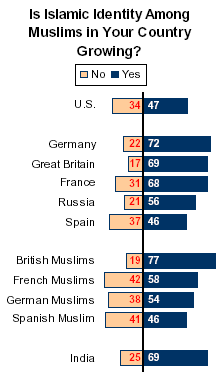
In France and Germany, by contrast, the proportion of Muslims who see Islamic identity intensifying (58% and 54%, respectively) is smaller than among the general public.
European Muslims who think Islamic identity is growing tend to consider it a good thing. This is especially so in Great Britain, where 86% say the perceived intensifying trend is a good thing, and Spain where 75% agree.
Most Westerners (as well as Indians) strongly disagree. Among those in the French general public who see Islamic identity on the rise, 87% call it a bad thing; in Germany, 83% say so; in Spain (82%); in India, 78%.
For those in the United States, Western Europe, Russia and India who see growing Islamic identity as a bad thing, the primary concern cited is that it may lead to violence. However, many are also worried that it may keep Muslims from integrating into the larger society. For Muslims in Germany who see growing Islamic identity as worrisome, concern about retarding integration is paramount for 58%, while fewer than one-in-five worry about violence. Among French Muslims, concerns are spilt between violence (40%) and integration (45%). In most countries, an attendant loss of freedom tended to be of lesser concern.

For guidance on religious matters, Muslims in Europe, as well as in most of the larger Islamic world, turn to their local Imam, as well as to national and international religious leaders. Local religious leaders are especially consulted in Nigeria, where 64% of Muslims see them as the most trustworthy source of guidance; in Indonesia, where 60% do so; and in Pakistan and Great Britain where more than four-in-ten Muslims do so. The only countries in which large numbers – about one-in-four – turn first to religious leaders on television are the two Arab countries, Egypt and Jordan.
Self-Perceptions
Large percentages of Muslims in Europe say they think of themselves first as a Muslim rather than as a citizen of their country. The tendency is strongest in Great Britain where 81% in the Muslim oversample self-identify as Muslim rather than British, while in Spain 69% do so and in Germany 66%. In sharp contrast, Muslims living in France are far less likely to identify first with their faith rather their nationality. While a 46%-plurality identifies first as a Muslim, a nearly equal 42% see themselves as primarily French, while an additional 10% say both equally.
The levels seen in Britain, Spain, and Germany are comparable to those seen in most of the predominantly Muslim countries surveyed. In Pakistan, 87% primarily identify as Muslims; in Jordan, 67% do so. In Nigeria, 71% of Muslims see themselves as Muslims first, whereas a smaller 53%-majority of Christians primarily identify with their faith.

In Turkey a slight 51%-majority now self-identifies as Muslim rather than Turkish, although this is a substantial rise from the 43% who did so in 2005. Among Muslim countries in the survey, only in Indonesia does the public split 39%-36% between primary national and religious identity, with 25% selecting both equally.
By contrast, Christians in European countries overwhelmingly self-identify with their respective nationalities rather than with their faith. And in India, fully 90% of the public self-identifies as Indian rather than Hindu.
Indeed, among non-Muslim nations, the United States is the outlier in terms of religious self-identification with the public closely split on the question of primary identification. Fully 42% of U.S. Christians say they think of themselves as Christians first rather than as Americans, compared with 48% who self-identify primarily as Americans; an additional 7% say both equally.

Concern About Islamic Extremism
The poll found no overall rise in concern about extremism among the general publics of nations with Muslim minorities. The percentage of the general public very worried about Islamic extremism was greater this year in the U.S., Britain, and Germany; however, it was unchanged in France and considerably lower in Spain and Russia.
Germans are the most concerned about rising Islamic extremism in their country with 82% of the general public saying they are very (40%) or somewhat (42%) concerned. However, concern was nearly as high a year ago when 78% of Germans expressed such concern including 35% who then said they were very concerned.
Great Britain, however, has seen an increase in worries about Islamic extremism over the last year, with 77% of the public now saying they are very (42%) or somewhat (35%) concerned. Strikingly, these concerns are largely shared by Muslims living in Britain, among whom 43% say they are very concerned and 26% say they are somewhat concerned.
In France, despite that country’s recent experience with riots, worry about Islamic extremism has remained essentially stable over the last year (76% of the public is at least somewhat concerned including 30% very concerned). And in Spain and Russia, such concerns have declined considerably.
As in Great Britain, most Muslims in France and Germany are also worried about extremism. However, Muslims in Spain are divided on this issue, with 46% expressing at least some concern and 49% expressing little or no concern.
By contrast, in the predominantly Muslim countries of Egypt, Pakistan, and Jordan large majorities (68%, 74%, and 69%, respectively) are very or somewhat concerned about the rise of Islamic extremism in those countries. And in India, with its substantial Muslim minority, 85% of the predominately Hindu public expresses such concern, essentially the same number as did so last year.
In Nigeria the level of concern is somewhat lower – a small majority (54%) of the public worries about Islamic extremism there. Muslims in Nigeria are significantly more likely than Christians to be concerned about Islamic extremism.
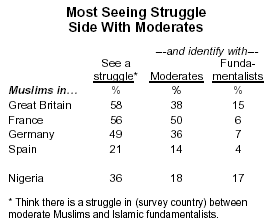
Consistent with these concerns, majorities or pluralities of Muslims in Britain (58%), France (56%), and Germany (49%) believe there is a struggle in their country between moderates and Islamic fundamentalists. Again, Spanish Muslims differ from their European counterparts, with a majority (65%) saying they do not see such a struggle, a view they share with 60% of Nigerian Muslims.

In all four European countries – and especially in France – those who do see a struggle heavily side with the moderates. In Nigeria, however, Muslims split evenly on this question.
Riots & Protests
Awareness of last year’s riots in France is relatively high among both the general publics and Muslim minorities in Western Europe, ranging among the general population from 91% in Germany to 78% in Spain and among Muslims from 86% in Germany to 63% in Britain. In Japan, 89% had heard the news.
Those who had heard about the riots were less numerous in the United States (55%) and in the Muslim world. In Turkey, 61% had heard about the riots, in Jordan 47%. But awareness levels in other Muslim countries ranged downward from 35% in Egypt, to 23% in Nigeria, 18% in Indonesia and 11% in Pakistan.
By and large, European Muslims – irrespective of their views about the riots per se – say they are sympathetic to the youths from immigrant and working class suburbs in France who felt frustrated by their place in French society. Muslims in Great Britain are most sympathetic (75% so indicate) followed by those in France and Spain (63% of Muslims in both countries).
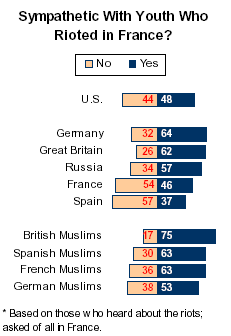
In Germany, however, more among the general public (64%) express sympathy than among the predominantly Turkish Muslims in that country, 53% of whom say they sympathize with the frustrations of French youth.
In general, Western publics are divided on this issue – only 37% of the Spanish public sympathizes with the French youth.
And despite more positive French views on many related issues this year, only 46% of the French general public takes the side of the country’s alienated young.
Regarding publication of cartoons featuring the prophet Mohammad in a Danish newspaper, the most common way in which people heard about the controversy that ensued was through television, although in Nigeria people were more likely to hear of it via radio or through family and friends.
Few in any country mentioned a church or mosque or the internet as the source of their awareness.


