
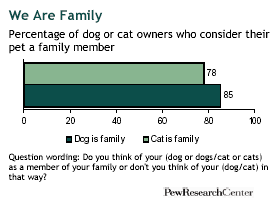
Dogs may be known as man’s best friend, but for most of their owners, even that lavish sobriquet appears to undershoot the mark. Fully 85% of dog owners say they consider their pet to be a member of their family, according to a Pew Research Center survey.
And most cat owners (78%) feel the same way.
The pets-as-four-legged-family-member phenomenon helps explain everything from the heart-tugging scenes during Hurricane Katrina last fall, when some Gulf Coast residents risked staying home because they did not want to abandon their pets, to the explosive recent growth of the pet care industry. Americans spent an estimated $35.9 billion on their pets last year, up from $17 billon in 1994, according to the American Pet Products Manufacturers Association. Some of that money went for pet cosmetic surgery, pet insurance, pet strollers, pet waterbeds and, yes, pet spas and hotels. (The “Presidential Suite” at the Ritzy Canine Carriage House in Manhattan is available for $175 a night, breakfast included.)
The nationwide Pew survey of 3,014 adults finds that just about every breed of human owner considers their pet to be family. But some groups are more disposed than others to feel this way.
For example, more women than men describe their dog or cat as a member of the family. So do those who aren’t parents, compared with those who have children. Also owners who live in cities or suburbs are more likely than those who live in rural areas to describe their dog or cat as a family member.
Profile of Pet Owners
Nearly six-in-ten (57%) of all adults in this country own a pet or pets of one kind or another, with dog owners (39% of all adults) outnumbering cat owners (23%), and owners of all other pets trailing far behind, the Pew survey finds.
More whites (64%) than blacks (30%) or Hispanics (39%) have a pet. There is also an income skew to pet ownership: nearly seven-in-ten (69%) adults with an annual family income of $100,000 or more has a pet, compared with fewer than half (45%) of adults with an income below $30,000. Also, rural residents (65%) are more likely than suburbanites (57%) or city folks (51%) to have a pet — though, as noted above, they’re a bit less likely to consider their dogs or cats a member of the family.
The Truth about Cats and Dogs… and Mom and Dad
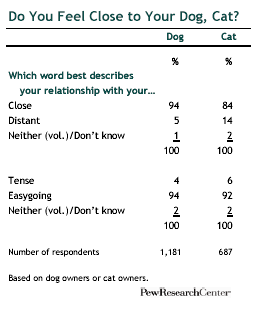
Dogs edge cats by a nose in the human intimacy sweepstakes. Not only are dog owners slightly more likely to think of their pet as family, so too are they more inclined to describe their relationship with their pet as “close” rather than “distant.” Some 94% of dog owners say this, compared with 84% of cat owners.
Needless to say, this finding won’t shut down the never-ending, (mostly) friendly competition between dog people and cat people. To the contrary, when paired with another set of responses from the same survey, it just might open an entirely new can of worms.
It turns out when you ask adults about their parents, 87% say they feel close to mom and 74% say they feel close to dad.
So for anyone keeping score, the family intimacy standings look like this: dog 94%; mom 87%; cat 84%; dad 74%.
About the Survey
Results for this survey are based on telephone interviews conducted with a nationally representative sample of adults, ages 18 years and older, living in continental U.S. telephone households.
- Interviews conducted October 5-November 6, 2005
- 3,014 interviews
- Margin of sampling error is plus or minus 2 percentage points for results based on the total sample at the 95% confidence level. The margin of sampling error is higher for results based on subgroups of respondents.
Survey interviews conducted under the direction of Princeton Survey Research Associates International. Interviews were conducted in English and Spanish.
In addition to sampling error, bear in mind that question wording and practical difficulties in conducting surveys can introduce error or bias in the findings of opinion polls.
Read the full report for more details.


