Americans and Their Cars: Is the Romance on the Skids?
Fewer Americans like to drive, survey shows
Any nation with more passenger vehicles than licensed drivers has a pretty serious love affair with the automobile. But the romance seems to be cooling off a bit -- a casualty of its own intensity.
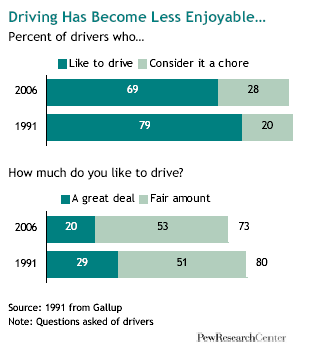
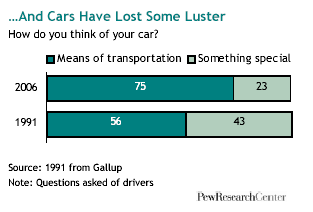
Today 69% of American drivers say they like to drive, down from 79% in a 1991 Gallup survey. And just 23% say they consider their car "something special -- more than just a way to get around," barely half of the 43% who felt this way in 1991.
The biggest reason for the cooling of the affair isn't the recent spike in gas prices. Rather, it appears to be the result of a longer term trend -- the growing hassle of traffic congestion, according to a Pew Research Center telephone survey among a nationally representative sample of 1,182 adults (including 1,048 drivers) conducted from June 20 through July 16, 2006.
When asked whether they like to drive or consider it a chore, 69% of drivers in the Pew survey said the former, while 28% said the latter. When the "chore" respondents were asked why they felt this way, traffic congestion (23%) and "other drivers" (14%) topped the list of reasons. Just 3% cited the expense.
Among the still sizable majority who say they like to drive, the biggest reasons offered were the relaxation (21%), the scenery (19%), the freedom (14%) and the ability to get around (12%).
A Plague of Traffic
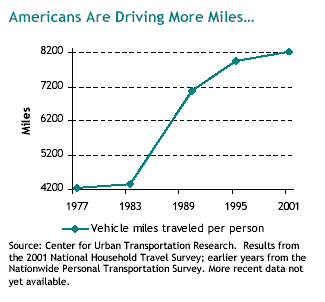
Trends from the U.S. Bureau of Transportation Statistics and the National Center for Transit Research show why, for a growing number of Americans, cars and driving seem to have become too-much-of-a-good-thing.
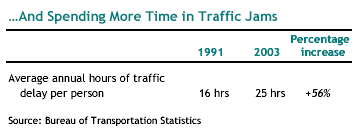
The National Household Travel Survey found in 2001 that, for the first time since such studies have been conducted, there were more personal vehicles (204 million) than licensed drviers (191 million) in this country. With all those cars, trucks, minivans and SUVs at their disposal, Americans have been making more trips and traveling more miles, thereby generating more of the very thing that has made them enjoy driving less - traffic jams.1 From 1991 to 2003, the amount of time per year that the typical Amercian spent stuck in traffic grew by 56%, according to the Bureau of Transportation Statistics.
The Car: Where Life Happens
However, despite the growing hassles of traffic, many drivers have strong feelings of intimacy toward their cars - 31%, for example, say they think of their car as having a personality. And despite the high price of gas, more than a quarter (27%) say they went driving "just for the fun of it" in the past week.
Moreover, most people see driving as a chance to take care of many of the other routines and amusements of daily living. Here is a (slightly scary) list of things people report having done in the past year while they were behind the wheel:
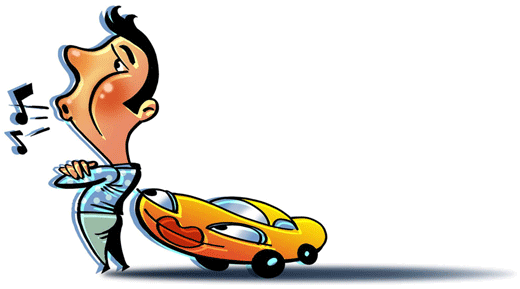
- More than two-thirds (68%) of drivers say they have sung aloud while driving.
- Roughly six-in-ten (58%) have talked on a handheld phone while driving.
- More than four-in-ten (41%) have eaten a meal while driving.
- One-in-six (16%) have combed their hair or applied makeup while driving.
- Some 6% have read a paper, book or magazine while driving.
- Some 6% have fallen asleep while driving.
- And 38% have cursed at another driver.
I. Who Likes to Drive, Who Doesn't, and Why
When asked whether they like to drive or consider it a chore, Americans by a better than two-to-one margin (69%-28%) say they like to drive. However, this ratio was even more lopsided 15 years ago - 79% to 20%. Also, only a fifth of American drivers today report that they like to drive "a great deal," down from 29% who said this in the 1991 survey by Gallup.
This decline over the past 15 years in enjoyment of driving has occurred among men and women, young and old, as well as in all regions of the country. Those in the lowest income brackets are more likely than others to describe driving as a chore, and among this group this view has grown from 14% in 1991 to 36% today. People who rack up the most miles on their odometers tend to be the most inclined to say they like to drive, but the feeling that driving is a chore has grown since 1991 among heavy as well as light travelers.
What is it about driving that Americans like and don't like? When asked to put their reasons in their own words, respondents who like to drive most often cited being alone and getting time to think or relax (21%) and being able see new sights and scenery (19%). Some drivers specifically mentioned the sense of freedom or independence while driving (14%) and others talked about the control over when and where to go that comes with driving compared with other forms of transportation (9%). Another 12% of responses suggested a more utilitarian appreciation for just being able to get around.
Women are more likely than men to cite relaxation and quiet time as the reason they enjoy driving, while men are more prone to cite the scenery and seeing new sights.
Among those who consider driving a chore, the most common reason cited was traffic congestion (23% of responses) followed by complaints about the behavior of those pesky humans who share the roadways (14%), the drudgery of running errands or commuting to work (10% each) and a laundry list of other complaints.
Overall, there is not much difference across socio demographic groups in enjoyment of driving. Men and women are about equally likely to consider driving a chore and to say they like to drive "a great deal." Similarly, there are no significant differences on these measures for residents of urban, suburban, rural areas or regions of the country. Even the differences by age are modest; adults under age 30 are a bit more enthusiastic about driving, with 82% saying they like to drive a fair amount or a great deal, compared with 70% to 73% among those in older age brackets.
II. Things We Do While Driving
As they spend more and more time in their cars, Americans report that they do an impressive - perhaps even scary -- range of activities while driving. Nearly seven-in-ten drivers (68%) use their time behind the wheel to sing out loud. About six-in-ten (58%) report talking on a handheld phone while driving, a practice that some states have outlawed due to safety concerns. Roughly four-in-ten (41%) say they have eaten a meal while driving and nearly as many (38%) report having shouted or cursed at other drivers in the past year. Other behaviors are less common -- 16% of drivers have done some personal grooming while driving, 6% have combined reading and driving and 6% have fallen asleep behind the wheel in the past year.
Drivers in the younger age categories (18 to 49 years) are more likely than older drivers to combine driving with singing, phone calls, eating, and cursing at other drivers. And female drivers are more likely than male drivers to break into song or take care of personal grooming. Meantime, drivers in the northeast are more likely to report cursing at other drivers than are those in other regions.
Despite the dip in enthusiasm for driving, and even with gas prices hovering around $3 a gallon, more than a quarter (27%) of all drivers (24% of all Americans) say they have gone driving "just for the fun of it" in the past week. Younger adults are more likely than older ones to have done so. Also, there's more joy riding in rural areas than in cities or suburbs. Men and women are about equally likely to have done some driving just for the fun of it. Not surprisingly, those who like driving are more likely than those who consider it a chore to have done this kind of recreational driving.
III. Car Personality
Just as positive feelings about driving have cooled a bit since 1991, so too has the special relationship that drivers have with their cars. The number of drivers who say they think of their car as "something special -- more than just a way to get around" has fallen by nearly half, to 23% now from 43% in the 1991 Gallup survey.
This drop-off occurred about equally among all major socio demographic groups of drivers –including men and women, older and younger, more and less affluent -- and in all regions of the country.
At the same time, however, about three-in-ten (31%) drivers report they at least sometimes think of their car as having a personality of its own.
There are virtually no differences between men and women on this question, but there are some variances by age. Some 41% of 18-to-29 year olds say their car has a personality, while just 25% of those ages 65 and older agree.
Also, just under three-in-ten (28%) drivers say they can usually tell what a person is like from the kind of car he or she drives, a figure that is on par with drivers' assessments in the 1991 survey. Of course, cars aren't the only inanimate window into the personality of humans. When asked to assess whether a person's car, home or clothing tells the most about what that person is like, respondents ranked the car a distant third -- at just 7%. Home was the big winner, with 54% saying it revealed the most about its owner, while 24% said that about clothing.
About the Pew Social Trends Reports
The Pew social trends reports explore the behaviors and attitudes of Americans in key realms of their lives - family, community, health, finance, work and leisure. Reports analyze changes over time in social behaviors and probe for differences and similarities between key sub-groups in the population.
The surveys are conducted by the Pew Research Center, a nonpartisan "fact tank" that provides information on the issues, attitudes and trends shaping America and the world.
Survey reports are the result of the collaborative effort of the social trends staff, which consists of:
Paul Taylor, Executive Vice President
Cary Funk, Senior Project Director
Peyton Craighill, Project Director
Notes
1Polzin, Steven E. 2006. "The Case for Moderate Growth in Vehicle Miles of Travel: A Critical Juncture in U.S. Travel Behavior Trends," Report prepared for the U.S. Department of Transportation.

