
Last Updated: November 20, 2009
Feeds: RSS
PewResearchCenter Publications
Receive Our Email Newsletter:
Site Search:
Pew Research CenterPew Research Center

What Americans Pay For - and How

'Information Age' Bills Keep Piling Up

PrintEmailShare

PDF Download the complete report for topline results

FigurePaying the monthly bills is a different experience for Americans now than it was a generation ago, a new Pew Research Center survey has found. A sizable minority of adults do most of their transactions online. A sizable majority pays for one or more of the "big three" information age consumer staples each month– internet connection, cell phone service and cable or satellite television service. And at the same time that they are carrying the cost of these new technologies, Americans are also paying off record levels of credit card debt each month.

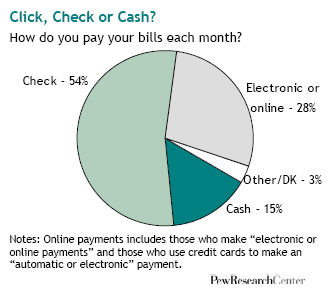
The Pew survey finds that nearly three-in-ten adults (28%) say the most common way they take care of their regular monthly bills is by an online or electronic payment. A bare majority (54%) mostly uses checks, and a small minority (15%) mostly uses cash.
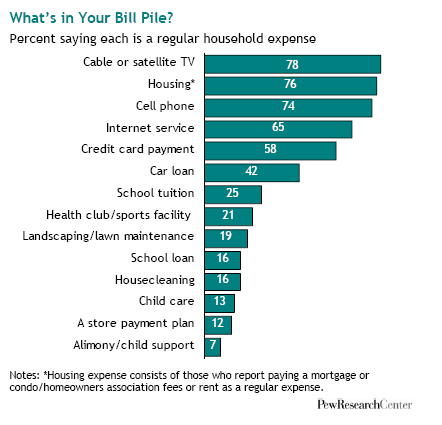
FigureThe survey also finds that at or near the top of the public's list of regular expenses are cable or satellite television service (78% of adults say they pay such bills every month); cell phone service (74%) and internet connections (65%). These information age staples either didn't exist or were in their infancy a generation ago. When survey respondents were given a list of common household expenses, the only one they cited as often as these three was housing (76%).
FigureAnother regular expense for most Americans is credit card bills. Among the 58% of adults who say they have a credit card as a regular household expense, about four-in-ten (41%) report that they generally pay their credit card bills in full each month while a 53% majority says that they usually make a payment. Credit card usage and debt have grown dramatically over the past generation, according to government and industry reports.1

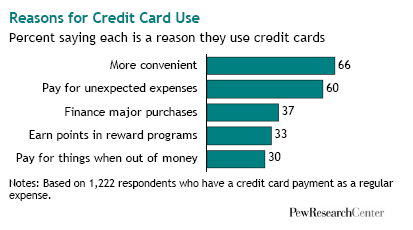
The Pew survey finds that convenience and short-term financing are at the top of the list of reasons people give for using credit cards. But the reasons vary by income levels. People with high incomes are more likely to cite convenience and rewards programs; people with lower incomes are more likely to cite unexpected expenses or the need to pay for things when they run out of money.

This telephone survey of America's bill-paying, budgeting and credit card practices was conducted from October 18 through November 9, 2006 among a nationally representative sample of 2,000 adults; it has a margin of sampling error of plus or minus 2.5 percentage points.
FigureAmong the survey's other key findings:

To Budget or Not to Budget? Americans are evenly divided about having some sort of formal budget to help them manage their household expenses - 48% say they use one, 51% say they don't. There is virtually no difference on this question by gender, by income level or by race. People who are paying off a lot of loans are more prone to use a budget, as are people who at some point in their lives have had a problem with debt.

"Major Expenses" Vary by Income level. People with high incomes are more than twice as likely as those with low incomes to describe dining out and vacation travel as "major expenses" in their lives. Conversely, those with low incomes are much more likely to describe medical or dental bills as a major expense.

Cash Is a Lesser King: When it comes to paying for everyday expenses (as opposed to monthly bills), cash is no longer king - or at least not a fully sovereign king. Just 37% of Americans say they mainly use cash for their everyday purchases, while 31% say they use debit cards, 16% say they use credit cards and 15% say they use checks.
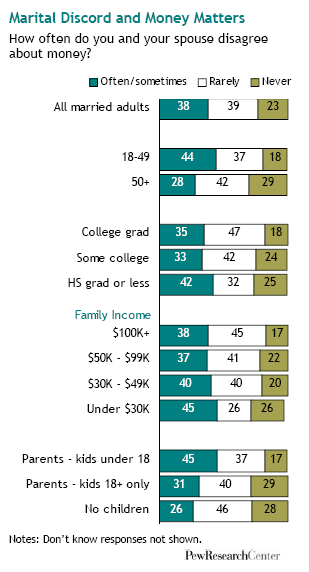
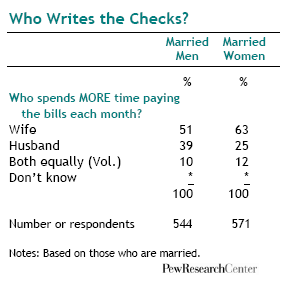
FigureMoney and Marriage: In the annals of human history, money has been known to cause a marital spat or two. The Pew survey finds that spousal disagreements about money extend even to the seemingly straightforward question of which partner spends more time each month paying the bills.

Most wives say they do. Most husbands agree that their wives do. So far, so good. But upon further inspection, a spousal gap emerges. Fully 63% of all wives say they pay the bills, while just 51% of all husbands say their wives pay the bills. People, can we talk?

Meantime, spouses also have what are presumably more substantive disagreements about financial matters. Nearly four-in-ten married adults say they and their spouse often (13%) or sometimes (25%) disagree about money. Another 39% say they rarely disagree with their spouse over money, and 23% say they never disagree.

Couples more likely to have disagreements about money include those with lower incomes; those with children under age 18; those who are younger; and those who have less education.

I. Monthly Expenses

Not surprisingly, housing is near the top of the public's list of regular expenses. This is true both for the 68% of Americans who own their home and the 27% who rent. Among homeowners, about a third (32%) report that they have no mortgage, while two-thirds report that they pay at least one mortgage bill each month. Also, a fifth of all homeowners regularly pay some kind of maintenance fee to a condo or homeowner's association. Among renters, virtually all (97%) include rent among their regular bills. Altogether, 76% of Americans have regular housing expenses from either mortgage, rent or a maintenance fee for a condo or homeowner's association.

Among the list of 13 other common household expenses asked about in this survey, cable and satellite TV service was most frequently cited as a regular household expense (78%), followed by cell phones (74%) and internet service (65%). By contrast, just four-in-ten adults (42%) say they make a car payment and just one-in-four say they make a school tuition payment.

Figure

There's a sharp age skew to who's most likely to be paying regularly for "information age" services. Older adults (ages 65 and over) are less likely than both the young and middle-aged to have cell phones (54% compared with 74% among those ages 50 to 64) and internet services (34% compared with 71% among those ages 50 to 64) in their household bill pile.

The age variances extend to other expenses as well. As expected, the youngest group of adults (ages 18 to 29) are more likely than their elders to be paying for education; 37% of this group is paying for school tuition (for themselves or their children) compared with 29% among those ages 30 to 49 and 22% among those ages 50 to 64. Similarly, 27% of the younger age group is paying off a school loan, compared with 21% among those ages 30 to 49 and just 10% among those ages 50 to 64.

The list of regular expenses also varies by income levels. Those with family incomes of at least $100,000 are more likely than the less affluent to have regular expenses for a number of these items, including cell phones, internet services, lawn and landscaping service and housecleaning.

FigureRegardless of means, people think of their expenses in different ways. When asked to consider which among a series of expenditures they considered to be a "major expense" for them, survey respondents most often cited health-related costs (45%), followed by clothing (34%) and restaurant dining (34%).

Not surprisingly, this line up of major expenses also varies by income. About half of those with family incomes of $100,000 and above consider vacation travel (49%) and dining out (48%) to be a major expense. Nearly six-in-ten (58%) of those with family incomes under $30,000 consider medical bills a major expense.

Figure

These assessments also vary somewhat by age and gender. Older women (ages 50 and older) are more likely than their male counterparts or than younger adults to classify medical expenses as a major expense. Younger women (those ages 18 to 49) are more inclined to consider clothing as a major household expense while younger men are more likely to say the same about eating out.

II. Consumer Credit

Nearly six-in-ten (58%) adults report having a credit card bill as part of their regular line-up of expenses while 41% do not.

Figure

About three-in-ten (31%) Americans say they generally make a payment on their credit card bills each month, while 24% generally pay off the balance in full.

These patterns vary by income. Those with lower family incomes (under $30,000 annually) are less likely than those with higher incomes to have a credit card as a regular household expense. Among those who do have a credit card as a regular expense, those with higher family incomes are more likely than those with lower incomes to report paying the bill in full each month.

Americans have other consumer debt not reflected in their credit card payments. About one-in-ten (12%) adults say they have a store payment plan for home furnishings or electronics as one of their household's regular expenses.

Convenience (66%) and short-term financing (60%) are the most common reasons people give for using credit cards. Other reasons (in response to a set of five questions) include financing major purchases (37%), the perks of credit card reward programs (33%) and paying for things when they run out of funds at the end of a pay period (30%).

Figure

Those with annual incomes of at least $100,000 are more likely than other income groups to say the convenience of cards and the reward points are reasons they use credit cards for some of their purchases. Not surprisingly, those with family incomes under $30,000 annually are more likely to report using credit cards when they run out of money at the end of a pay period.

III. Debt Problems

FigureAbout one-in-seven Americans (14%) report that at some point in their lives they experienced debt problems serious enough to have caused them to file for bankruptcy or to use a credit consolidator.

Those with annual family incomes of $100,000 or more are less likely than other income groups to have experience with these kinds of debt problems.

People who make payments on their credit card bills are more likely to have had a problem with debt than are those who don't use credits cards and those who pay their credit card bills in full each month.

Similarly, homeowners who have one or more loans (for example, car loans, mortgages and second mortgages) are more likely than homeowners with no loans to have had a problem with debt.

The age group most likely to report having had a problem with debt are those in a broad range of middle years - from ages 30 through 64. Adults both younger and older than that are less than half as likely to report having had a problem with debt.

IV.Bill-Paying Practices

About half (51%) of all adults surveyed say they don't rely on a formal budget to guide household expenses. There are no significant differences between men and women; or among income groups. And, there are only modest differences by education and along racial and ethnic lines.

FigureThere is some variance in the use of a budget by age. Adults on the younger side (ages 18-64) are more likely than those ages 65 and older to rely on a budget.

Significant differences surface by marital status. Married people are more likely to rely on a budget (51%) than are the unmarried (44%). Parents of minor age children (54%) are more likely than non-parents and those with adult age children (44% each) to say they use a budget to guide household expenses.

Employment status is also important. Workers are more likely than retirees or non-retirees who are not employed to rely on a budget.

More than half (55%) of those who have had a debt problem (those who have used a credit consolidator or declared bankruptcy in the past) say they rely on a formal budget. Similarly, those with credit card debt that exceeds their ability to pay in full each month are a bit more likely to have a budget for household expenses.

Those who use a budget are more likely than those who don't to regularly review their household expenses.

Among the former group, nearly two-thirds (64%) say they review their expense at least once a month to see how well they are doing or to make changes in their spending habits; among those in the latter group, just 40% say they engage in this sort of monthly review.

V. Cash, Check, Debit or Credit?

FigureConsumers have more choice than ever before when it comes to how to make a transaction for goods and services - the old standbys of cash and checks are now side-by-side with debit and credit card options for many goods and services. While some have speculated that we are moving towards a cashless - or at least a checkless - society, that verdict seems premature. When it comes to both everyday living purchases and monthly bill-paying, the Pew survey finds that both the old and new payment modes have their following.

For everyday purchases, about four-in-ten (37%) report they rely on cash, while 31% rely on debit cards and about half as many use either checks (15%) or credit cards (16%).

Those with lower incomes rely mostly on cash for everyday living expenses; 54% of those with incomes under $30,000 do so compared with 24% among those with incomes of at least $100,000 annually.

FigureFor monthly bill-paying, more than half (54%) of adults say that they mostly use checks, while 28% say they mostly make electronic or online payments and 15% say they mostly use cash.

A majority of every age group save one - adults under age 30 - relies on checks for most of their bill-paying. Among adults ages 65 and older 71% mostly use checks to pay their bills; this figure drops to 63% among those ages 50 to 64 and 51% among those ages 30 to 49. Among adults under age 30 about a third (35%) use checks for most of their bill-paying while three-in-ten use cash and 32% pay bills electronically.

Among Internet users, a 53% majority reports paying most bills by check while 35% pay electronically and 10% pay in cash.

About the Pew Social Trends Reports

About the Pew Social Trends ReportsThe Pew social trends reports explore the behaviors and attitudes of Americans in key realms of their lives - family, community, health, finance, work and leisure. Reports analyze changes over time in social behaviors and probe for differences and similarities between key sub-groups in the population.

The surveys are conducted by the Pew Research Center, a nonpartisan "fact tank" that provides information on the issues, attitudes and trends shaping America and the world.

Survey reports are the result of the collaborative effort of the social trends staff, which consists of:

Paul Taylor, Executive Vice President
Cary Funk, Senior Researcher
April Clark, Research Associate

Related Reports from the Pew Research Center

We Try Hard. We Fall Short. Americans Assess Their Savings Habits. January 2007. Pew Research Center.

Most Americans Moderately Upbeat About Family Finances 2007. January 2007. Pew Research Center.

Luxury or Necessity?: Things We Can't Live Without: The List Has Grown in the Past Decade. December 2006. Pew Research Center.

As Home Prices Cool Down, Homeowners Temper Their Optimism. December 2006. Pew Research Center.

Online Banking 2006: Surfing to the Bank. June 2006. Pew Internet & American Life Project.


Notes

1See for example Table 703, Federal Reserve System, Flow of Funds Accounts of the United States for the Household and Nonprofit Sector. Statistical Abstract of the United States: 2007. Also see, Federal Reserve statistical release, G.19, Consumer Credit.

PDF Download the complete report for topline results