

by Robert Ruby and Timothy Samuel Shah, Pew Forum on Religion & Public Life March 21, 2007
If Nigeria’s presidential election takes place as scheduled on April 21, it will mark the first transfer of power from one elected civilian president to another in the country considered the key to stability for all of West Africa. But the campaign leading up to it is already serving as a reminder of the sharp Christian-Muslim divide in Africa’s most populous country.
Nigerians will be choosing the successor to President Olusegun Obasanjo, a born-again Christian who has served two four-year terms. While Obasanjo’s eight years as president symbolized an era of Christian control, even before he took office in 1999 political leaders began talking of alternating the presidency between the country’s largely Christian south and predominately Muslim north. After considerable infighting and the disqualification of several would-be contenders, all of the country’s major political parties have now chosen Muslims as their candidates. (A rundown of the three leading candidates)
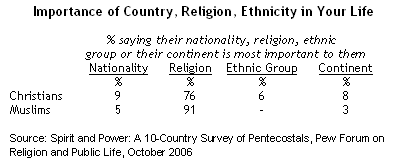
Nigeria’s population of some 140 million is divided nearly equally between Christians and Muslims. The importance of that divide is well illustrated by the fact that religion — not nationality — is the way in which most Nigerians choose to identify themselves. In a May-June 2006 survey conducted by the Pew Forum on Religion & Public Life, 76% of Christians say that religion is more important to them than their identity as Africans, Nigerians or members of an ethnic group. Among Muslims, the number naming religion as the most important factor is even higher (91%).1
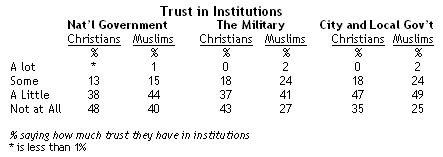
The appetite for major political change, however, extends across the religious spectrum. Large majorities of both the country’s Christians (94%) and Muslims (97%) say they are dissatisfied with conditions, and the discontent extends to virtually every major secular institution. Large majorities of both groups say they trust the national government only a little or not at all (86% of Christians, 84% of Muslims). These strongly negative opinions extend to the military (80% of Christians trust it only a little or not at all, as do 68% of Muslims) and city and local government.
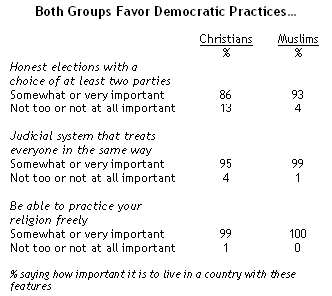
Both groups also endorse many of the underpinnings of democracy. A majority of the country’s Christians — and an even larger majority of its Muslims — say it is important that elections be held regularly with a choice of at least two political parties.
Similarly both groups are essentially unanimous in agreeing that it is important that the judicial system treat everyone in the same way and that people be able to practice their religion freely.
Both groups, however, have mixed feelings about the desirability of a government with greater political participation by ordinary people. Christians favor participatory government by a slight majority but Muslims are evenly divided, with essentially the same percentage preferring a leader with a strong hand as favor government by the people.

Still, while both Christians and Muslims list many of the same issues in identifying the major problems facing their country, the solutions favored by the two groups are heavily colored by their respective religious affiliations. Large majorities of both groups, for example, identify corrupt political leaders as a problem (86% of Christians, 90% of Muslims). A majority of Christians (72%), however, say the country’s leaders should have strong Christian beliefs; an even larger majority of Muslims (77%) say the leadership should have strong Islamic beliefs.
Most of the country’s Muslims (52%) also believe the government should take steps to make Nigeria an Islamic country. A significant minority of Christians (42%) say the government should make the country overtly Christian.
Underlying these sharply divergent desires is the deep distrust each group feels toward the other: Most of the country’s Christians (62%) say they trust people from other religions only a little or not at all. A similar percentage of Nigeria’s Muslims (61%) say they trust people of other religions little or not at all.

These differences extend to opinions about world affairs, including views of the United States and its policies, as shown by a Pew Global Attitudes Project poll conducted in spring 2006. While a large majority of Nigeria’s Christians (89%) have a favorable opinion of the United States, most Muslims (67%) have an unfavorable opinion. Most Nigerian Christians say they favor U.S.-led efforts against terrorism; most Nigerian Muslims say they oppose those efforts. Those divisions carry over into opinions about the Israeli-Palestinian conflict. Many more of Nigeria’s Christians (47%) than Muslims (10%) say they favor Israel; many more Muslims than Christians say they favor the Palestinians.
Religion and religious conflict have long been part of Nigerian politics and public life. In the 1950s, while Nigeria remained under British rule, Islamic personal law, Sharia, was incorporated into the country’s legal system. In the late 1960s, religion was one factor in the internal conflict that eventually erupted into the Biafra war (1967-1970), which killed as many as 600,000 people.
Since the mid-1980s, however, tension between Christians and Muslims has become an even more consistent feature of Nigerian politics. In 1986, the country’s then Muslim military ruler made Nigeria a member of the Organization of the Islamic Conference, provoking an immediate outcry from many Christians, who objected to the implication that Nigeria was an officially Islamic country. In response, Nigerian Christians began to push the government to establish formal diplomatic relations with the state of Israel, which occurred in the early 1990s.
During President Obasanjo’s rule, Christian-Muslim tensions have deepened. Shortly after Obasanjo took office in 1999, states in the country’s northern half began to apply Sharia to criminal cases, provoking considerable insecurity and hostility on the part of Christians. Twelve states in the predominately Muslim north have established some form of Sharia. At the same time, many Christian churches, including independent evangelical and pentecostal churches as well as mainline denominations such as the Catholic and Anglican churches, have stepped up evangelistic and missionary efforts in Nigeria’s middle and northern states, further increasing tensions. Since 2001, incidents of Christian-Muslim violence have become both more frequent and bloodier. (For an historical overview of Nigeria’s religious groups see Historical Overview of Pentecostalism in Nigeria.)
Of course, religion is not the only divisive factor operating in Nigeria. The country’s oil wealth, which accounts for about three-quarters of the government’s revenues, is a potent fuel for both contention and corruption. Although the country’s oil earnings total more than $500 billion, more than a third of the population lives in what the World Bank terms “extreme poverty.” Most of the oil comes from the Niger delta, in the country’s south. In recent years, militias there have kidnapped foreign oil workers, attacked pipelines and engaged in battles with soldiers and police. Oil also accounts for part of Nigeria’s importance to the United States. Nigeria supplies about 9% of American crude imports, and steady production depends in part on political stability.
Still, whoever wins the presidential election, religious faith is likely to continue to exert a powerful influence on the country’s public life. It will continue to do so for as long as Nigeria’s people say they are Christians or Muslims first, Nigerians second.
Notes
1Religious affiliation and the relative size of the Muslim and Christian populations in Nigeria remain such sensitive issues that the government chose not to ask about religion in the national census conducted in 2006, the first in 15 years. In this report, data on religious affiliation is drawn from the 2003 Demographic and Health Survey of Nigeria.


