Washington, D.C.
Recent violence between Hezbollah, a Shiite Muslim guerrilla group, and Israel; sectarian conflict in Iraq and escalating tensions around Iran’s nuclear ambitions have drawn urgent attention to the resurgence and politicization of Shiite Islam and its relationship to Sunni Islam.
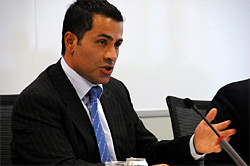
The Pew Forum and the Council on Foreign Relations invited Vali Nasr, author of the new book, The Shia Revival: How Conflicts Within Islam Will Shape The Future, to address a small group of academics, policymakers and journalists and to answer questions after his opening talk. Nasr argued that Iran, a Shiite theocracy, is emerging as a regional power in the Middle East, a region where Shiites comprise about half the population. When the U.S. removed the Sunni-dominated regime of Saddam Hussein from power in Iraq, and allowed Shiites to gain political control through “one man, one vote” democracy, it shifted sectarian power in the region toward Shiites. Nasr asserted that despite its growing ambitions, Iran may well hold the key to regional stability.
Speaker: Vali Nasr, Adjunct Senior Fellow for Middle Eastern Studies, the Council on Foreign Relations, Associate Chair of Research, Department of National Security Affairs, Naval Postgraduate School
Moderator: Walter Russell Mead, Henry A. Kissinger Fellow for U.S. Foreign Policy, the Council on Foreign Relations
TIMOTHY SHAH: I’m Timothy Shah, and I’m a senior fellow in religion and world affairs with the Pew Forum on Religion & Public Life, which is a project of the Pew Research Center. We’re delighted that you could be here. I want to thank Vali Nasr for agreeing to speak to us.
Obviously the topic we’re discussing today could not be more pertinent to what is going on before our eyes in the world today. We very much look forward to the discussion.
We’re delighted that all of you could be here. This is an extremely diverse crowd of experts.
Without further ado, I’m going to introduce Walter Mead, who is actually going moderate today’s discussion and will introduce our speaker. This meeting is part of a series of joint meetings between the Pew Forum on Religion & Public Life and the Council on Foreign Relations, which Walter will say a little more about.
WALTER RUSSELL MEAD: Thanks, Tim. And thanks, Luis, for having us.
For the last year or so, the Council and the Pew Forum have been working together on a series of meetings as we think through the question of what impact religion has on foreign policy.
We look both domestically at what impact American religion has on the formation and design of American foreign policy, and internationally at how religion shapes the world where American policy takes place. We’ve been fortunate enough to have a number of international collaborators and partners at various times. I see that Germany is represented today; welcome to Freidrich-Ebert-Stiftung.
We have done our best to include a number of different political and religious points of view. We are planning future meetings, and, obviously, as we learn more, we think about better ways to do this.
On the Council’s end, this question of religion and foreign policy is clearly something engaging more of our attention than it ever has before. We have a number of fellows, Vali Nasr is one of them, whose work is centered on different aspects of religion in the world; and it’s not simply a question of Islam, but many different parts of the world. If you look at India, Africa, Latin America, China and, of course, the United States, you see how religion and religious change is affecting political forces in the world at large.
Today’s session is under a modified form of Council rules. That means the meeting is off the record, with one exception. Our speaker, Vali Nasr, has agreed that his remarks will be on the record. So if anyone is here journalistically, Vali is on the record unless he wants to say something terribly frank – (laughter) – that’s off the record. However, in terms of the questions and comments that members of the group make, that part remains off the record under our normal rules.
We will ask Vali to speak for roughly half an hour and then go to a Q&A and discussion. I will probably abuse the moderator’s privilege of asking the first question, and then we will go forward.
So, Vali, thank you.
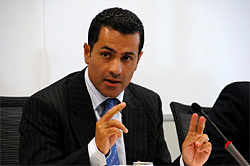
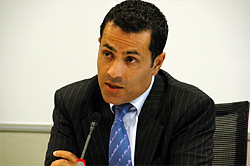
MR. NASR: Thank you very much, Walter, and let me begin by thanking the Pew Forum and Walter and Tim for inviting me here and providing the occasion to discuss these issues.
The question of how Islam relates to public life has been a preoccupation in academia and policymaking that involves the issue of fundamentalism, which has been with us for a number of years. When we talk of democracy, globalization, and change in the region, inevitably, those issues have involved the question of where religion stands in the public debate.
Recently we’ve seen a twist on this. The old issues of Islam and its role in public life have not gone away; we’ve seen them manifested more forcefully than ever in the elections in Egypt and Palestine and other parts of the world. But in the aftermath of the Iraq War, we’ve also seen a sectarian dimension, which I think of as a different fault line, a different chasm in politics and religion in the Middle East, which has its own repercussions and will have its own logic to impose on how things develop.
The events in Lebanon have pointed out the importance of the sectarian dimension, particularly in the way Saudi Arabia and the Arab League reacted. They didn’t do so in the expected way of declaring Arab solidarity in the face of Israel. They lamented first Hezbollah’s misbehavior – and that might have been expected – but then they went further to characterize this as a Shiite push for domination in the region and a Hezbollah-Iranian axis. So that contradicts a lot of people who argue that it’s the West who raises the specter of sectarianism and that somehow Muslims don’t see themselves as Shiites and Sunni. In this particular case, it’s the government of Saudi Arabia who put the Shia card on the table.
In some ways, this is a reality that’s becoming somewhat inevitable, and many actors in the region are trying to understand how to calibrate this factor into policymaking.
There is no doubt the Iraq war has had a very profound impact on the region, and I do not in any way want to put the record of that war on trial of whether it was right or wrong, because I think it’s somewhat irrelevant to the point I want to make. Whether it was right or wrong, whether it had been prosecuted differently, the impact of it was to shift the balance of power from one community in Iraq to another community. And that, in my opinion, was inevitable because Iraq, particularly after 1991, was much more organized along ethnic lines, as far as the Kurds were concerned, and sectarian lines, as far as the Shias were concerned.
So any kind of a change in that regime would have inevitably meant a transfer of power. The question is, does the transfer of power in any circumstance happen necessarily violently or could it happen in a different manner? That’s an important question because if there’s going to be any kind of change in the region in the coming years, this question’s going to be revisited. It’s going to be revisited in Lebanon, it’s going to be revisited in Bahrain, it’s going to be revisited in Saudi Arabia. Even now, the question we also ask is, what comes after the bombing? What comes after Hezbollah is shattered as a political military organization?
The fact of the matter remains that Shias are about 45 percent and possibly more of the population of Lebanon, and the current political structure of the country does not reflect that numerical reality. Whatever political force replaces Hezbollah this issue’s going to be on the table. The way in which the issue in Lebanon has been raised – mainly, a number of Lebanese asking what right did Hezbollah have to do this – raises the issue of who actually speaks for Lebanon.
We saw after the Hariri assassination, when each side was capable of bringing a million people to the streets one day after the other, that this is a very, very divided country. If anything, this current crisis is going to make the sectarian division between Shias and the rest in Lebanon a political issue that will have to be sorted out with Hezbollah or whatever succeeds Hezbollah as the political voice of the Shias.
One of the most important issues about Iraq is not how we handle the insurgency or how we come out in terms of the final setup of Iraq, but what kind of model emerges in Iraq for the transition of power between Shiites and Sunnis. The symbolic effect of Iraq is tremendous in the Arab world. This is the very first Shia Arab country; it hasn’t existed before in modern times. In many ways, the anger at the United States is not just because they invaded an Arab country or occupied an Arab country, but because the United States has facilitated the change in a balance of power that is centuries’ long in that region.
The numbers tell the story. The Shiites – just as an introduction – are about 10 to 15 percent of the Muslim population worldwide, which makes them about 130 million to 190 million people, depending on what kind of statistics you look at. You don’t find any in Indonesia or Nigeria or Senegal, they’re all bang in the middle of the Middle East, and there the numbers are relatively even. In other words, between Lebanon and Pakistan, in that belt, there are as many Shiites as there are Sunnis. And around the Persian Gulf, the overwhelming majority is Shiites. Shiites always like to point out that wherever there is oil, they’re sitting on top of it, including in Saudi Arabia. But outside of Iran, they have always been treated like a minority, regardless of whether they were a numerical minority or not. The conception of the region has always been Sunni – even in the United States, the region has always been conceived of as Sunni.
Now, this balance of power has changed, regardless of whether or not we like it, or whether or not the regimes in the region like it – this is now a fact on the ground. It is more so because sectarianism is not new to the region; it was an underlying factor in the balance of power in the Middle East. Before the U.S. arrived in Iraq, for a decade after the Iranian revolution, close to two decades, there was a sectarian balance between Iran and its neighbors, and its main rivalry with Saudi Arabia did involve a sectarian undertone. In South Asia, there were outright sectarian wars between Shia and Sunni communities that were sponsored and supported by these regional powers.
I’ve argued that Saudi Arabia followed a policy throughout the 1980s and 1990s of creating a Sunni wall around Iran, and they contained Iran by investing in Sunni identity, because the only way to break Khomeini’s influence as an Islamic leader was to convince the Sunnis that “He’s a Shia, he’s a heretic; you shouldn’t listen to him.”
[The fatwas say, in effect,]
For the Sunnis, Iraq created, at least initially, winners and losers, in the conception of the region. The Shiites, whether or not they welcomed the U.S., whether or not they wanted the war, whether or not they were pro-American or not, benefited from this. Even Hezbollah was initially very involved in the affairs of Iraq. Al-Manar, its television station, used to constantly repeat Ayatollah Sistani’s “one man, one vote” mantra. They clearly had an eye on what “one man, one vote” could mean for Shias in Lebanon, as far as the distribution of power was concerned.
[shift in Iraq]
And the understanding of the Shiites in Iraq was that it’s not so much the U.S. that facilitated this as the process of voting.
[Iraqi Shias]
This model has been extremely influential. I just mentioned the case of Hezbollah. In Saudi Arabia’s municipal elections last year, the main Saudi Shia leader, Sheikh Hassan al-Safar, repeatedly quoted Sistani’s sermons in telling the Shiites they should vote. He didn’t say he’s following Sistani, he didn’t say that Sistani says Saudi Shiites have to vote. Rather, he said there is a model out there, of voting, and that model clearly benefits the Shiites.
It was no surprise that in the Shi’ite areas of Saudi Arabia, the voter turnout was twice as much as it was in the Sunni areas. It ran about 45 percent, compared to 25 percent in the rest of Saudi Arabia. It was so overwhelming that there was actually a text message campaign among the Sunni population in Qatif that they should go to the polls before they close, otherwise the Shiites will sweep the municipal councils.
The result in Saudi Arabia is telling. It’s the first time that Shiites are sitting in any position of authority on municipal councils. It hasn’t occurred before. We’re going to be looking at elections coming up in Bahrain, which is 75 percent Shia, in the fall; that is, if they do actually take place. There again, the expectation is that of following the example of Iraqis.
So I would say the first aspect of this Shia revival is an expectation of transfer of power through voting or through participation or through accepting political reform.
The only thing that’s changed is that the Shiites initially did not expect the ferocity of the Sunni resistance and the willingness of the Sunnis to engage in violence in order to resist this transfer. This resistance, even in Iraq itself, led to a debate. After the Samarra bombings occurred, the argument, particularly from the more violent militias, was “restraint is interpreted as weakness; turn the other cheek does not work; the Shias have to establish a balance of terror; and that simply participating is not influential.” To some extent, Sistani has actually lost ground because of the degree of violence that has been perpetuated.
The second aspect of this revival is that the opening of the borders of Iraq has created networks of relationships among people. Pilgrims, migrants, investors and money have begun going back and forth all the way from Lebanon to the Gulf to Iran. There are hundreds of thousands of Iranians who have gone to Najaf and Karbala since Iraq opened up. Iran now is investing in building an airport in Najaf; I guess they are trying to spare pilgrims from having to go through the Triangle of Death from Baghdad to Najaf. There is an enormous amount of money and investment going to Iraq now. Ayatollah Sistani receives far more money from Kuwait and Iran than he does from Iraq itself. In fact, Iraq is not really sufficiently economically vibrant to support the taxation mechanism that the Ayatollah benefits from.
[new]
And Hezbollah, which for some time has been arguing that it wants to define what Lebaneseness is – they took this concept from the Christians – does not see Lebaneseness as necessarily Arabness. It is Arab, but it also has non-Arab components in it, and that dynamic is clearly at play; namely, that the cultural relationships among the Shia communities is strengthening, rather than weakening. The Arab-Iranian tie is not as strong. And partly, it is the ferocity of the Sunni resistance to Shia empowerment that pushes them together, and as I’ll discuss, it has something to do with the way in which Iran and Hezbollah are conducting their politics.
We often hear people talk about the Iran-Iraq War, that Saddam’s army was over 80 percent Shia, his conscript army, and that he put up a valiant fight in defense of Basra against an Iranian siege in 1982. But then we forget about 1991, when the massacre in the south occurred. Over 100,000 Shiites escaped to Iran, and during that horrible decade it was largely Iran and Iranian networks of clerics that supported the refugees and helped the people in southern Iraq. The memory of 1991 is far more important than the memory of the 1980s. And until such time as there is some kind of peace in the Arab world between Shiites and Sunnis, the Shiites are going to worry far more about a Sunni restoration in Baghdad than about Iranian influence in southern Iraq.
I would say if the U.S. wants to wean Iraqi Shiites away from Iran, the way is not to play footsie with the Sunnis in Baghdad. I think that policy not only is not working, but it has actually been counterproductive in terms of our influence among the Shiites in Iraq.
Finally, the other element in this Shia revival is the rise of Iran. In some ways, this is a multifaceted phenomenon. One could say that Iran was for a long time becoming the two-ton elephant of this region. It is probably the largest land mass there. It has oil, it has minerals, it has a very educated public, it has a fairly sophisticated society – that is, its leadership excluded. I’m not talking about the Iranian leadership. But the Iranian society itself has a high literacy late. It has a dynamic culture. Just look at Iranian cinema, for instance, and its impact on the outside. And Iran has a far larger economy than either that of Saudi Arabia or Egypt. One might say it was inevitable that Iran was going to assert itself.
Iran has been on the rise from within for the past decade. It began during the Khatami period. It’s only manifesting itself right now, unfortunately, under the wrong kind of regime, something like Japan of 1930: militaristic, ultra-nationalistic, self-confident and seeing itself very clearly as a regional force.
The Iraq war had two dynamics in it that accelerated this process. One is that it removed the Sunni bulwarks around Iran. This began, really, with the Afghan war. For reasons that had nothing to do with Iran, the U.S. took the Taliban out. Now, the Taliban-Pakistan-Saudi axis was the principal Sunni wall on Iran’s east. You talk to Iranian policymakers, that’s the way they saw it. You talk to Shias in Pakistan, that’s the way they saw it. This was a very successful containment strategy that essentially eliminated Iran’s influence in Afghanistan through the Taliban, reduced Iranian influence in Pakistan and was pushing further north into Central Asia as well.
On Iran’s west, the Iraq war removed the Saddam regime and, in fact, made southern Iraq far more permissible to Iranian influence. So Iran found elbow room, if you would. And Iran all of a sudden found itself in a Prussian moment. In other words, its zone of influence became very obvious: the Persian/Shia zone in Central Asia and north-western Afghanistan, and the Shia zone of influence across the Persian Gulf and southern Iraq.
[zones]
Of course, the problem between the U.S. and Iran existed before the war in Iraq. It found new dimensions after the war in Iraq, and as the Iranian nuclear issue became front and center, it became more pronounced. But even the Iranian nuclear issue is part of this whole issue of the rise of Iran. We forget, but the Iranians began to think about nuclear weapons when there was a nuclear weapon sitting in the middle of the Taliban-Pakistani-Saudi axis. In the late 1980s, it was thought of as a deterrent against Iraq and a way of asserting Iran’s regional hegemony.
After 2001, it found additional deterrence value because it was seen as a way of preventing regime change in Tehran by the U.S., and now in Iran, it’s seen essentially as a mark of Iran being the India of the region, the China of the region, as the great power that would establish hegemony in the Persian Gulf.
Iranian assertiveness feeds on the Shia revival because in some ways Iran believes a Shia regime in Iraq and Shia power in the region automatically makes the region less hostile to Iran, even forgetting about ruling over them. But generally, Iran believes that Arab nationalism is racist, chauvinistically anti-Iranian, that particularly Ba’athism was particularly anti-Iranian; and that a greater Shia voice in the region makes it more “Iranian friendly.” That can have multiple impacts – cultural, economic, all the way to military, foreign policy and the like.
The issue that faces Iran and is critical in this current crisis is how do you handle the Sunni reaction, and particularly the ferocity of violence in Iraq from 2003 all the way to the Samarra bombing. I put Samarra as a date because after that, the Shias in Iraq, at least some of them, decided to join in and create a balance of terror. But before that point, there was a debate about how to handle this.
There are two issues. One is that the Iranians understand very well that the successful rise of Iran cannot have street-Sunni resistance to it, either from Jihadis and the Salafists or from the mainstream Arab street; and that the more Zarqawi and Iraq problematizes the Shia revival in Iraq and attaches it to Iran, the more problematic it is for Iran to fully harness the new environment.
Secondly, the Iranians look with concern at the primary Sunni governments in the region – namely, Amman, Riyadh and Cairo – trying to play Washington by playing the Shia-Iran card, which, as you know, began with the Shia crescent comment of King Abdullah a while back and culminated in President Mubarak’s statement that Shias are always loyal to Iran. Iran’s profile as a rogue state obviously increased after Ahmadinejad became president and began to attack Israel and question the Holocaust and the like. Clearly Saudi Arabia, Egypt and Jordan see playing this game of emphasizing the Iranian-Shia relationship as away of actively engaging the U.S. in the containment of Iran and changing the balance of relations in Iraq among the U.S., the Shia-led government and the insurgents.
Now, whether this is true or not, it is an operative assumption in Iran that Iran has a problem because it’s at loggerheads with the U.S. over the nuclear issue. That has a logic of its own, but at the same time, Iran’s policies are leading to an opening for its traditional rivals in the region to try to cobble together what they would call “an American-Sunni alliance” to contain the Shia.
[those governments]
Iranian strategy has been to focus on the Arab-Israeli issue, and that’s been Hezbollah’s strategy as well. This has always been the Shia reaction to sectarianism. Khomeini’s strategy was to divert attention from the sectarian issue to the Arab-Israeli issue. It was Hezbollah’s strategy throughout the 1980s and 1990s.
There was a brief debate after Ahmadinejad was elected, because one of the groups that supported his rise to power was a very chauvinistic Shia group that believed this was the Shia moment, and they ought to take the fight to the Wahhabis. They didn’t win the day. The counterargument came that you ought to focus on the Arab-Israeli issue because that is the way to deal with the Salafists. It creates confusion on the Arab street, as we’re seeing now in Amman and other places – should they support Hezbollah, or should they listen to Salafi fatwas that declare Hezbollah to be a heretical organization?
Even before Ahmadinejad began to pick up the cause of attacking Israel, already you were hearing this kind of argument in Tehran. I remember when Abu Musaab Zarqawi gave his famous declaration that you should kill Shiites anywhere, anyhow, any time, a deputy commander of Iran’s Revolutionary Guard – who ironically was born in Najaf and whose family was expelled from Iraq by Saddam Hussein in 1975 – gave a very rare interview, saying there is no such thing as Abu Musaab Zarqawi; these are Zionist creations designed to confuse the Muslims and sow discord among them. The line was very clearly being laid that you don’t want to engage the sectarian issue, you want to bypass it. Ahmadinejad’s first volleys of attack against Israel made him very popular, with pictures of him being sold in Damascus and Amman – and the joke in Iran is that he’s more popular in Cairo than he is in Tehran – clearly meant that there is some capital in Iran essentially advocating the cause of the Palestinians.
I think in some ways Hezbollah made a similar calculation. Not only did Hezbollah lose some support because of the way it supported Syria after the Hariri assassination, but also when Iraq happened, Hezbollah’s base of support among Palestinians and Sunnis in the region – in Jordan, in Palestinian camps, in Syria – expected Hezbollah, as an anti-imperialist, anti-American, anti-Israeli organization, to be on the side of the insurgents, that that should have been Hezbollah’s cause, to actively oppose the American invasion of Iraq.
But Hezbollah’s real loyalties lay with the Shia, and Hezbollah’s television station was constantly broadcasting “one man, one vote” and the benefits that it had for Shias of Iraq. Hezbollah was early on fairly close to SCIRI and has been fairly close to Muqtada al-Sadr. Rumor has it that Nasrallah intervened directly with Sistani to come back from London to save Muqtada al-Sadr in Najaf. It’s just a rumor, but still the rumor itself is interesting.
So Hezbollah began to lose certain support. And the more Zarqawi made the Shias of Iraq look like collaborators with Americans – which is the way they are depicted, as a collaborator government, as a collaborator people, not only are they heretics, but they’re collaborators, too – the more Hezbollah felt its space constricted. They decided to pick the same fight, follow the same logic, reach the same conclusion, that the Iranians did.
So there is a convergence of interests in trying to focus on Israel. The benefit lies in saying the following; that it is the Shiites who are willing to take on Israel when the traditional Sunni governments have basically thrown in the towel, number one. Number two is that the Shiites are going to redefine the Arab-Israeli issue to back before Oslo: You don’t accept Israel’s right to exist, you don’t accept it as a country, and forget about a political process, you’re back to conflict. That’s exactly Ahmadinejad’s tactic; that everything that was agreed and settled in the past 20 years is off the table. Again, it’s the Shiites who are doing this, it’s not the Sunni government.
And as far as Iran is concerned, the message is to tell Washington that it matters; it matters not only in Iraq, it matters in Lebanon, it’s going to matter in Afghanistan, it’s going to matter in Uzbekistan, it’s going to matter everywhere, and that Washington can bomb Hezbollah out of existence, but what is it going to do with the next one, and next one, and next one; that Iran holds a lot of cards, it is the regional power. The assumption is that Cairo, Riyadh and Amman really don’t have much to offer in this conflict; they’ve been sidelined in many ways. They don’t have any pawns in the game. It remains to be seen whether they can deliver Syria. That would be the litmus test, if they can deliver Syria.
But ultimately, the underlying driver is the shift in the sectarian balance that happened in Iraq and the fact that sectarianism is now a main cleavage line in the region’s politics. It’s redefining not only the balance of power in individual countries, but the regional balance of power. And the region is reacting to this.
I’ll stop there, though there is a whole different issue we can talk about: that this situation is also likely to fuel for a number of years the Salafi Jihadi problem. It was very, very interesting that bin Laden, whom everybody kept saying was not sectarian – his mother is supposedly Alawite from Syria, to whom he is very close – and has always shunned sectarianism and tried to focus on the U.S. as the main enemy, after Zarqawi’s passing away, decided to pick up where Zarqawi left off by giving that statement that the Shiites are at fault in Iraq, and they are the collaborators and therefore ought to be resisted. It suggests that the militant Salafis see anti-Shiism as the other face of anti-Americanism and as a way to continue to recruit and radicalize the Islamic political discourse in the region.
Why don’t I stop here, and then you could follow up on any of the issues.
MR. MEAD: Thank you. That was, as always, incredibly stimulating and interesting, and one learns a lot, at least I do.
MR. NASR: Thank you.
Following his presentation, Vali Nasr responded to questions from those present. Below is a condensed version of the exchanges.
QUESTION: Public opinion in the Sunni Arab world seems susceptible to the Iranian-Hezbollah tactic of focusing on Israel, while elite and clerical opinion appears less moved. Is that tactic really working to suppress sectarianism?
MR. NASR: The initial indication is that it’s working to a good extent, though the Iranians are not looking at Lebanon alone. The Arab street is not only the Beirut street. It’s Amman, it’s Cairo, it’s Damascus, it’s Riyadh. The Iranians believed from very early on that the U.S. owns those governments and that Iran has no way of changing that dynamic. But Iran can appeal to the Arab street because that’s where those governments are vulnerable. There is anti-Americanism on the Arab street and anger about Iraq and the Palestinian issue, all of which Iranians can use to make a play.
[Sunni]
The Salafis are going to be more interesting. There’s been the flurry of Salafi fatwas against Hezbollah, but they have not impacted the mood on the street. That’s part of the problem these governments face and why they are trying desperately to get a cease-fire. Iran and Hezbollah have embarrassed and marginalized them, even though this may be a foolhardy effort by Hezbollah, banging its head against an Israeli concrete wall.
But the Arab street rewards courage and foolhardiness over wisdom; look at Nasser and Sadat. The prudent diplomat is not going to be rewarded; it’s Hezbollah who’s going to have that heroic image. People in Amman or Cairo, they don’t have skin in the game. It’s not their neighborhoods that are going to be bombed.
QUESTION: Is there a basis for a U.S.-Iranian understanding? Or are the two sides just so far apart that this relationship must continue to be conflicted?
MR. NASR: The picture is changing. When Iraq first happened, the Iranian perception was that the U.S. and Iran had a common interest; namely, they were both supporting the same side. That picture is becoming a lot more complicated, particularly because of Lebanon and also because opportunities in Iraq were lost. Iranians still believe that the U.S. needs Iran in Iraq as a regional patron to bring the two sides together. The image in Iranian minds is the way Afghanistan was solved at the Bonn conference, where all the regional players were present.
What’s changed since 2003 is the Iranians feel the U.S. is steadily weaker and they’re steadily stronger. There is a momentary shift in the balance of power, they think, and now is the time to run a very, very hard bargain with the U.S. because five years from now the balance may be reversed.
The Iranians do not want to talk about single issues. They want a broader structure of agreement that commits the two countries to normalization of relations, kind of like Kissinger going to China. For Iranians, normalization would mean that regime change is off the table and Iran’s interests are recognized. I am not saying this is something that the U.S. necessarily can or should do, but I’m saying that’s what they want.
One of the main Iranian strategic thinkers, a former commander of the Revolutionary Guard who is executive secretary of a very powerful council in Iran, said that the U.S. is attacking Iran on four fronts. It is attacking Iran on the nuclear issue, on human rights, on terrorism and on weapons of mass destruction, and ultimately, it wants to change this regime.
So with the nuclear issue, then, it has to be everything or nothing. Because as they see it, “If we negotiate over the nuclear issue without relations being normalized, we’re going to be a lot weaker on the other issues, and the U.S. is going to be back.”
QUESTION: Is there any price the Iranians would be willing to pay for some normalization with the U.S.? Is there any give on their side?
MR. NASR: In their mind, they have things to give which we don’t value right now. One is called stability in the Middle East.
I remember a high Iranian official said, even before Lebanon started, something like, “The U.S. doesn’t understand; they need us in Uzbekistan, Afghanistan, Persian Gulf, Iraq and Lebanon, and they actually have to give us something for helping them with stability in these places.” Troubles like Lebanon are beneficial to Iran because they drive that point home.
So in their mind at least, the first thing they’re going to give is something we don’t think we ought to be negotiating over at all, which is stability in Afghanistan and Lebanon and other places.
As for other issues like support for terrorism, support for Hamas, and reining in Hezbollah, I think they would be willing to negotiate those issues and ultimately address the nuclear issue, under some kind of rubric of normalization.
QUESTION: Why are the Iranians responding with such dramatic rhetoric about going to the U.N. Security Council on the nuclear file? Their rhetoric is out of proportion to what observers would say is likely to be the outcome of the U.N. Security Council process. If the Iranians feel they’re so ascendant, couldn’t they just defy the U.N. Security Council and say, “Go ahead, do your worst.” Or are they betting that their bluster will cause the Europeans to crack over this issue?
MR. NASR: They see Europe is the weak link. Iran didn’t get any punitive measures from Solana; that package is short on carrots and has virtually no sticks. If the powers that be cannot agree, officially, to what the punitive measures will be against Iran, then that looks like weakness. Iran thinks there is enormous amount of disagreement at the Security Council. In their opinion, the Security Council process will fail because it will not yield any useful outcome the United States can hang its hat on. At the end of the day, in the Iranian view, the U.S. will find the Security Council process unsatisfactory. So the U.S. will sit down to assess the military option and find it unsatisfactory. That is how Iran wants the U.S. to approach the negotiating table: far more broadly than just talking about nukes.
Iran’s domestic scene is also a factor here. Ahmadinejad’s power is by no means completely consolidated. There are rivalries in Tehran, and he is pitching to the bleachers here, taking the hard-line position defending Iranian rights and sovereignty.
But the Iranians definitely do not want real sanctions at the U.N. It’s very risky domestically for them.
QUESTION: If Iran is so confident the U.N. Security Council process is going to turn to mush, why would they be issuing such dramatic ultimata about it?
MR. NASR: Even if the Security Council process doesn’t get anywhere, it’s much easier for Iran if there is no resolution on the table. Once a resolution is on the table, as we’ve seen with Iraq, as we’re seeing with Hezbollah, it is something you could take action with, even years later. You want to avoid a resolution, even if it’s not immediately effective.
QUESTION: Are there any theological fissures with Shia Islam? It seems there is a quietist tradition, as exemplified by Sistani, and then you have a more militant or politicized tradition represented by Iran and Hezbollah.
MR. NASR: Theological fissures exist, but they have not become conflictual in the way predicted before the Iraq war. At one point, Hezbollah strongly objected to Ayatollah Sistani’s call for the clerics to withdrawal from politics. This is the only time Hezbollah has openly showed its disdain for Ayatollah Sistani’s opinion.
Sistani has not involved himself in Iranian politics. He is an alternative model because Sistani is akin to the pre-Khomeini Shiism of Iran; namely, you want to protect the faith, but you don’t put forward a model of government proactively. You say, “Let the political process take place, I’ll have a veto power over what I like, but I’m not saying that there is a model of Islamic government.” The Iranian Constitution of 1906 was exactly such a document. Many, including myself, have argued that Sistani is very influenced by the Iranian Constitution of 1906, even though it was never really implemented in Iran.
The Iranians have not really pushed for an Islamic republic in Iraq, or at least not yet. The level of cooperation is far higher, at the level of consolidating gains rather than trying to decide on the form of government. Iranians also understand the limits of their influence. They learned their lesson in the 1980s that you cannot influence outside communities very directly.
A friend of mine just visited with the Shias in Saudi Arabia and met many of their religious leaders. They all speak Persian because they all got educated in Qom because they couldn’t go to Najaf during the last decade. We forget that people who spent time in Qom read a lot of democratic literature. They read Akbar Ganji just as much as they read Khomeini. They want Iran’s support, not Iran’s overlordship. This may change, but now there is a lot more co-opting, if you would, than there is confrontation. For instance, Ayatollah Sistani is the most popular ayatollah in the bazaar of Qom; most of the money from religious taxes goes to him. His son-in-law is his representative in Qom who runs Sistani.org. Many Sistani representatives complain that Qom has become too dominant in articulating Sistani’s religious views because he controls the website.
It’s too early for Iraq to challenge Iran. It may come, but not yet.
QUESTION: Looking at the millions of Shia around the world, would you say most of them follow the Sistani theological tradition and see the Iranian Revolutionary tradition and Hezbollah as aberrations? What is the long-term theological trajectory of Shiism, if it’s going to be ascendent in the region?
MR. NASR: Large numbers of ayatollahs everywhere have pledged allegiance to Sistani, including the primary ayatollah of Afghanistan, Muhsini; the primary ayatollah of India; all of the Shias of Pakistan; and large numbers in the Persian Gulf. Those who don’t pledge to Sistani are pledging to other ayatollahs who emulate his model. Sheikh Fadlallah in Lebanon now has an enormous following in Bahrain and Kuwait, but only after he transformed himself into a quietist and moved away from the Hezbollah model.
Nobody follows Ayatollah Khamenei, other than political guys. Hezbollah as an organization officially follows Khamenei, but the rank and file either follows Fadlallah or Sistani. Sistani has revived a pre-Khomeini notion of Shia piety and devotion, and I think that’s his most important mark; it’s not what he’s doing in Iraq, but what he’s doing in the region.
You do have Muqtada al-Sadr, you do have militias, you do have Hezbollah, and I do think they’re a threat. They don’t have a theological doctrine, but they’re capable of an enormous amount of troublemaking. If we see these ayatollahs as one level of transnational Shia leadership, I would like to refer to the militias as another level of transnational Shia power, because you have Hezbollah, Mahdi Army, Badr Corps, and the Basij Revolutionary Guards in Iran. These are a Shia regional assertion of power that is not theological at all, but purely political.
QUESTION: Can you guess who among the various factions is going to control Iran in the next five years?
MR. NASR: There are a number of factors. First of all, the reformists have been marginalized in Iran. So among the elite, you have two factions of conservatives: radical conservatives like Ahmadinejad and pragmatic conservatives like Rafsanjani. The supreme leader right now is vacillating both because his base of power is with the radicals, but at the same time he’s afraid that if they dominate, he will essentially become their prisoner. For instance, he’s postponed elections to the Council of Experts, which can decide his fate and the fate of his successor, three times now over since the presidential election.
There’s a joke in Iran that everybody can drive at 60 miles an hour, but that when it gets to 100 miles an hour, only Rafsanjani can drive. That is, when things get really tense, the pragmatists, and in particular Rafsanjani, are going to rise to the top.
The Ahmadinejad faction is rooted in the militia, the street thugs known as the Basij, who number anywhere from 300,000 to a million people and are designed to control the streets in Iran. The Basij have a cultic, xenophobic, militant, militaristic world view. They are insular, they intermarry, and that’s the power base he harnessed in order to establish himself.
How it all works out will depend on the outcome of this current standoff between the U.S. and Iran. There is also an economic clock. Ahmadinejad has been making an enormous amount of promises – he’s a populist, a Chavez-like figure – and there is a window of time after which people will want reality to catch up to their expectations. But even if there is money to build hospitals and roads, there is not the capability to build everywhere at the rate he’s promising.
Most people believe the reason the supreme leader doesn’t rein him in right now is because he is popular with the street and outside of Iran. He’s taken the high nationalist road, and it’s difficult to maneuver against him.
But I suspect that he will be a casualty of a serious engagement with the U.S., unless he is very successful in building his case. He was kind of a Manchurian candidate. He came from nowhere within two years of being mayor of Tehran. He doesn’t have a strong independent base yet.
QUESTION: What is the balance within the Iranian regime between the motive of power politics and the motive of religious messianism? Who can the U.S. negotiate with? You can negotiate with Machiavellians, however murderous they may be, but you cannot negotiate with messianists.
MR. NASR: During the Khatami years, there was a revival of folk piety in Iran. It is like the Catholicism you might find in the barrios of Rio de Janiero, with shrine visits and dedication to the cult of saints. Khomeini and the revolutionary elite look down on that kind of thing. Khomeini never, ever went to a shrine. I argue in my book that the revival was actually a rebellion against the kind of Shiism Khomeini was promoting because these practices are not associated with the Islamic Republic’s high Islam. One aspect of this revival is a dedication to the cult of the hidden imam. It’s parallel to Pentacostalism in Christianity, in that it is not necessarily political.
There is a mosque south of Qom. Nobody knew about it 20 years ago. Over the past 10 years, it has become famous. I went there about nine years ago; it was filled with upper-class Iranian kids. Ahmadinejad is trying to tap into that because the Khomeini version of Shiism is dead. It only mobilizes the Basij. He is trying to marry the rationalistic, revolutionary, liberation theology Shiism of Khomeini with the Rio de Janeiro barrio Shiism of the street. Buying a phone card to call the hidden imam in Iran is far more popular than the call for war against America.
Any populist leader – like Chavez or Evo Morales – has to relate to the religion of the masses, the passionate, immediate religion of the poor and illiterate, not the religion of the educated literati. That’s exactly what Ahmadinejad is doing. He calls himself one of the downtrodden.
QUESTION: How is this Middle East-based Sunni-Shia struggle playing out in the rest of the Muslim world? Do the Shias have a prayer of countering Salafist influence in the 75 percent of the Muslim world that’s not in the Middle East?
MR. NASR: For the Shiites, it might not matter, because they don’t live outside of the Middle East. For Iran, it will matter, because in the 1980s and ’90s, they were trying to be a great Muslim power, and Saudi Arabia effectively shut them out of Indonesia and Malaysia. It was very difficult for them to find local patrons, and many Sunni governments found it useful to characterize religious opponents as Shiites. Like in the case of Nigeria, where generals wanted to try a leader of the Muslim Brotherhood, which is a very Sunni organization; they accused him of being a Shia.
Iran and the Shiites do look at Salafism with extreme concern, because you can always negotiate with the Saudi government and bury the hatchet or open economic ties with Jordan. But the violence of anti-Shiism that Salafism has produced will have far more long-run effect in terms of sectarian relations and Iranian power.
Domestically within Iran it’s an issue, because now in southern Iran, in Baluchistan province, there is a Salafi insurgency, which has been quite violent. There’s been beheading of security officials. Iran accuses Saudi Arabia and Pakistan of being behind it. But it is indicative of the fact that Salafism can spread.
The incentive structure in the region is likely to increase Salafi activism. Bin Laden and Zarqawi understood that anti-Shiism is a far more powerful driver for Salafism than anti-Americanism. I think from the beginning they saw the other side of the coin; namely, if you guide the U.S. out of Iraq quickly, then you can have a Sunni restoration in Baghdad. Ultimately the other governments in the region as well as the United States will pay the price for the rise of Salafism. But the danger of Iraq is that what’s happening in Al Anbar will not stay in Al Anbar, even after the dust is settled in Iraq, it’s going to travel, just as it traveled out of Afghanistan. So that’s yet another consequence of sectarianism: We’re going to have a period of Salafi bluster ahead of us.
QUESTION: Is Shia revivalism limited by its own Shia theology? In Nasrallah’s recent speech, he said to Israel, “You’re fighting not only the army of Mohammed, but of Ali, Hassan, and Hussayn,” the first three Shiite imams. Somehow I wouldn’t imagine that would gain popular support in Cairo.
MR. NASR: In a globalized age, what you say to your own community will immediately be transferred and broadcast everywhere. That does create a problem. Shias need to mobilize their own community, and at the same time, they want to pose above and beyond sectarian divisions as an Islamic force. It remains to be seen which will matter more end of the day: Hezbollah’s fight against Israel or Hezbollah’s very clear Shia identity.
QUESTION: What is your assessment of the relationship between religious or political Shia identity and the economic support given to Shia communities outside Iran?
MR. NASR: The relationships are strongest among those social classes that actually practice the religion. Middle class or upper middle class Iranians don’t feel any affinity, say, with Najaf and Karbala. But lower middle class and lower class, they do. There is a network of pilgrimages, business and ayatollahs that tie them together.
Some of these organizations criss-cross the border. For instance, even during the Saddam period, Ayatollah Sistani had some charitable work in Iran, particularly in his own province. There are clerics in Iran who have charitable work now in Iraq. Recent history has made this more complicated; namely, you had large numbers of Iraqis of Iranian origin expelled from Iraq who settled in Iran. Then in the 1990s a larger community came from Iraq, further strengthening those cross-border ties.
But there’s a big difference between Iran and other countries where Shias live. In Iran for a very long time now, Shiism has been the state religion, so social services have always been provided by the state, with only marginal social services during the Palavi era left to the clerics. Under the Islamic Republic, the government is the Islamic Republic. So the Shia establishment is essentially all the foundations and ministries controlled by the government.
In the rest of the Arab world, where Shias are the minority, living under Sunnis, they have had no patronage, so they have a network, a pyramidal network of tax collection and donations that go up from below. From the smallest preacher in Basra, the money goes all the way up to Sistani, and then the patronage comes back from the top down.
Finally, in the Shia world, you follow an ayatollah. It might be your local neighborhood ayatollah, but that ayatollah ultimately represents what is called the marja, which is a source of emulation, of which there are very few, and Sistani is one. That person, the marja, has always been transnational in Shiism. It doesn’t matter what his nationality is. There are Shiites in London who follow Sistani. Whether they’re Pakistani origin or Arab, their money will go to Sistani.
So you have this criss-crossing network of money and opinion and patronage. It’s strongest outside of Iran because the Shiites have never had state patronage. That’s exactly what made them so powerful and why the clerics were able to take control of Iraq, because Saddam was very successful in shattering Shia political organizations, so there were no secular Shia ethnic sectarian parties. But in a society with no institutions, the institution that’s left standing becomes the dominant political force, and this was the clerical institution.
QUESTION: How do Syria and Turkey fit into this picture?
MR. NASR: Turkey’s main interest revolves around the Kurdish issue. There has been increasing cooperation between Iran and Turkey over this issue. Interestingly, the most anti-Iranian institution in Turkey, the military, is now the one leaning most in the direction of Iran, even talking about possible joint military exercises with Iran’s Revolutionary Guard. When Iranians engaged the PKK in a battle several months ago, in which 16 Iranian soldiers were killed, the Turkish military said publicly that they look at Iran essentially as an ally. So as long as the Kurdish issue is not solved – and every indication is that it’s worsening – you’re going to have a common interest between Iran and Turkey. But Turkey is also very worried about Syria, because it believes that any change in Syria would ultimately expand the scope of the Kurdish problem, possibly creating another Kurdistan in Syria. The integrity of the current regime in Syria is key.
Syria is a bit more complicated. Syria has for a very long time allied itself with the Shias in the region. It’s nothing new. There was a fatwa from Iman Musa al-Sadr, the leader of Amal in the 1980s, declaring that the Alawis of Syria are Shias. But for the mainstream Sunnis, the Alawis are an offshoot of Shiism, and they are beyond the pale. They don’t practice, they don’t belong to Shiism, although the Alawis also revere the shrine in Samarra that was destroyed.
But that fatwa was key because the set-up of government in Syria is the opposite of Iraq. It’s Alawis ruling over a majority of Sunnis. One of the jokes in the Middle East is, “Give Syria to the Sunnis, and we’ll be even.” For Syria, this relationship with Iran and Hezbollah is a tactical relationship. It goes to the whole legitimacy of the regime. It doesn’t make sense for Syria to abandon these allies because they’ve been the lifeblood of Syria for the past 20 years. And Syria’s not likely to contemplate political reform, because look south. Just like political reform empowered the Shias, it’s going to empower the Sunnis.
Domestically, though, Syria’s very worried about the Salafi-Wahhabi influence. The regime has relied on the Sufi orders, particularly the Naqshbandi order, as a way of balancing out the Muslim Brotherhood.
Syria’s interest is to destroy the insurgency in Iraq. It does not benefit Syria to have militant Sunnis south of the border. The knee-jerk reaction of Syria would have been to do to Al Anbar what it did to Lebanon in the 1970s – Syrians first went into Lebanon to crush the Palestinians.
But because Syria and the United States are at loggerheads, Syria follows a policy of supporting the insurgency just so far as the U.S. doesn’t develop an appetite for going after Syria, but at the same time containing it. Ultimately the insurgency is far more dangerous to Syria than any country in the region, because the Sunnis in Syria are a minority ruled by an “un-Islamic” Shia minority.
QUESTION: Do you see any chance that the Syrians could be picked off by the Jordanians, Egyptians and Saudis?
MR. NASR: It wouldn’t be cheap. It’s the same issue as with Iran. There are things we want from these regimes, but whether they’re good or bad, let’s put that aside. They do have interests, and the first interest is regime survival, in both cases. If the Syrians are going to navigate out of this relationship with Iran and Hezbollah, they would have to do so ensuring that the Alawi domination of Syria is going to stay intact. I don’t think they will just bite on promises from Saudi Arabia and Amman without having direct U.S. commitment to survival of the Alawi regime.
QUESTION: What else would Syria want?
MR. NASR: Economic aid and everything else. What they have to offer is to abandon Iran, abandon or rein in Hezbollah, and shut down the border with Iraq, which can do a great deal of damage to the insurgency. But it comes at a cost, and the cost is regime survival.
QUESTION: Is it true, the assumption that Muqtada al-Sadr is biding his time until the Shiite position is consolidated and he can make his own push for power? And if so, who’s going to win that struggle?
MR. NASR: On the surface, it’s true; the prominence of the Sadrist movement has been expanding. The Samarra bombing strengthened it because the bombing took some of Sistani’s authority away and shifted it towards the militias.
His popularity is also growing in areas where there are both Shiites and Sunnis because the Sadrist rhetoric has been better. For instance, in Kirkuk you have Turkomen and Kurds as well as Arab settler Shiites – SCIRI lost a lot of support when it argued for federalism. It’s the Quebec problem. The Quebecois were willing to give up on the French everywhere else in Canada if they could get rights for themselves. Federalism works for SCIRI, but the Shiites who are going to be left in Kirkuk or Baghdad will end up being minorities. So those people like Muqtada’s arguments that Iraq has to remain unitary. Sadr also sent his militias into Kirkuk to prevent ethnic cleansing of Shiites. So he’s on the game.
The danger is that Sadr’s control over this movement is not as firm as Abdul Aziz Hakim’s control over SCIRI and the Badr Brigade, which are very disciplined, hierarchical, almost Leninist organizations. Sadr rules through about 30 chieftains whose power varies depending on whether they have access to oil or some kind of contraband trade route, and whether they are in Sadr City or Basra or some other place. Sadr has more power if he goes along with the cheiftans’ opinions than if he’s restraining them. It is conceivable that the 30 may not always see eye to eye on a policy; for instance, what might be good for the chieftains in Basra may not end up being good for the chieftain in Kirkuk. He’s had difficulty ruling them. He will have challenges if he makes a clear bid for power.
One question often raised is, what happens if he dies or is taken out? The danger is you end up with 30 Muqtada al-Sadrs and a very bloody turf battle within the Sadr movement. On top of it, he doesn’t have religious control of the entire movement, which is shared with Ayatollah Yaqubi in Basra who doesn’t recognize Sadr at all and with ayatollahs in Qom.
So generally yes, the movement is on the rise, but the silver lining is that it’s not a organized, well-disciplined movement.
QUESTION: Should we be striving to make the fight between the Shia and the Sunni Salafists more prominent than the fight either one of them has with us – a dual containment strategy? It seems right now we’re tipping towards the Salafists and heading towards a confrontation with Iran. Is there a way of shifting this situation to benefit American interests?
MR. NASR: My plea has always been that we ought to take sectarianism seriously, have a public debate about it and formulate policies that take this it into consideration. Sectarianism is part of the lay of the land. There are self-consciously Shia forces and now self-consciously Sunni forces in the region and on the street level. What does it mean for our policy?
In Iraq, we have been following the policy, under Ambassador Khalilzad, of trying to take one step in every direction. I don’t think it has worked. We could follow a policy of dual containment, which might have merit in places. We’re facing two challenges in the region, and we have taken our eye off of one of them, which is very dangerous.
We face a Salafi jihadi threat that is not a state actor. It runs from Mumbai to Madrid, it’s on the streets in Amman, and it may explode way out of Al Anbar. We don’t have a strategy of containment, other than relying on other governments to do the war on terror – “keep your own house safe” – and, hopefully, defeating the insurgency.
The other challenge is that of Iran and Hezbollah, which I would say is not a terrorist challenge. We shouldn’t lump everybody under the same heading, it’s self-defeating. But they represent a challenge of rogue organizations, rogue governments. Shiites are not recruiting on jihadist websites. They have forces on the ground that are engaging in battle in Lebanon and potentially could, in the case of Iran, end up in a military confrontation. But that’s a very different challenge; that’s a military threat.
Our policy ought to be sufficiently nuanced to deal with both of these. The Iranian-Lebanese challenge is one that we have to take head-on. But even after Hezbollah is gone, even if we either attack Iran or negotiate with it, the Salafi challenge is likely to be there, and that has to be dealt with very differently. Even if there is peace in Iraq, this thing is not going to go away. Al Anbar is going to fester in that region. Jordan in particular is in a precarious situation because there’s an enormous reservoir of support for what’s happening in Iraq, as well as tribal lines running between the two countries and the regional Palestinian link. Lebanon is what can connect these two Sunni insurgencies in the West Bank and Iraq.
In some of these cases dual containment might work, but after that, it ought to be a separate policy. We need the Shias at some level to deal with the Salafis; half the population of the region is not going to listen to Salafi fatwas. We also need the Sunni governments to deal and balance between the two, as well as to control their own governments.
QUESTION: Should our policy be to first reach out to Syria and then, if that works, move on to Iran and create some kind of a grand bargain? Or should it be Iran first?
MR. NASR: The current policy afoot has Israel taking out Hezbollah and showing Iran a heavy hand. But after Hezbollah falls, there has to be a political settlement for Lebanon that will redistribute power. In other words, you cannot create an Israeli Christian/Hariri political order in Lebanon and call it democracy and expect it’s going to work.
It’s a perfect opportunity to say that you’re going to destroy militancy, but then after militancy will come real political reform. If the outcome of this war is that Iran has miscalculated and ends up losing Hezbollah and Syria, then it will be weakened and maybe some of its arrogance and self-confidence will be gone. That would be the time to regulate Iranian power by bringing it to the table. That would allow us to put our hands around the Shia side of things, and after that we could focus on the Salafi side.
QUESTION: Of the two sides – the Sunni jihadists and the Iranians – one will have an atom bomb, probably five years from now, while the other one doesn’t, unless it takes over Pakistan. Doesn’t that make the Iranian challenge more serious?
MR. NASR: Yes, but it’s a challenge that we’re more familiar with; namely, dealing with a state. We have mechanisms and ways of thinking about that. It’s about balance of power, it’s about when is the right time for the U.S. to be at the table with the Iranians, what should be the structure of a diplomatic discussion. Wars are horrible, but one silver lining of this war in Lebanon might be that it creates the right conditions for bringing the Iranians down a couple of notches so you can talk.
The jihadi, Salafi problem is far more complex, for two reasons. One is that maybe we’ve escalated its value by calling it “the war on terror” and giving it more pretensions than it had before. Second is that it’s not about Mumbai and Madrid and London and New York, it’s about the fall of Saudi, Jordanian governments – having an impact on states in the region. If the Salafi problem continues to grow out of Al Anbar and becomes something bigger, then it will also have far broader implications for our interests and for Israel’s as well.
QUESTION: If we make a grand bargain with a weakened Iran, what does that do to the liberal reformers in Iran that you say are already marginalized?
MR. NASR: The question of continuing with the policy of democracy promotion in the region is a whole different discussion – that is, whether or not it actually coincides at this juncture with the U.S.’s security interests.
By and large we’ve already made a decision that U.S. security and interests matter more; we’ve removed pressure from Egypt on the democracy issue. We’re not likely to push the Jordanians very hard, knowing what might be coming in an election. Let’s set our priorities on the table with Iran, and the biggest priority is to deal with the nuclear issue and the regional issues that we care about.
The current regime in Iran in an ironic way provides a better venue for having a lasting negotiation. This is like Begin and Likud in Israel in 1977-78; it is like Nixon and China. What we can hope in the short run is not to democratize Iran. I don’t see an organized pro-democracy movement in Iran. They lost the elections; we can justify that loss any which way, but there was no Ukrainian moment before or after the elections in Iran. There is a lot of democracy potential in Iran, don’t get me wrong. But there is nobody to carry the torch within the time frame that matters to us, which is the next 18 months to two years.
The best we can hope is to get the things we want from the government that’s there right now. Like with Syria: We want it to dump Hezbollah, dump Iran and close the border. We’re not going to wait for democracy in Syria to deliver those things. That would take a lot longer, if it happened at all.
Our priorities in the region right now are hard-lined political, realist ones. Ultimately, engaging Iran will facilitate democratization far more than what’s happening now, where you have a rise of nationalism and rallying to the flag in an environment of imminent war. That does not favor democracy.
QUESTION: What effect would a Sistani triumph in Iraq have on internal politics in Iran?
MR. NASR: Sistani’s impact already has been profound, and it will manifest itself in all kinds of political and constitutional debates. But Iraq right now does not present a viable government or a model of transition for people to think about. Iranians welcome the outcomes only. Every Iranian would say “I’m very happy to go to Najaf,” or “I’m very happy for Iraqi Shias to have their own country.” But ask them, “Would you want this kind of regime transformation in Iran?” The answer would be no.
There used to be a story that after Algeria blew up, Morocco became very stable because the king of Morocco would constantly point next door and say, “Is that what you want?” And every Moroccan would say no.
Iraq has a tremendous amount of cultural, religious, emotional and intellectual impact on Iran, but Iran, ironically, is more stable than Iraq. The Iranian regime, even during the presidential elections, made a great deal of noise about the fact that it alone right now can provide stability and security to Iran. And not boycotting the elections and participating was a way, they argued, to confirm the civility and security of their daily lives.
QUESTION: Over the last four or five years, we’ve seen indiscriminate violence in the name of Islam: the beheadings, the bombs going off at mosques, funerals, et cetera. Has this kind of fanaticism and violence impacted the leaders in Iran or elsewhere and changed their thinking in any real way?
MR. NASR: Yes and no. Because this violence is happening in the context of a political struggle, it is legitimated in some ways. For Sunni Salafis, the suicide-bombers are taking on a far more powerful force, and they’re using their bodies in place of missiles. Or they are killing heretical Shias. The Salafis believe that Shia blood is “halal,” permissible to be shed. Only a few weeks ago, a Wahhabi cleric in Saudi Arabia challenged the monarchy: “How can it be that in this country somebody can be born Shia and die Shia?” By which he meant, what sort of an Islamic country are you if people can be born and die heretics? They shouldn’t exist at all. In that circle it gets justified. And in most of the Sunni Arab world, this is depicted as a war against the Americans, and the Shiites are depicted as collaborators, and therefore it’s been legitimized.
Among the Shia, the violence has had a cathartic effect, particularly when the insurgents blew up the Samarra shrine. Shias felt the Sunnis were going for the jugular of the religion. They had a sense of, “It’s not just killing people in markets – they want to uproot us. There is no way of living with these people.” It led many Shia Iraqis to buy more into the argument for federalism. At what price are you willing to coexist with Al Anbar? “If the Sunnis don’t indicate they are willing to accept Shiism as a religion and live with us, then let’s forget it.”
The U.S. is missing the point. It is still working on the assumption that the Iraqis really want to live together. I think that’s not the case. The battle for Baghdad has already begun. Ethnic cleansing’s begun, except everybody speaks in the name of Iraqiness. Nobody’s going to say, “I’m a secessionist,” other than the Kurds. For all effective purposes, the insurgents convinced the Shiites there is no way to coexist.
The $64,000 question is whether this sectarianism will travel out of Iraq and translate into similar mass violence in Lebanon, Pakistan, Saudi Arabia and elsewhere. If Iraq comes apart, it will not just be the question of how to manage the humanitarian issue. It will have a tsunami effect in the rest of the region.
QUESTION: So the Vali Nasr theory of the Middle East is as follows. The U.S. policy should tilt more toward the Shia in Iraq in order to stabilize a Shia-centric Iraq solution. We should give Iran a bloody nose with Hezbollah in Lebanon, maybe detaching Syria and having them close the frontier, which would help defeat the Sunni insurgency in Iraq. At that point we make a grand bargain with a chastened and weakened Iran. That will further stabilize Iraq. The depolarization of the U.S.-Iranian relationship will strengthen the tendency among Shia to support a more Sistani-style moderate form of Shiism. A more stable Iraq becomes an ideological model that influences Iran. With the Shia side of the Middle East in a good spot, we are then better prepared for the long-term battle with the Salafi jihadis. Is that a reasonably accurate summary?
MR. NASR: Let me highlight two aspects that have to do with Lebanon, which is the immediate crisis. First, Lebanon may have taken away the reason to hit Iran militarily, as gruesome as that sounds. You have already shown force in one location; you hope the lesson is learned in Iran. But you need to take advantage of that. The use of force should be followed immediately by engagement.
Second, if we want the Sistani model to spread to Lebanon, it will mean one man, one vote. The U.S. can have legitimacy if it supports the dismantling of Hezbollah, provided that then it supports the political aspirations of that community. If you don’t, then you’re going to face another Hezbollah with a different name. If we really want the Sistani model to go forward, we have to use the vacuum of Lebanon to politically enfranchise the Lebanses Shias.
This transcript has been edited for clarity, style and grammar by Andrea Useem.