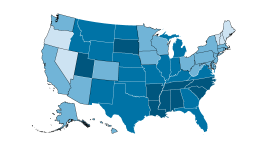
Religious Groups Differ Widely in Their 2026 Midterm Preferences
White evangelical Protestants and White Catholics favor Republicans in the midterms, while other religious groups split or lean Democratic.
Numbers, Facts and Trends Shaping Your World
Read our research on:

White evangelical Protestants and White Catholics favor Republicans in the midterms, while other religious groups split or lean Democratic.

Sent weekly on Wednesday
All
Publications
10:00-11:30 a.m. Washington, D.C. Featured Speaker: Andrew Kohut, Director, the Pew Research Center for the People & the Press Respondents: Craig Kennedy, President, German Marshall Fund Justin Vaisse, Visiting Fellow, Foreign Policy Studies, Center on the U.S. and France, the Brookings Institution Moderator: E.J. Dionne Jr., Co-Chair, the Pew Forum on Religion and Public Life; […]
6:00 p.m., Reception 6:30 p.m., Screening followed by discussion National Press Club Washington, D.C. Comments by: Michael Pack, Producer and Director of God and the Inner City Featured Speakers: Rev. Dr. Wilson Goode, Sr., Senior Advisor, Faith-Based Initiatives at Public/Private Ventures and former Mayor of Philadelphia Richard Nathan, Director, The Roundtable on Religion and Social […]
10 a.m. – Noon Washington, D.C. Speakers Dr. Michael Lawrence, Associate Pastor, Capitol Hill Baptist Church Kate Moynihan, Deputy Regional Director for Middle East and North Africa, Catholic Relief Services Dr. Abdulaziz Sachedina, Professor of Religious Studies, University of Virginia; Chairman, Board of Directors, Center for the Study of Islam and Democracy Bruce Wilkinson, Senior […]
Introduction and Summary The speed of the war in Iraq and the prevailing belief that the Iraqi people are better off as a result have modestly improved the image of America. But in most countries, opinions of the U.S. are markedly lower than they were a year ago. The war has widened the rift between […]
John D. Carlson and Erik C. Owens, eds. Georgetown University Press, 2003 $26.95 Until September 11th, 2001, few in the West fully appreciated the significance of religion in international politics. The terrible events of that day refocused our attention on how thoroughly religion and politics intermingle, sometimes with horrific results. But must this intermingling always […]
Conference took place May 20-22, 2003 Freedom Forum Arlington, VA Keynote Speech Jon Butler, Yale University Teaching About Religion in Public Schools: History and Background on the U.S. Constitution Speakers: Charles Haynes, First Amendment Center Melissa Rogers, Pew Forum on Religion and Public Life Jennifer Norton, Argonaut High School Evelyn Holman, Bayshore, New York School […]
4:00 p.m. University of Chicago Divinity School Chicago, Illinois Ambassador Palouš is a political philosopher and was among the first signatories of the Charter 77 document calling on the communist regime in power in Czechoslovakia to respect human rights. In November 1989 he became one of the founders of the Civic Forum, which replaced the […]
9:00 am-5:00 pm Chapel Hill, NC Due to technical difficulties, we are unable to provide the transcript from the Q&A of these panels. Session 1: History of the Blaine Amendments Session 2: Blaine Amendments and the First Amendment Session 3: Blaine Amendments: Current Litigation and Legislation Session One JASON KAY: My name is Jason […]
Introduction and Summary Americans Hearing about Iraq from the Pulpit, but Religious Faith Not Defining Opinions Most American churchgoers are hearing about the issue of war with Iraq at their places of worship. But most say their ministers are not taking a position for or against the war, and relatively few people say their own […]
Across 25 countries, Americans are the most likely to see the morality and ethics of people in their country as somewhat or very bad.
Singapore is the world’s most religiously diverse country overall as of 2020, while Yemen is the least diverse. But the U.S. ranks first among nations with very large populations, followed by Nigeria and Russia.
The Christian share of the population, after years of decline, has been relatively stable since 2019. And the religiously unaffiliated population, after rising rapidly for decades, has leveled off – at least temporarily.
The Global Religious Futures (GRF) project is jointly funded by The Pew Charitable Trusts and The John Templeton Foundation. Here are some big-picture findings from the GRF, together with context from other Pew Research Center studies.