
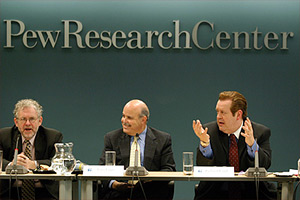
Pew Research Center Washington, D.C.
In his recent article in Foreign Affairs, Walter Russell Mead argues that as U.S. evangelicals exert increasing political influence, they are becoming a powerful force in foreign affairs. In recent years, evangelicals have voted overwhelmingly Republican, helping to put conservatives at the helm of U.S. foreign policy, while focusing their energies on a handful of specific issues, including support for Israel, the promotion of religious freedom abroad and the alleviation of hunger in Africa. But as evangelicals mature politically, they are showing interest in a broader array of foreign policy issues, including some, such as global warming, traditionally seen as liberal.
The Pew Forum invited a group of distinguished journalists to hear Mead discuss his article and asked Leon Fuerth, of George Washington University, and Richard Land, of the Ethics and Religious Liberty Commission of the Southern Baptist Convention, to respond to it.
Speaker: Walter Russell Mead, Henry A. Kissinger Senior fellow for U.S. Foreign Policy, Council on Foreign Relations
Respondents: Leon Fuerth, Research Professor of International Affairs, Elliot School of International Affairs, George Washington University
Richard Land, President, Ethics and Religious Liberty Commission of the Southern Baptist Convention
Moderator: Luis Lugo, Director, Pew Forum on Religion & Public Life
LUIS LUGO: I’m Luis Lugo, director of the Pew Forum on Religion & Public Life. We are a project of the Pew Research Center. The center is a research organization and does not take positions on policy debates. This luncheon is part of an ongoing series that brings together journalists and government officials, policy leaders, et cetera, to discuss timely topics at the intersection of religion and public affairs.
I am pleased to welcome you today to a discussion on evangelicals and U.S. foreign policy, a discussion that is prompted by an article on the subject in the latest issue of Foreign Affairs, entitled, “God’s Country?” The author, Walter Russell Mead, is our special guest today.
Evangelical Protestants, as most of you know, constitute about a quarter of the American electorate. In the last presidential election, they voted 78 percent for George W. Bush, and that constituted about 40 percent of his total vote. Evangelicals have made a name for themselves, primarily through their involvement in domestic culture-war issues. But in recent years, they have also been building up a head of steam on foreign policy issues.
Everyone knows that evangelicals are stalwart supporters of Israel, and that has been the lodestar of evangelical foreign policy. But of late, they have also been branching out in significant ways, in areas such as human trafficking, HIV/AIDS, and international religious freedom.
Just how are evangelicals influencing the priorities of American foreign policy? What is the extent of their agenda on these humanitarian issues? How do they view Islam and the war against Muslim radicalism? What are the main fault lines on foreign policy issues within the evangelical community?
To help us explore these and other questions, and the implications for the future direction of U.S. foreign policy, we are pleased to have with us three very distinguished experts.
Walter Russell Mead is the Henry A. Kissinger Fellow for U.S. Foreign Policy at the Council on Foreign Relations in New York. Walter will be discussing his Foreign Affairs article on evangelicals and U.S. foreign policy.
In the interest of full disclosure, I should tell you that we have been in partnership with Walter and the council for the last couple of years on an ongoing study group led by Walter and Timothy Shah, a senior fellow here at the Pew Forum, that looks specifically at religion’s role in U.S. foreign policy.
Responding to Walter will be two very active participants of that study group. Leon Fuerth is research fellow at the Elliott School of International Affairs at George Washington University, and former national security advisor to Vice President Al Gore. Richard Land is the president of the Ethics and Religious Liberty Commission of the Southern Baptist Convention, and a very important player in evangelical advocacy efforts on foreign policy issues.
As you know, we always structure this as an informal conversation, and we have asked the presenters to keep their remarks brief so we have plenty of time for your questions and comments.
Walter, let’s hear from you first.
WALTER RUSSELL MEAD: I have a number of good reasons to be brief today. One is that most of what I have to say on this subject is available in my article. But as I reflect on the article, there are a couple of extra things that might be worth saying.
Probably the most important point is that most of us have tended to look at the rise of a more conservative form of Protestantism in the United States and divide American Protestants into two camps: a liberal or mainline Protestant camp of churches including Methodist, Episcopalian, Presbyterian, Congregationalist, and then a fundamentalist camp in which we put the Southern Baptists, Pentecostals, and many other groups.
A more helpful and useful way of thinking about this is to divide American Protestantism into three groups, that is, the liberal or mainline group and then, within the world of conservative Protestantism, a fundamentalist and an evangelical camp. Both fundamentalists and evangelicals have grown somewhat both in influence and in numbers because in the United States, as almost everywhere in the world other than Europe, religion is becoming more salient as a factor in identity and politics. In general what I call “hot religion” is becoming more prominent and “cool religion” is fading.
Both forms of conservative Protestantism have been gaining. But the evangelicals are where the real political action is in the United States. This is partly driven by the fact that fundamentalists in the U.S. are somewhat divided in their political vision. If you’re looking for people in America who would like to see a Christian or biblicist theocracy, say, on the model of Oliver Cromwell’s England, or Massachusetts of the 17th century, or Scotland in the 17th century, you would find people with those views among fundamentalists, though not all fundamentalists share them.
But the fundamentalists are so small in number as a percentage of the overall population and so isolated politically that this is a very unrealistic aspiration. The other alternative is withdrawal from an impure world, or concentrating on a very small number of causes. So fundamentalists are not as much of a factor in American politics and in the future of this country. Evangelicals who share some features with fundamentalists and some features with mainline Protestants are probably where the real action is, and that is where I have concentrated.
To step back a little bit, American Protestants still constitute about 52 percent of the American population as a whole. The next largest group is Roman Catholic, which includes about 24 percent of the population, and then you get rapidly into much smaller groups. Luis can probably give you the demographics better than I can.
MR. LUGO: That is why I have John Green in the crowd. For any numbers question, we are going to turn to him for a definitive and authoritative answer.
MR. MEAD: Right. American Protestants remain the majority religion. But the big news is evangelicals have become the majority of the majority in the last couple of decades. If you look at polling that is two or three decades old, you’ll find the mainline Protestants were the majority of the majority, and if you look more recent polling, you’ll see evangelicals have become the majority of the majority.
We can talk about the theological differences between mainline Protestants and evangelicals. I’m not sure that that would get us very far today. I have concentrated, in the article and in my work, mostly on evangelicals’ impact on foreign policy.
One thing I didn’t say in the article, but is very important to understand, is that their biggest impact on foreign policy is not necessarily a direct result of their own views. The fact that evangelicals, for largely domestic reasons, tend to vote Republican means that when people have made foreign policy in the United States, particularly in the last six years, they have been Republicans and not Democrats.
Nevertheless, evangelicals do have some rather specific foreign policy views that are politically relevant. In my article, I looked at two: one was their concern over poverty in Africa, and the other was a concern over Israel and Israel’s place in American foreign policy.
I didn’t say much about religious freedom in my article, but evangelicals have definitely been the major force in making religious freedom a much more salient feature in American foreign policy. When, for example, President Bush receives Chinese dissidents, they are now more likely to be members of house churches or groups like that than some of the more traditional dissident figures who might have visited past administrations. It doesn’t mean that there is no concern for these other issues, but the secular human rights movement had more or less marginalized the cause of religious freedom and viewed it as one of many issues. For evangelicals, it is a central freedom, if not the central issue.
What we are seeing, then, is the emergence of a powerful force in American foreign policy. I believe the evangelical moment in American politics is not over and that the impact of evangelicals on American politics generally and on foreign policy in particular is likely to become greater. It is also likely to become less focused. As the group grows and matures intellectually and politically, you will see more diversity in the way leading evangelicals define their political agenda. For example, a few years ago, you would not have seen many evangelical leaders engaged in something like global warning; today you will find significant religious leaders in the evangelical community speaking out on global warning and saying the church ought to be involved with climate change.
You will see some learning through experience. Any group that hasn’t been involved in a hands-on way with foreign policy tends to learn, once it has its fingers burned a few times, that foreign policy is complex, difficult, and sometimes requires counterintuitive steps – two steps backward in order to take a step forward a later date. But you will also see that American politicians must be increasingly able to relate the goals of American foreign to the religious and political concerns of evangelicals.
Why is this religious revival or this evangelical revival likely to continue in the U.S.? It is partly because liberal Protestantism is in serious decline. Liberal Protestants are the chief rivals of evangelicals for power and influence in the religious world, and the liberal Protestant crisis is a deep one. It’s a demographic crisis; membership in the churches is shrinking.
It’s also becoming a financial crisis. These denominations have historically exerted their influence on policy less through grassroots networks, like, say, the Christian Coalition, and more through Washington-based lobbying offices. As denominational financial bases shrink, and more resources have to be devoted to keeping up shrinking congregations and aging buildings, there is less and less money available for the forms of national outreach that have characterized these churches.
Seminaries and some others of the very elaborate and expensive institutional infrastructure that liberal Protestantism developed, particularly in the second half of the 20th century, are likely to come under increasing strain. It won’t just be doctrinal and political struggles over things like ordination of gay and lesbian clergy that divide the liberal denominations, but also the struggle for survival and how to handle a dwindling pool of resources.
We will also see, I think, a theological shift toward a more conservative stance by some of these denominations in keeping with changes generally in American culture and religion. When brand X is working pretty well, brand Y starts trying to look more like brand X in order to be more successful.
Liberal Protestants are also less capable than they used to be of exercising the role of the convening body in American religion. Again, if you go back 25 years, it would be the liberal Protestant leadership that would convene the Catholics, the Jews, and an ecumenical group of Protestants to deal, at a local or national level, with various kinds of political or social problems.
Because of quarrels over abortion and other social issues with Catholics, and because of increased sympathy for Palestinians rather than Israel in the Middle East, liberal Protestants today are less able to perform that role of the neutral convener. Meanwhile, evangelical relations with both Jews and Catholics are far, far stronger than they were 30 years ago. Again, this is as much to do with domestic issues as it is with international issues.
We are in the midst of a change in the balance of power in American religion, one that is not likely to end soon. That, I suppose, more than anything is what I was trying to call attention to in this article. Thank you.
MR. LUGO: Very good summary. Leon, you’re first up in responding.
LEON FUERTH: If I can begin with a bit of personal background. I started off in the New York public school system, like any other kid, but when my father died, to fulfill a wish of his, I was transferred to a Hebrew school. We were taught half the day in Hebrew under Orthodox auspices, and half the day in English under advanced liberal auspices – (laughter) – the result being that there were some classic battles between the faculty within hearing range of the students, most of whom were not fully comprehending of what these arguments were all about, but I was all ears.
The impact of spending the morning learning about the Talmud and the afternoon learning about evolution was permanent. What it left in its place was a constant interest in equilibrium, that is, how to lead a life with these two impulses, rather than pitch them against one another in a battle to the death. That had an impact on me as I grew up and became interested in international affairs and as I practiced them in the course of my time in the White House with Vice President Gore.
Point being that I was engaged in the governance of a secular state with firewalls between religion and the interests of the state, and, in principle, entirely separate doctrines regarding how to think about the interests and requirements of the nation state, and how to think about the interest and requirements of the people as a religious and ethically driven group.
From my perspective, it was always obvious that religion was important, not so much in the question of who had power – though that is an increasing concern – but more because it is so fundamental, so much a part of the foundation of the country and its history and psychology. As a nation, we reason from religion to ethics and from ethics to a sense of the American identity, and from that sense of American identity to the question of right conduct, including right conduct in the world and what was expected of us, and only from there to foreign policy.
I always thought that efforts to short-circuit that reasoning and jump into foreign policy without consideration to the ethical center of gravity of people would put American foreign policy in a place where the American people would not follow.
I’m an outsider to the religious strivings of the Protestant world. As I read Walter’s article, I practically had to make a tally sheet to keep track – (laughter) – of who was who. But I tend in the face of complexity to force simplicity, and what I derived is that there is an ongoing struggle over certain questions that are central to our foreign policy. One of them is whether the world is worth struggling over or whether it should be left to God entirely. Anybody who goes into government has already answered that question. You should not be in government unless you have an a priori conviction that the world is really worth struggling over.
But once you get into government, the next questions are what compromises are you going to make in the course of that struggle, and at what point in making those comprises do you run off the rails and reach a condition where what you are doing itself is destructive and should be abandoned. Those are eternal questions and any of us can think of their contemporary cognates.
In the highest councils of government, at least as I have experienced them, policy discussions would often revolve around very raw questions of what is right: what is right for the participants in terms of their personal ethics in the knowledge they would eventually leave office and have to live for the rest of their lives with things done and undone; what would be right for the country in the sense of what do people expect their government to do in their name; and what is right for the world, given our strong perception at that time that if the United States would not act in a given situation, no one else would. There was this sense of weight because the default position in most of the crises that we saw was inaction if we would not engage.
One must deal not only with the question of the role of formal religion in shaping people’s attitudes towards governance, but also with the question of theoretical ideology. We can all identify our favorite Hegelian theorists, theoreticians, people who believe that they understand the laws of history, whose reasoning is not religious but teleological; that is, they seem to sense that history is going to deliver us some place and the right policy consists of helping the delivery, not resisting it. That too is a constant presence in governance; it’s essentially the other side of the house.
One thing that has always interested me about the Pew Research Center is the image it creates of American opinion. It shows that the American people, by and large, are sane even when their leaders are not. The typical result of a Pew Research Center poll of American opinion, even on subjects considered to be red-hot and divisive, is a fairly clear rule of reason down the middle.
I have always had this feeling that between theoreticians who understood where history was going and theologians who had the same sense, there were the American people who still looked at events with a critical eye and were open to argument and responsive to the facts. That goes to Lincoln’s remark about how you can fool all of the people some of the time, but not all of the people all of the time.
With respect to this question of the range of foreign-policy topics that evangelicals are engaging in, my opinion is that range is destined to expand and expand in ways that one does not often think about at present. The interest in global warming, for example, is the front door to a lot else. One does not become interested in protecting the global environment as a religious obligation without marching into the interesting areas of economics, taxation, the ethics of use, the ethics of what is a common, the ethics of what belongs to this generation and what needs to be safeguarded for the next. When the evangelical clerics declared that the global environment was a fit topic for people of religion, they opened the gate to a great deal else yet to come.
In my work at the GW, I pursue work on something I invented called forward engagement. It’s my effort to teach my students to think across the categories of disciplines – because in my experience in government, events did not obediently stay within those categories – and to think long range because the long range arrives on your lap soon enough, and very often, if you are not sensitive to it, the determinants of what the long range will be are actually in your hands but slipping through them if you’re not thinking about what they are.
When I look at these long-range trends, I see things that no religion, not branches of the Protestant faith or Catholicism, or Judaism, or the rest, are ready yet to engage because of their speed and magnitude. I’ll conclude by giving you an example.
Last April I gave a conference at GW that I called three societal tsunamis. This was an effort to depict what I thought were three tremendously powerful forces that are gathering, capable of transforming the structures that we are accustomed to, and needing to be addressed now rather than later.
One of these was what I call evolutionary succession. It was the result of my readings about the convergence of sciences such as genetics, nanotechnology, and informatics. I concluded that, driven by the marketplace, we will have sciences and technologies entering common use that enable us to select our destiny not only as individuals but as a species, and that this will happen in the lifetimes of those seated at this table, and that much of this will already be embedded before we can even ask ourselves whether it should be allowed to proceed down these routes.
From the point of view of the discipline that I try to inculcate, the future is already being shaped. The future is so dynamic that it is discontinuous with any of the experience that has shaped any of our religions. So in effect, all people of belief are going to have a hard time coming to grips with what is afoot.
MR. LUGO: Thank you, Leon. I want to make sure I understood one of your points before I move to Richard. In your comments about the expanding agenda of evangelicals, I take it you think it is a good thing because it will tend to have a moderating effect on evangelical political involvement rather than a theocratic effect, if I may use the other pole. Did I read you correctly on that?
MR. FUERTH: That depends on whether I read Walter correctly. What I read was that people have made a decision that the world is worth striving for, and have started to make choices about what in the world is of priority importance, and he has listed a number of these areas. Not surprisingly, they have a strong ethical and religious foundation. I thought that was a fundamentally good thing with lots of caveats about how it unfolds. But it is good that a bedrock American consensus about what is right and what is wrong is sustained by a religious view that says, “This is worth fighting for in our policy.”
MR. LUGO: Thank you. Richard?
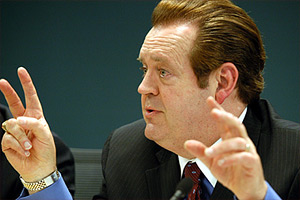
RICHARD LAND: I very much appreciated Walter’s article and where it appeared. I think he has picked up on an important underlying force in American social and cultural and political life. If you have not read this article carefully, I would encourage you to read and reread and then read again his analysis of the numbers because this town and, I would argue, the foreign policy establishment, and to some degree the social and cultural elites in our culture, haven’t caught up with the numbers yet, that American liberal Protestantism is imploding and evangelical Protestantism is burgeoning.
I must confess I was a little surprised at some of Walter’s numbers myself. I don’t dispute the numbers, but the fact that there are more Southern Baptists than there are Methodists, Presbyterians, Episcopalians, and Lutherans even surprised me a little, and I’m a Southern Baptist.
MR. LUGO: And that was combined, right?
MR. MEAD: Yes, but I think it wasn’t Lutherans; it was somebody smaller, maybe Congregationalists. There are a lot of Lutherans.
MR. LAND: Congregationalists and United Church of Christ; that’s right.
On this three-fold grid he uses, which I think is a very useful interpretive tool, I’m an evangelical. The vast majority of Southern Baptists are evangelicals. We do have Southern Baptists who are fundamentalists, and we do have Southern Baptists who are liberals, some of them rather famous, like Al Gore and Jimmy Carter and Bill Clinton.
Based on my experience of 18 years as a denominational agency head, I would say about 15 to 20 percent of Southern Baptists would fit into this fundamentalist category, and about 15 percent would fit into the liberal category. This would be reflected in the exit polling, for instance, from the 2004 election, which showed that people who identified themselves as Southern Baptists voted 84 percent for George Bush and 16 percent for John Kerry. That same exit polling showed that in 2000, they voted 80 percent for George Bush and 20 percent for Al Gore, which I think is probably the maximum vote someone like Vice President Gore could get from people who identify themselves as Southern Baptists.
In Walter’s article I love the analogy that we have seen parts of this movie before. Evangelicals, as broadly understood, were a dominant force in 19th and early 20th century American Protestantism. I would describe Woodrow Wilson as an evangelical, and I would consider what are being described as evangelical approaches to foreign policy as Wilsonian in many ways.
Perhaps the most helpful thing to me about Walter’s article was the concluding paragraph, because it helped me articulate what I already believe: “Evangelicals are likely to focus more on U.S. exceptionalism than liberals would like, and they are likely to care more about the morality of U.S. foreign policy than most realists prefer.” I think that is true.
Let me hasten to define how most evangelicals define American exceptionalism. They do not see it as a doctrine of empire; they do not see it as a doctrine of pride and privilege; they see it as a doctrine of obligation, of responsibility, and service in the cause of freedom under the rubric of to whom much is given much is required.
Most evangelicals I know would agree with me that they do not believe that America has a special claim on God, but they do believe that God has a special claim on them, that to whom much has been given much is required, and that we have an obligation and a responsibility to be the friend of freedom and to share freedom, to speak out in defense of freedom, and to help foster freedom. By freedom we mean more than just one vote, one time; we mean more than democracy. We mean what we believe are universal human rights of life and liberty.
I serve on the U.S. Commission on International Religious Freedom. It was brought into place by a wide-ranging coalition of groups, evangelicals being significant participants in that. I have learned in Washington it’s absolutely true that there is no telling what you can get done as long as you don’t insist on getting credit for it.
So I won’t say that evangelicals deserve the major credit for the International Religious Freedom Act, which created USCIRF and the State Department’s yearly report. But I will say, like General Patton did when there was a big fuss among the Russians and the Americans and the British over who should march first in the victory parade in Berlin, “We’ll march last because no one can say we did the least to win the war.”
Evangelicals certainly were a major player in that legislation, and I would agree with Walter that the evangelical involvement in foreign policy has focused on human rights, the USCIRF and the International Religious Freedom Act being one thing, and the expansion of the Sudan issue to Darfur being another. I would encourage all of you who have an interest in seeing more documentation or a more expansive discussion of this to read Allen D. Hertzke, Freeing God’s Children, which documents in a major way the evangelical involvement in human rights and religious freedom issues around the globe.
Walter, you were more charitable toward fundamentalists than I would be – (laughter) – but that may be because you don’t have to deal with them as often as I do. (Laughter.)
MR. MEAD: Malice towards none and charity to all. That’s my approach.
MR. LAND: But just a couple of things from an insider’s perspective. In your article, you talk about the breakup, and there certainly was a bitter breakup in the mainline denominations between the liberals and the conservatives, some of whom ossified into fundamentalists, some of whom remained evangelicals. But it didn’t just happen in the early 20th century.
This is a division in American Protestantism that goes back at least to the 18th century when you had the first Great Awakening, which turned the least religious part of the country, the South, into the most religious part of the country, which it has remained since.
In the New England you had the fight between the old lights and new lights, and then the middle colonies among the Presbyterians, the old sides and new sides, the old sides being the more liberal group, the more established group who hated the revivalists, and hated what Whitefield and Wesley and Edwards were doing. And that has been a continuing theme in American Protestantism from the very beginning between more established and more liberal elements, and more conservative and more revivalist elements.
I have always considered Reinhold Niebuhr to be neo-orthodox, not liberal. I think there is a difference. A lot of evangelicals have a very positive attitude toward Reinhold Niebuhr and toward Karl Barth, which is one of the differences between us and the fundamentalists. I don’t know any fundamentalist who has a positive attitude toward either one. I still read Niebuhr all of the time and find him very helpful and that causes my fundamentalist colleagues to consider me suspect.
MR. LUGO: But Richard, a quick explanation of the distinction in your mind between a liberal and a neo-orthodox.
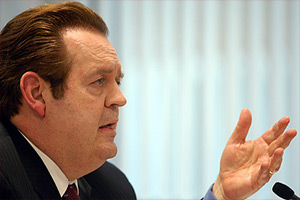
MR. LAND: Neo-orthodox are often called fideists. They still observe the classical orthodox teachings of the faith. But they have surrendered the ground epistemologically. They are saying these beliefs cannot be put up to tests of proof, that the normal laws of evidentiary evaluation don’t apply. People like Barth and Niebuhr would talk about things in very classical Christian terms but would say, “These are faith affirmations” – a very Kierkegaardian approach, a leap of faith – “and they can’t be subjected to evidentiary truth standards,” whereas evangelicals would reject that.
Walter gets so much right in his article that it’s hard to talk about the things he gets wrong, but I do think he gets it wrong when he talks about the evangelicals on Israel. I don’t think most evangelicals wouldn’t say this: “U.S. evangelical theology takes a unique view of the role of Jewish people in the modern world. On the one hand, evangelicals share the widespread Christian view that Christians represent the new and true children of Israel, inheritors of God’s promises to the ancient Hebrew. Yet unlike many other Christians, evangelicals also believe that Jewish people have a continuing role in God’s plan.”
I think that is a conflation of what actually goes on. Within evangelical Protestantism there is a basic split. On the one side are people who accept what is called replacement theology, the belief that the church has replaced Israel, and that God’s promises to the Jews and God’s promises to Israel have been abrogated, and now the people of God are the church.
A majority of evangelicals reject replacement theology – I don’t know any evangelical personally who would argue that the church is now God’s children; they would argue that God still has a plan and a purpose for Israel, and that the promise that “God blesses those that bless the Jews and curses those who curse the Jews” is still in place. They would see the church and Israel as separate; that God is continuing to fulfill his promises with the Jews, but he has made other promises to the church.
D.J. Kennedy, for instance – many of you will know him, he’s a leading evangelical Presbyterian – he believes in replacement theology. He is an a-millennialist – no millennium – as opposed to being a pre-millennialist. A majority of evangelicals would reject replacement theology, but there would be a significant minority who would accept it. Most Southern Baptists would reject it, and virtually all of the Pentecostals I know would reject it. But those elements that were once part of the Presbyterian denomination, they are the more conservative elements within the mainline denominations and would be more likely to believe in replacement theology.
When you talk about liberal Protestantism and its demise, or its shrinking, you make a point that I think is made a little more tartly by Charlotte Allen in an L.A. Timescolumn. She is the Catholicism editor for Belief Net. She says when your religion says “whatever” on doctrinal matters, regards Jesus as another wise teacher, and refuses on principle to evangelize, and let’s you do pretty much what you want, it’s a short step to deciding that one of the things you don’t want to do is to get up on Sunday morning and go to church. I think we have seen that lived out in liberal Protestantism.
The second very important fact is the demographic one. And I would encourage all of you to go to our website. There are numerous articles by Phillip Longman and others that show that conservatives in America tend to have a lot more children than liberals. This isn’t just true of non-Christians; it’s true of Christians as well. Liberal Protestants tend to have much lower birth rates than conservative Protestants, and this tends to show up 25 years down the road in a rather dramatic fashion.
One calculation is there is a 41 percent procreation gap between people who identify themselves as conservatives and people who identify themselves as liberals in the United States. (Laughter.) I started thinking about it, and most of the liberals I know have one or two kids or no kids, and most of the conservatives I know have at least three.
The last thing is a little more parochial, but I think it’s important. Southern Baptists are the largest evangelical denomination. We’re the largest Protestant denomination. For the last 20 years, we have been growing at 12 percent a year outside the South and 2 percent a year inside the South. We have gone from being an intentionally white denomination – as late as 1970 – to being a denomination that is currently 20 percent ethnic. We have 750,000 African-Americans Southern Baptists, and about half-million Hispanic American Southern Baptists.
South Baptists have taken the lead in many ways in terms of evangelical involvement in public life, and I think there are two reasons for that. One is a lot of evangelicals outside the South are the children or the grandchildren of the people who lost the debates in their denominations in the 1920s and the 1930s, and they view themselves as outsiders in their own culture.
Southern Baptists were the de facto established group of the South. We consider ourselves insiders. We are far more comfortable with power than northern evangelicals have been historically. Once we were liberated from our Babylonian segregationist captivity, we have found it much more natural and much more comfortable to be involved in the public policy process than some of our evangelical brethren.
MR. LUGO: Thank you, Richard. The “20 percent ethnic” includes African Americans, Latinos, and Yankees? (Laughter.)
MR. LAND: And Asians. We have a lot of Asian Americans in the West. We have a lot of churches in the West that do not have a majority ethnic makeup in the congregation. They literally do not. They are like California; there is a plurality but not a majority.
MR. LUGO: Before I turn it over to questions, I would like to introduce Michael Cromartie and E.J. Dionne. They help us co-host these lunches.
Mike is vice president of Ethics and Public Policy Center, an expert on evangelicals and politics, and a player in his own right on foreign policy issues, particularly international religious freedom questions.
E.J., as you know, wears many hats – columnist for The Washington Post, professor of politics at Georgetown University, senior fellow at Brookings.
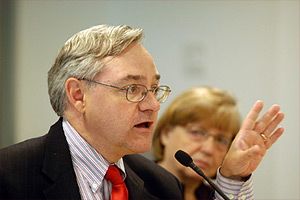
E.J. DIONNE: First, I want to assure Richard that my wife and I take our responsibilities to liberalism seriously, and we have three kids. (Laughter.) So we want to make a difference. I always joke we have a 1950s Catholic family discounted for inflation. (Laughter.)
Walter has been so instructive over the years in inventing revealing categories that allow us to see reality from a different angle. I want to ask Walter if, to speak in marketing terms, he can relate his current product to an earlier product, which is to say your interesting distinction you made a few years ago, very shortly after 9/11, when you went with some traditional categories of American foreign policy thought, including Wilsonianism, Hamiltonian.
But the most interesting category was the Jacksonians. In my bastardized version of your Jacksonians, they are tough-minded, practical, more nationalist than internationalist, ready to fight but not eager to fight far away or for a very long time.
Two questions related to that: One is, it strikes me looking at opinion on Iraq, that the people whom the policy has lost may be your Jacksonians, that they thought it was a Jacksonian war; it turns out to be a Wilsonian war, and they don’t like it so much.
But secondly, I would like to see how your Jacksonians fit in with these religious categories because I suspect demographically a lot of the Jacksonians may be evangelicals, and yet I’m not sure there is a clear fit. I want you to enlighten me on what the fit is between the Jacksonians and the people you described as evangelicals.
MR. MEAD: Good question. First, I think you’re right, that some of the administration’s problems have come from the fact that Jacksonians aren’t so sure that a Wilsonian war is what they wanted. And a lot of Andy’s polling is showing that where the administration has lost support has been often among Jacksonians. That would include issues like immigration.
If you look at things that Jacksonians want the government to do in foreign policy, they mostly involve protecting the American people from bad things outside America, which would include illegal immigrants, the loss of American jobs overseas, evil tyrants who were planning to attack us with WMD, and terrorists.
Once the WMD argument for the war in Iraq evaporated, Bush went to a Wilsonian strategy that hasn’t helped him much. I have thought if he wanted to go up in the polls, he needs to talk less about how wonderful Iraq will be if we win and there is a beautiful democracy there, and more about how horrible it would be if al Qaeda controls all of this oil. He might get a second wind politically if he talks about the consequences of failure rather than the glories of success.
On the question of how evangelicals and Jacksonians fit together, I think it’s very complicated. In general, the white South, if we take that as a marker, has tended to be both Jacksonian and evangelical. But there is a tension between Christianity and populist nationalism. In the Southern Baptist case, for example, there was a lot of segregationalism in their theology that in more recent decades has been very thoroughly critiqued on a biblical basis. Folk beliefs had been read into the Bible by several generations of preachers.
What I think we’re going to find is as the evangelical intellectual resurgence develops further and people bring critical tools to American nationalist aspirations among evangelicals, we will find that evangelicals today are sounding more like a mix of William Jennings Bryan and Woodrow Wilson in some ways.
For a lot of average non-intellectual types, they won’t be more moved by the Wilsonian aspirations of intellectuals. American populists are very hard to lead away from where they want to be. They will follow you as long as you are going in the direction they want you to go, but they have a tendency to desert you if you move too far.
The dominant theme here is that the relationship of Protestant Christianity and American nationalism is problematic now and has been through all of our history, and that we are probably headed for more of the same of debates. Is our foreign policy supposed to come out of the Sermon on the Mount, or maybe it comes out of the Book of Joshua – you know, “smite them.” Religious leaders won’t fully control that debate, but they will be shaping it.
MR. DIONNE: I know Richard has strong views on nationalism.
MR. LAND: I think we can never assume that God is on our side, and we have to take Lincoln’s posture of trying our best to be on God’s side. The difference between us and a lot of our liberal friends is we believe God has a side, and that America should be on it, that God is not neutral about things like freedom, that it is a God-given right.
Secretary Rice gave a very Wilsonian speech to the Southern Baptist convention assembled in Charlotte, North Carolina, this past June, and she got 12 standing ovations. And when she left the podium, people spontaneously broke into an a capella chorus of “God Bless America,” and she turned to me and said, “Wow; that is great.” It was a little different than some of her audiences. (Laughter.)
MR. MEAD: I wonder if that has ever happened to her at the U.N. General Assembly. (Laughter.)
MR. LAND: Even as early as 1991 in the first Gulf War, George Bush’s arguments and bankers’ arguments that this was about oil fell like a dud among Southern Baptists. It was only when he started talking about St. Thomas Aquinas – as he famously said, “St. Thomas A-keen-us,” (laughter) and this guy’s a Phi Beta Kappa from Yale – that it began to catch fire among Southern Baptist constituencies, that this was something we should do. So I think it is more Wilsonian and will get more Wilsonian in the future.
MR. LUGO: Very interesting. I have Alan Cooperman, Washington Post. Alan?
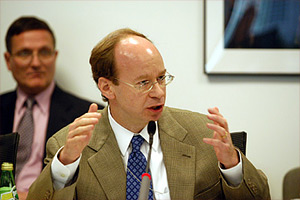
ALAN COOPERMAN: Most of the foreign policy areas in which evangelicals are very active these days are areas in which there is a lot of common ground with liberals, both liberal Christians and liberals more generally, certainly in the Sudan and trafficking, and AIDS, and debt relief, and even religious freedom. There is not really much that liberals fear from evangelicals, except in one particular area, and that area is the Middle East, and it has to do with eschatology.
The question I want to ask – but first I’m going to burden you with a long mini-disquisition – is do evangelicals have a different attitude toward war in the Middle East than non-evangelicals? With a little bow to Leon and Leon’s religious training, I would note that in Judaism, as I understand it, there is a bit of tension over understanding the question of whether we, living here in this world, can do anything to help bring about the coming of Mashiach, the Messiah.
There are two elements on this in Jewish tradition. One is the notion that we can do something; it is said that if all Jews in the world were to simply keep the Sabbath for two Sabbaths in a row, Mashiach would return. The other is, however, a Talmudic injunction against what is called hastening, that you should not do anything deliberately to try to bring about Mashiach.
Among evangelicals, in addition to in Walter’s division, post-millennialists and pre-millennialists, there is also what Dr. Land referred to, a-millennialist. When I go out and talk with evangelicals, I find most have no fixed eschatology at all, that really contrary to the Leahy thing, many evangelicals will not tell you, “I know exactly how this is going to go down in the end times.” However, I say no fixed eschatology, but they do have an eschatology. They believe that the Second Coming is going to happen.
I just heard Dr. Land a moment ago say, “One important difference between us and our liberal friends is we believe God has a side; there is a plan.” So I do not want to over-emphasize this. But I don’t think most evangelicals, in my experience talking with them, actually believe we should try to bring about Armageddon. However, I do wonder whether as a general rule, a kind of attitudinal thing, commotion in the Middle East is less upsetting to evangelicals than it is to non-evangelicals.
If you watch something like CBN and the 700 Club, you will pick this up in the attitude presented toward events in the Middle East. The commotion that is going on there, the upsets, violence, et cetera, is seen both as upsetting and in a certain way as fulfilling of God’s plan. I would wonder if Dr. Land could comment on the truth or falsehood of that.
MR. LAND: I have to take your word about CBN because I don’t watch it, and I don’t think most evangelicals do, if you look at their viewing audience. When you define “no fixed eschatology” as not claiming to have an idea of exactly how this is all going to play out or when, I would include myself in that number, and I think most evangelicals would, too. You’ll find more fundamentalists who think they have got it all figured out and can play out the future of the world on a small flipchart, with only one flip, meaning that we are near the end.
Most evangelicals would take the view I take, which is that Jesus told us no man will know the hour or the day of his coming. And when he says no man, he means no man, even TV preachers on the Trinity Broadcasting Network. No one knows. It could be a thousand years from now; it could be next week. That is beyond our purview. Most evangelicals I know would agree with me that there is nothing we can do to either hasten or retard God’s providence and God’s plan; it will happen when God decrees it will happen.
That is why I and most evangelicals I know don’t spend much time worrying about it. We do have a commandment to be salt and light, and we do have a Great Commission to go and share our faith. That is what we should be about doing.
I do think those evangelicals who do not accept replacement theology, which would be a majority of evangelicals in America, do believe that God has a special plan for the Jews and that God still has a special relationship with the Jews. But I hear more nonsense talk about this issue from the talking heads in the secular media than virtually any other issue in foreign policy, the idea that we are somehow going to be God’s agent to give to the Jews what God has promised them. God promised that land to the Jews, we believe, and God is the one who will deliver it to them in his time.
I would point out that probably the most popular president ever among evangelicals is the first American president to officially make a two-state solution American foreign policy, and a majority of evangelicals support him in that.
The part that is most often missed is the enlightened self-interest part. Most evangelicals who believe that God still has a relationship with Israel believe that the promise is still in force, that God blesses those who bless in the Jews, and God curses those who curse the Jews. And we want God to bless America. If America is acting in ways that are detrimental to the Jews, the God is not going to bless America. This seems to be totally lost on a secular audience. I’ll just give you two vignettes.
When Dr. Dobson was 8 years old, he says his father called him in – his dad was a Nazarene pastor, which is sort of the milder form of evangelicalism.
MR. LUGO: Form of fundamentalism.
MR. LAND: Pardon me?
MR. LUGO: It’s a form of fundamentalism.
MR. LAND: No, it’s evangelical. Most Nazarenes are evangelicals. But anyway, his father called him in and wanted him to listen to the radio broadcast of the U.N. vote that created the Jewish state of Israel. He said, “What you are hearing, Jimmy, is the fulfillment of Biblical prophesy. God promised that land to the Jews.”
In 1956, when I was 10 years old, and the Suez war was going on, my mother called me into the kitchen while she was making supper – I think it was John Cameron Swayze on the news. My mother turned to me and said, “God blesses those who bless the Jews, and God curses those who curse the Jews. If America blesses the Jews, God will bless America.” And then she said, “If you want to know what cursing looks like, Richard, you remember you saw the film of the planes over Germany in June of 1945. That is what happens when you curse the Jews.”
I’m telling you, those two vignettes have been played out millions of times in evangelical homes in the last half century.
MR. LUGO: Thank you, Richard. Did you want to draw upon what you learned in your morning classes, Leon, to talk about this idea of hastening? By the way, this is all over the place now because, as you know, Ahmadinejad and other Shi’ites use that term very frequently. Muqtada al-Sadr’s group in Iraq, for instance, their rally cry is “Hasten the coming of the Mahdi.” So this is not just within one religious tradition. Did you want to weigh in on this, Leon?
MR. FUERTH: This is putting me in the position of rabbinical interpreter, which is not comfortable. I had those kinds of discussions with the rabbi who was my seventh-grade teacher during recess. (Laughter.)
MR. LUGO: He is the kind of student you pray you would never get in your classes, right. Go ahead. (Laughter.)
MR. FUERTH: I was more the kind of ball player you pray you never get on your team. (Laughter.)
But to answer your question directly, what I, as a little kid, absorbed was that there is a path of life that is clearly illuminated by the precepts of Judaism, and those precepts, though they refract into hundreds and hundreds of specific things that you are supposed to do or not do are, at the point of origin, extremely simple, and they are simple by design because they are meant to give people guidance throughout their lives under very difficult circumstances.
So whether not one accelerates the coming or decelerates the coming is the kind of issue for scholars to argue about. I think religion belongs to the people because it tells them how they should live with respect to one another and how they should live with respect to God. So it’s a somewhat blunter dispensation.
As I said, I’m an outsider to an in-house discussion about the – (laughter) –
MR. MEAD: Whatever we call it –
MR. LUGO: Well, at least you’re not saying “among the goyim.”
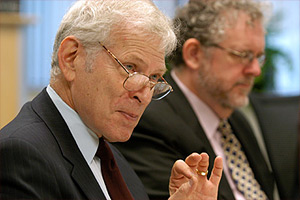
MR. FUERTH: Only in private. (Laughter.) What I am trying to get at is a different kind of a message. No one can doubt the premise that these streams of religious thought and reflection have been terribly influential in the making of this country. But I’m coming from a different place. What I want to say is America is a very large concept in and of itself. Although it is not a concept that is bigger than God, it is a concept that is bigger than denominations.
What we are talking about here is the degree to which America represents things that are larger than any particular set or subset of denominations. The outcome to that debate is always in process. But in my view, the requirements for governing the United States, including its foreign policy, require religion and ethics and cannot ignore them, but neither can they be entirely defined by them, and we will be in deep trouble if we reach the point where that happens. That is the essential question.
MR. LUGO: Very good. Walter, you wanted to get in on this.
MR. MEAD: On Leon’s point, Voltaire said that if you have one religion in a country, you’ll have despotism. If you have two, you’ll have civil war. If you have 30, you will all live together in harmony and peace. I think in the U.S., at last count, we had well over 500 –
MR. FUERTH (?): More than cheeses.
MR. MEAD: Yes, I think we have more religious sects than France has kinds of cheese. (Laughter.)
MR. FUERTH: That makes a civilization, doesn’t it.
MR. MEAD: It makes for something. It makes for interesting conversation. Anyway, I think it’s important on the Middle East question to get the mix of excitement and fear that comes in here. It is absolutely true that most evangelicals and fundamentalists, and even a certain group of liberal Christians, and even Catholics like Walker Percy – Walker Percy would point to the continuing existence of the Jewish people as a sign that God acts in history, and that there is a personal God who makes specific choices in history.
The fact that world politics today is seen to revolve around the successes and failures of Jews in their ancestral homeland is for many, many people of faith in the United States a deep confirmation that their religion is true. I’ve used the phrase before that to a certain degree Herzl trumps Darwin. That is to say, the success of the modern Zionist movement for many people makes them feel, “Yes, Darwin may have said some very interesting things about those rocks out by the quarry, but the book of Genesis actually has tremendous power when I pick up the morning newspaper and look at what is happening.”
I agree with your observation that when the fundamentalist whips out the flip chart of stages and dispensations and so on, evangelicals would tend to be interested but not convinced. One of the big differences between evangelicals and fundamentalists, in my view, is that fundamentalists have a drive to systematize and totalize religious perception. Evangelicals are happier living with gray areas and unanswered questions. Is that fair, Richard, would you say?
MR. LAND: We are far less rigid.
MR. MEAD: A fundamentalist, I’m sure, would say you have less spine. (Laughter.)
MR. LAND: On a good day that is what they would say. (Laughter.)
MR. MEAD: Everybody has got their own view on this. But even though there is no direct connection between a war in Lebanon and the battle of Armageddon, the button is getting pushed that says, “God acts in history, the God of the Bible is the dominant force in shaping our world’s reality today.” When the Middle East looks like it’s the center of world politics, it looks like religion is at the center of the secular world’s concern.
This is one of the causal factors in the return of conservative Protestantism to a larger role. It’s not the only one, by any means, but it’s a real factor. It’s a powerful apologetic argument, and not just in the United States. When I talk to Pentecostals and others in Nigeria, I hear the same thing – that for them, the fact that Israel is there is a sign that this Christian message is an important one. This is a real factor in politics, and it cuts in all kinds of surprising ways.
MR. LAND: Walter, I think you point out in your article that Zionism in American Protestantism long pre-dates the 20th century.
MR. MEAD: That is right. The first book published in the United States that predicted, based on scriptural prophesies, that the Jews would return to the promised land came out in the late-17th century, I think. It was published in colonial New England. So this is a very, very old theme. It has often been one that separated more conservative Protestants from more liberal Protestants, or more populist Protestants from more prophesy-oriented Protestants. It not only confirms for them that Christianity is true, and God is real, but also that my kind of Christianity is better than your kind of Christianity at predicting the future. To the empirical pragmatic American mind, that is a powerful apologetic tool.
MR. LUGO: Quickly, Leon.
MR. FUERTH: I’m not dressed for it, but let me engage in a little bit of prophesy. We get past somehow the never-ending crisis in the Middle East. We get past somehow the threat of international terror, and we are into a world where, as I tried to say before, things haven’t stayed still, not by a long shot. I’m trying to tell you that in that world, which I try to see by getting up on tiptoes, there are more issues than our religions have dreamed of, and bigger ones. We will be confronting, as if we have never heard of them before, issues of free will, causality, the distinctions between man and not man, you name it, and it is coming very fast.
One reaction I have had to this discussion is that its horizon in time is very much too limited by the things that preoccupy us, and whether we are preoccupied or not, more is on the way.
MR. LUGO: Jonathan.
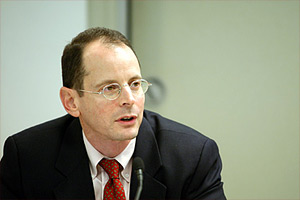
JONATHAN RAUCH, NATIONAL JOURNAL: Thank you. Walter, I had lunch yesterday with an Austrian diplomat who just finished a five-year tour here, and you came up, as you sometimes seem to in conversations.
He said when he traveled around the United States how struck he was, and how utterly alien it seemed to him as a European, when ballgames, for example, or a prison rodeo would open with people standing up and praying in public. (Laughter.) He said you would just never, ever see this in Europe. I said, “You need to read Walter Russell Mead’s new article, and he’ll tell you that this isn’t just a bad conservative thing from a liberal European point of view; they are moving toward, for example, greenhouse gases, which Europeans are going to love.”
He said, “I did read Walter Mead’s article, and I didn’t find it persuasive. We in Europe see ourselves increasingly dealing with a power we fear is theologically driven in conflict with another power that is even more theologically driven, and we really don’t like this; there is a sense of profound discomfort.”
If you’re right that evangelicals’ influence in foreign policy is just getting going, what are the long-term implications for relations with Europe and other great secular powers?
MR. MEAD: This would not be the first Austrian diplomat who has had that reaction – (laughter) – nor is it the first time I have failed to persuade a European on some of these points.
But I do know when I went to the Zugspitze, which is the highest summit in Germany, in Bavaria – what is on the summit is a cross. I was there with a friend whose mother survived the Holocaust in Germany hiding in a basement, and he said he would love to see what would happen in Bavaria if a team of Israeli mountaineers one night scaled the Zugspitze and took down the cross and put up a Star of David, what sort of a reaction that would set off.
Christian identity is tied up in more ways with European identities than many Europeans are aware of and are comfortable with. Their discomfort is not only with the United States and the increased salience of religion in the United States. You go to Britain where people are now talking about, “Do we need blasphemy laws” – laws that criminalize certain statements about God or religious figures – “and if so, what should those laws say?” These things are now on a European agenda from which it would have once seemed that they would have vanished forever.
So even in Europe, which is the one continent that seems less affected by what is otherwise a global religious resurgence, religion is going to be a much larger factor than it has been. Many of the reasons that Europeans have pushed religion into the background of public life – the still unresolved historic discomforts and questions – are going to be back on the agenda in a rather unpleasant way. That will affect U.S.-European relations and European-Islamic relations. The fact that it looks now like it will be a cold day in hell, so to speak, before Turkey is invited to join the European Union, at least before the French hold a referendum accepting it, may have more to do with the religious climate secular Europe is creating than with anything the U.S. will do.
Between the U.S. and the Europeans, probably the biggest issue where an evangelically informed America is going to want to do something that a non-evangelical Europe would wish it wouldn’t do will involve Israel/Palestine, which is already something of a flash point in European-American relations.
One thing that needs to be done from a European point of view, as well as from an American one, is – The interfaith and inter-civilizational conversations that have taken place so far between Islam and the West or various Muslims and various non-Muslims have mostly been between liberal Jews and liberal Muslims, most of whom think the more extreme forms of their own religions are part of the problem, and if we could all just get together and be a mildly Unitarian Abrahamic post-religious religion, everything would be fine.
What we actually need to have in an evangelical-Muslim context – and I think Benedict’s remarks have kicked this off in a Catholic-Muslim context – is for pious evangelicals and pious Muslims to have a series of conversations about how to live together, how to handle each other’s faith commitments. It would be very interesting to hear some Muslims ask evangelicals the question, “Okay, you have a theology of Israel; what is your theology of Palestine and of the Palestinians?”
I do believe that as Europeans get to know evangelicals better, they will be more appreciative of the distinction that I draw between evangelicals and fundamentalists, because I think it is a real and important one. But going beyond that, what needs to happen is for America to get better at what you might call the diplomacy of civilizations and to promote a different and richer kind of contact between people who, right now, aren’t talking very much and probably need to.
MR. LUGO: Our time is slipping by very quickly. Let me get two or three questions on the table and then we’ll ask these folks to respond.
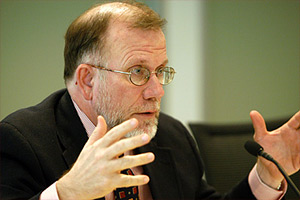
MICHAEL CROMARTIE: Just a couple of comments, Luis. Number one, I want to agree with Alan Cooperman that most evangelicals do not have a fixed eschatology, but in fact they are, like one Baptist theologian said, “all pan-millennialists – it will all pan out in the end.” (Laughter.) When it comes to situations like the current Middle East, though, it is clear that the pan-millennialists still believe – during the recent war with Israel and Lebanon, it was all over the websites, this stuff; “This could be it, this is the ‘Ezekiel option.’”
MR. LUGO: Do you think it makes them a little more sanguine about commotion, war, upset in the Middle East than the –
MR. CROMARTIE: Exactly, yes. They are not nervous about it, they are looking forward to it. But secondly, Walter mentioned it in the article in passing but if we are going to talk about mainline decline, we also should talk about fundamentalist decline. Mega churches are not fundamentalist churches, and the ones that are growing are evangelical churches and American fundamentalism is actually dying also. If you go to the little Bible colleges in the South, they are not growing, but the evangelical schools are.
One thing left out of the conversation was a real definition of the difference between what a fundamentalist is and what an evangelical is. The best definition is by Grant Wacker at Duke University: “An evangelical is somebody who really, really likes Billy Graham. A fundamentalist is somebody who thinks Billy Graham is a liberal.” It’s an important distinction; it has to do with style, with militant tone. Then I just wanted to say in response to what Richard said about replacement, supercessionist reform theology – I want to both agree with it and also add to it.
Even those who believe in replacement theology, that the church is the new Israel, even they still deep down have a tug for the modern state of Israel when it comes to foreign policy. Even D. James Kennedy, for all of his reform theology at the end of the day is going to vote down the line on what is right for Israel prudentially as a foreign policy question. So even those who don’t agree that Israel still has a place today politically, emotionally they do.
MR. LUGO: Very helpful, Mike, thank you.
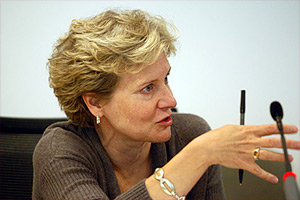
KATHY SLOBOGIN, CNN: I have two questions for Dr. Land, but one is short. How do you differentiate between a fundamentalist and an evangelical? Is it a theological distinction? A political one?
The other question is for Mr. Mead. I don’t know if you are familiar with a relatively recent book by Randall Balmer, Thy Kingdom Come, but is this evangelical juggernaut always and forever conservative? He traces the progressive historical roots of evangelism, and I’m just wondering if you think it’s always conservative.
MR. LUGO: Very good. Terry.
TERRY EASTLAND, THE WEEKLY STANDARD: Walter, I was struck by your comment about the mainline churches and how there might be market corrections. Some of them might require some conservative theology. I would be curious to know which denominations you have in mind.
Parallel to that, I would like to know whether you all think there is weakness in evangelical theology. I think of David Wells’ critique of evangelical theology; I think of open theism. I think of any number of trends which suggest a weakening of more conservative themes.
MR. LUGO: A whole lot of good questions there. Walter, I want to give you the last word, so let me have Richard take a crack at a couple of these.
MR. LAND: First of all fundamental versus evangelical, it need not be a difference theologically. A lot of evangelicals would agree with fundamentalists theologically but they don’t believe in the principle of separation. Fundamentalism says you have to be so concerned about purity that you separate from anybody who disagrees with you. Evangelicals believe in cultural engagement, they believe in social engagement, they believe in civil engagement. They are willing to work with people with whom they disagree. They don’t see this as a compromise to the faith.
They are more optimistic. They tend to be less Calvinistic than fundamentalists – but even the Calvinists are more calvinists with a small c than with a capital C. But it’s really about whether you engage the culture or whether you withdraw from the culture, whether you operate out of Christian ghettos in an unredeemable world, or whether you believe there are times and places when substantial portions of the society can be redeemed.
MR. CROMARTIE: Richard, the best illustration: Bob Jones University has a barbed-wire fence around it. That says it all right there.
MR. LAND: Yeah. And I don’t know any fundamentalist –
MR. CROMARTIE: To keep the students from getting out and dating. (Laughter.)
MR. LAND: I don’t know any fundamentalist who would say what I’m going to say to you. Martin Luther King, Jr., is one of my heroes because he brought his Christian faith to bear on the major social evil of his time and demanded America live up to the promises of its founding documents.
MS. EASTLAND: And fundamentalists would disagree with that because –
MR. LAND: The fundamentalists would say you shouldn’t get involved in stuff like that, first of all, even the ones that don’t have sub-Biblical views of race – and many of them don’t – but they would say Christians shouldn’t waste their time; they should be involved only with spiritual things.
Yes, there is a weakening of evangelical theology in many places, and the reason is it’s a victim of its own success. As evangelicals become more successful and more popular, more people want to be evangelical, so more people wrap themselves in an evangelical mantle who, if you check under the hood, you find the oil in their fuel pumps is not up to grade.
MR. LUGO: Thank you. I heard a fundamentalist preacher once say, Kathy, this is to your point concerning cultural involvement, “You don’t polish the brass in a sinking ship.”
MR. LAND: You heard D.L Moody give that sermon? I was there personally. (Laughter.)
MR. MEAD: On the evangelical/fundamentalist question, a key distinction is that evangelicals make coalitions with Catholics, and fundamentalists would generally consider any coalition that has Catholics in it on the wrong side. In American history that has been a powerful divide, and it remains one today. It was the point on which a lot of fundamentalists moved away from Billy Graham early in his career when he invited Catholic priests onto the platform at his rallies. If you can’t have Catholics in your coalition of faith in the United States, this says a lot about your marginalization, your political prospects and so on.
Evangelicals, are they always conservative? They haven’t been in American history, and you can hear from Richard, there is an element of social reform in the evangelical message. This will take you back to people like Wesley and Whitfield. David Garrick once said Whitefield could move an audience to tears by the varying ways he pronounced the word “Mesopotamia.” (Laughter.) So he is an oddly current figure in the United States even today maybe.
While evangelicals today are likely to pick up the kind of social reforming agenda that made William Jennings Bryan a populist, they are fundamentally more convinced that capitalism is a good fit with Biblical theology than, say, they were a hundred years ago, particularly in the white South.
That, by the way, is also true of American conservative Catholics, that there has been in both the Catholic and Protestant wings of American religion a settling in to belief in markets. Rick Warren is a good example. He is trying to work with others in a big coalition to do a lot of development work in Rwanda. But he won’t do what a William Jennings Bryan would have done in 1890 and say that the poor farmer has to be protected from the wicked markets and the wicked corporations; rather he will say the poor farmer needs the opportunity to benefit from this capitalist system that works so well.
Some of the democrats who are hoping to reap a harvest of neo-New Deal social activism among maturing evangelicals are probably missing the boat here. But you will find, again, as the evangelical community becomes more powerful, more self-assured, more experienced, it will be branching out into new issues and feeling a need to take more responsibility.
What we are seeing in the evangelical movement today is the old pre-fundamentalist modernist American religious establishment trying to reconstitute itself, which gets me, Terry, to your question. If you go back to, say, 1875, you would have seen an American Protestant religion with a spectrum of people. D.L Moody and others who were close to what we would call fundamentalists would think that people like Reverend Henry Ward Beecher were not real Christians or not good Christians.
But there was a great chain of being so that there was always somebody one step to the left of you or one step to the right of you who you recognized as a good Christian, even if you disagreed with them a little bit.
There was a unity in diversity to American Protestantism, even if the wings were fighting. The fundamentalist-modernist controversy cut hardest at the center, and you had the fundamentalists moving over into the far-right, into a very rigid form of theology, social vision, and so on, that was not the 19th century American Protestant establishment. The fundamentalists became more conservative than the old conservatives used to be, and the modernists became more liberal than the liberals used to be. And there wasn’t much of an attractive force in the center.
This evangelical resurgence, combined with the relative decline of the fundamentalists and the absolute decline of the liberals is creating again – and this is getting to what Richard said – that there are now people who may not meet some of the classic tests of evangelicals but find it better to minimize those differences, to wear some evangelical camouflage, if you will, rather than as 15 years ago they wanted to wear more liberal camouflage to be more acceptable.
You’re going to see efforts to rebuild that bridge separating the worlds of American Protestantism. How that will play in different denominational structures and so on I don’t know.
MR. LUGO: Thank you, Walter. Leon did signal me that he wanted to also say something, proving again the Biblical dictum that many that are Fuerth shall be last. Is that right? (Laughter.)
MR. FUERTH: Meet me out behind the schoolhouse; we’ll settle this. (Laughter.)
MR. FUERTH: From the point of view of an outsider, this is all extremely interesting. From the point of view of a citizen, it raises some very consequential matters. The capacity of the American idea, as distinguished from the Protestant idea, or the Catholic idea, or the Muslim idea, the capacity of the American idea to remain intact and to meet the future will be influenced by what happens among the Protestant denominations of the Judeo-Christian heritage.
But it will be even more influenced by the attitude of denominations of all sorts to the question of whether or not there is a superior concept that needs to be protected and defended, one that is worth making common cause across denominational lines for the purpose of building alliances to defend basic national values, which I think all of us would agree are to some extent held universally.
As I listen to this, my concern is less with what happens to liberal Protestantism versus some other branch, but more about whether there is enough mutual commonality of purpose and vision of the future for the country between Protestants and Catholics and others to keep us in a position to govern from the facts, which are capable of being understood in a variety of ways, rather than to govern from theology, which tends to demand that the world be understood in only one way.
MR. LUGO: Thank you, Leon. Thank you, Richard. And thank you, Walter Russell Mead. (Applause.)
This transcript has been edited for clarity, style and grammar by Andrea Useem.


